Middle-earth: Shadow of Mordor and Shadow of War Story Explained
Talion and Celebrimbor's story across Shadow of Mordor and Shadow of War, where it fits between The Hobbit and The Lord of the Rings, and why it divided fans.
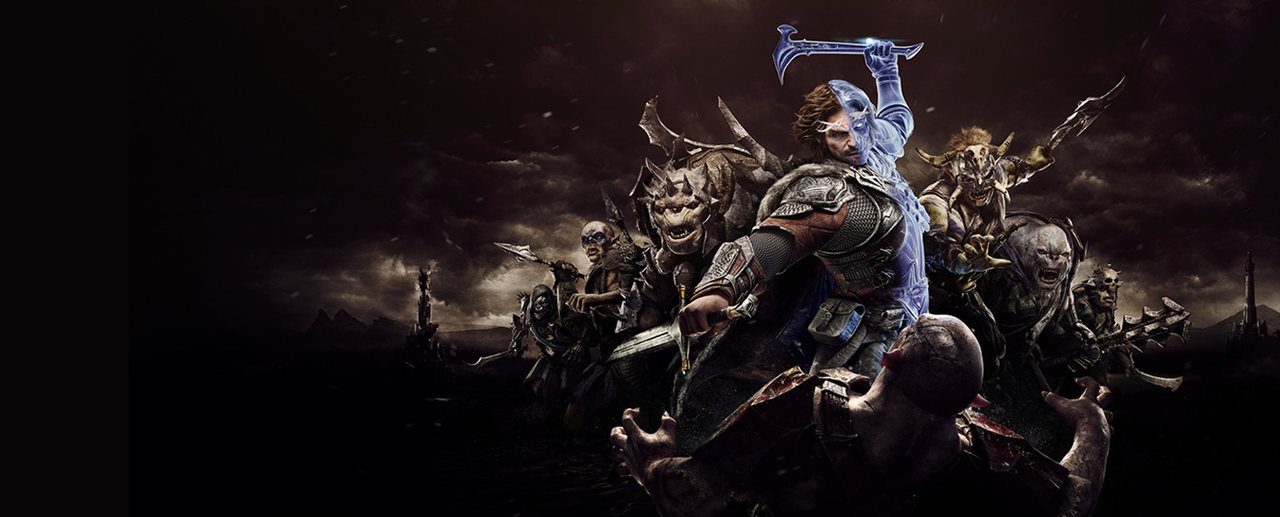
Spoiler warning: this article summarises the full stories of both games, including their endings.
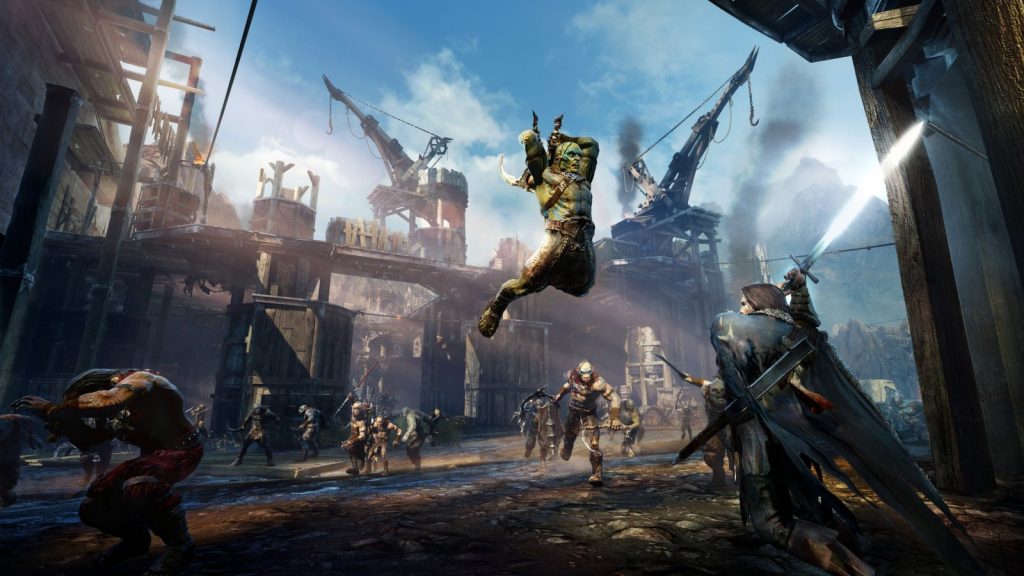
Monolith Productions’ two Middle-earth games are best known for their open-world orc battles, but they also tell a single, connected story about a dead ranger, a vengeful elf and a second attempt to forge a Ring of Power. That story borrows heavily from Tolkien while inventing a lot of its own, which is why it remains one of the most debated pieces of licensed Middle-earth fiction. This guide walks through the plot of Middle-earth: Shadow of Mordor (2014) and Middle-earth: Shadow of War (2017), explains where they sit on the timeline, separates original characters from Tolkien’s, and outlines why many fans objected to the liberties taken.
The Games in Brief
| Shadow of Mordor | Shadow of War | |
|---|---|---|
| Release | September 30, 2014 (PS4, Xbox One, PC in North America); PS3 and Xbox 360 in November 2014 | October 10, 2017 (PS4, Xbox One, PC) |
| Developer | Monolith Productions | Monolith Productions |
| Publisher | Warner Bros. Interactive Entertainment | Warner Bros. Interactive Entertainment |
| Story expansions | Lord of the Hunt, The Bright Lord | Blade of Galadriel, Desolation of Mordor |
Both games were also scheduled to come to Nintendo Switch 2 on September 30, 2026. The series is best remembered for its Nemesis system, which generated orc captains who remembered their encounters with you, but this article sticks to the story. For the wider history of Middle-earth games, see our complete history of Lord of the Rings video games.
Where the Games Sit in Middle-earth’s Timeline
Both games are set in the roughly 60-year gap between The Hobbit and The Lord of the Rings. By this point, Bilbo has found the One Ring, Sauron has returned to Mordor, and Gondor’s watch over Mordor’s borders is weakening. That window is attractive to writers because Tolkien left it relatively sparse: it allowed Monolith to tell a new story without directly contradicting the events of the main novels.
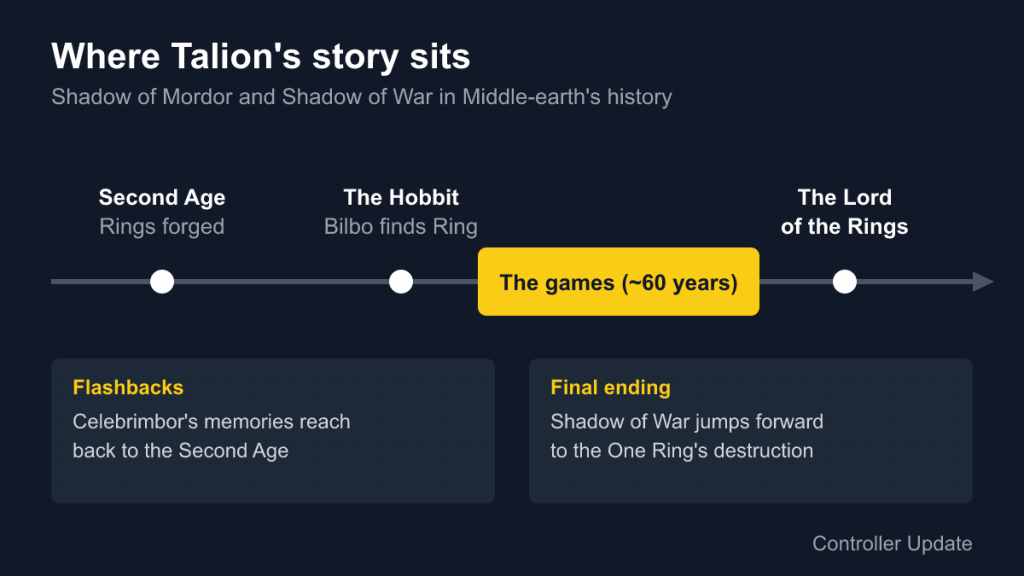
The games also reach back much further through flashbacks. Celebrimbor’s memories take players to the Second Age, thousands of years earlier, when the Rings of Power were forged. And the final ending of Shadow of War jumps forward to the destruction of the One Ring at the end of The Lord of the Rings.
Visually, the games lean on the look popularised by Peter Jackson’s films, but they are not adaptations of the films and do not share their continuity in any official sense.
Shadow of Mordor: The Plot
The Black Gate
Talion is a ranger of Gondor stationed at the Black Gate of Mordor. When Sauron’s forces return, the garrison is overrun. Talion is forced to watch as his wife, Ioreth, and his son, Dirhael, are killed by Sauron’s Uruks, led by three captains known as the Black Hand of Sauron, the Hammer and the Tower. Talion himself is killed in a ritual meant to summon a spirit into his body.
The wraith
Instead, Talion is revived when he becomes bound to a wraith: Celebrimbor, the Elven smith who forged the Rings of Power in the Second Age. Celebrimbor has lost his memories, and both he and Talion want revenge on Sauron. Talion cannot die permanently while the bond holds, which explains why he can return after defeat.
Recovering the past
Gollum, drawn to Celebrimbor’s connection to the Rings, helps Talion find artefacts that restore the elf’s memories. They reveal that Sauron, disguised, tricked Celebrimbor into forging the Rings, that Celebrimbor later took the One Ring for himself and tried to challenge Sauron with it, and that the Ring betrayed him. Sauron then killed Celebrimbor’s family and executed him.
Allies in Mordor
In northern Mordor, Talion helps an ambitious orc named Ratbag climb the ranks and eventually kills the Hammer. He also aids Hirgon, a deserter leading a community of Gondorian outcasts. In the fertile south, around the Sea of Núrnen, he meets Lithariel and her mother, Queen Marwen, who guide him. It emerges that Marwen is under the influence of Saruman, who is secretly working toward his own ends. Talion frees her, but still uses an army of orcs under his control to attack the stronghold of Ered Glamhoth, where he kills the Tower.
The ending
At the Black Gate, the Black Hand overpowers Talion and then sacrifices himself in a ritual that allows Sauron to take physical form through him. Celebrimbor briefly paralyses Sauron from within, giving Talion the opening to destroy that form. Celebrimbor wants to finally depart for Valinor, but Talion persuades him to stay and keep fighting. The game ends with Talion declaring that they will forge a new Ring of Power.
The Bright Lord
The story expansion The Bright Lord (February 2015) lets players control Celebrimbor himself, 3,000 years earlier, as he wields the One Ring against Sauron, showing the confrontation that ended in his defeat.
Shadow of War: The Plot
The new Ring and Shelob
The sequel opens with Talion and Celebrimbor forging their new Ring of Power at Mount Doom. Almost immediately, Shelob captures Celebrimbor and demands the Ring as the price of his release. In this game, Shelob can take the form of a woman, and she regards Sauron as a shared enemy. With the Ring, she gains visions of the future, and she sends Talion to Minas Ithil, a Gondorian city under siege that holds a palantír.
The fall of Minas Ithil
Talion defends the city alongside General Castamir, his daughter Idril and the soldier Baranor. Celebrimbor considers the city lost and wants the palantír instead, and the two begin to disagree. Castamir turns out to be a traitor: he opens the gates and hands the palantír to the Witch-king of Angmar in exchange for Idril’s safety, and is killed for his trouble. Eltariel, an Elven assassin serving Galadriel, helps Talion escape, and the Witch-king renames the city Minas Morgul.
Building an army
Using the new Ring’s power, Talion dominates orcs to build an army. He helps Idril and Baranor protect survivors, aids Carnan, a nature spirit, against the Balrog Tar Goroth, and hunts Nazgûl with Eltariel.
Isildur and the betrayal
The story’s turning point is a battle with a Nazgûl who turns out to be Isildur, the king who cut the One Ring from Sauron’s hand, corrupted by one of the Nine Rings. After seeing Isildur’s memories, Talion destroys the wraith to free his spirit rather than enslave him. Celebrimbor is furious, and Talion realises that the elf intends not to destroy Sauron but to dominate him and take his place as a new “Bright Lord”. When Talion refuses to follow him, Celebrimbor abandons him and binds himself to Eltariel instead.
Talion’s choice
Without Celebrimbor, Talion begins to die. In a vision, Shelob warns him what Celebrimbor would do with Middle-earth and urges him to keep Sauron’s forces contained. Talion takes up Isildur’s Ring, seizes Minas Morgul and defeats the Witch-king. Through the palantír, he watches Celebrimbor and Eltariel attack Sauron. Sauron cuts off two of Eltariel’s fingers, one bearing the new Ring, and merges with Celebrimbor, the two becoming trapped together in Barad-dûr as a flaming eye, a neat explanation for the Eye of Sauron seen in the films.
The final ending
The true ending unlocks after the post-story campaign, originally called Shadow Wars and later renamed Epilogue. Decades pass as Talion holds Mordor’s forces back from Minas Morgul, until he finally succumbs to Isildur’s Ring and becomes a Nazgûl himself, one of the Ringwraiths later hunting Frodo. When the One Ring is destroyed at the end of The Lord of the Rings, the Nazgûl die and Talion’s spirit is set free. He is last seen on the shores of Valinor, laying down his weapons and armour as he walks west.
The expansions
Blade of Galadriel (February 2018) follows Eltariel as she hunts the remaining Nazgûl with the recovered Ring, and Desolation of Mordor (May 2018) follows Baranor and a band of mercenaries in eastern Mordor.
Original Characters vs Tolkien’s Characters
One way to understand the games is to sort their cast by origin:
- From Tolkien: Sauron, Celebrimbor, Gollum, Saruman, Shelob, Isildur, the Witch-king and the Nazgûl, Galadriel (referenced through Eltariel), and the Balrogs as a type of creature.
- Original to the games: Talion and his family, the Black Hand, the Hammer and the Tower, Ratbag, Hirgon, Lithariel and Queen Marwen, Eltariel, Castamir, Idril, Baranor, Carnan, Tar Goroth and Torvin the dwarf hunter.
Even the Tolkien characters are reinterpreted. Celebrimbor is a real figure from Tolkien’s writings, but his role as a vengeful wraith and would-be Dark Lord is the games’ invention.
Why the Games’ Liberties Were Debated
Critics and fans were divided from the first game. Some reviewers praised how Shadow of Mordor used Lord of the Rings lore, while others felt its plot was generic or would not make sense to devoted readers. Shadow of War drew stronger reactions. The main points of contention included:
- A new Ring of Power. In Tolkien’s world, the rings were forged in the Second Age and nobody forges a rival to the One Ring. The games’ central premise contradicts that.
- Shelob as a woman. Many fans objected to Shelob, an ancient monstrous spider in the books, appearing in a human form.
- Isildur as a Nazgûl. In Tolkien’s account, Isildur died at the Gladden Fields when the One Ring slipped from his finger, and the Nazgûl were kings of Men ensnared long before. Making him a Ringwraith was a significant invention.
- Minas Ithil’s fall. Tolkien places the capture of Minas Ithil by the Nazgûl about a thousand years before the War of the Ring, not in the gap after The Hobbit.
- Celebrimbor’s motives. Recasting the smith as someone who wants to replace Sauron changed a tragic figure into an antagonist.
Defenders argued that the games were never meant to be canon and that licensed fiction often explores “what if” territory. That debate touches on how licences work: rights holders approve adaptations, but approval is not the same as faithfulness. Our explainer on how video game licensing works covers the general mechanics of those approvals.
The Legacy of Talion’s Story
Whatever fans thought of the plot, the duology was successful: Shadow of War was the best-selling game in the United States in October 2017. It was also the last game Monolith completed; Warner Bros. closed the studio in February 2025, ending hopes of a direct continuation.
Read as a whole, Talion’s story is a tragedy about revenge and power. He begins wanting only to avenge his family, gains a weapon that could rival Sauron’s, and ends up a servant of the darkness he fought, freed only when Frodo’s quest succeeds. It is not Tolkien’s story, but it borrows one of Tolkien’s central ideas: that the desire to wield power against evil can itself become a path to corruption.