Marvel’s Guardians of the Galaxy (2021): The Game Explained
Eidos-Montréal's Guardians of the Galaxy explained: its original take on the team, Star-Lord-only combat, conversation choices, soundtrack and legacy.
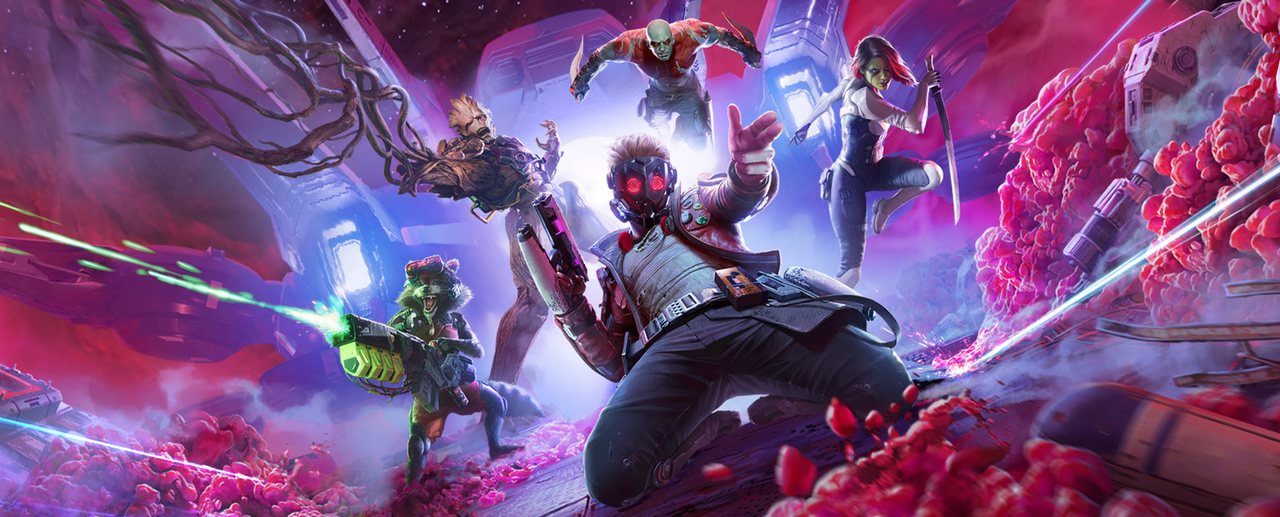
When Square Enix and Eidos-Montréal revealed Marvel’s Guardians of the Galaxy in 2021, expectations were cautious. The same publisher’s Marvel’s Avengers had launched the year before to a lukewarm response, and a Guardians game sounded like more of the same. Instead, it turned out to be a strictly single-player, story-driven adventure with no microtransactions, and it became one of the best-reviewed Marvel games of its generation. This explainer covers what the game is, how it plays, how its version of the team differs from the films, and why it is still discussed years later.
The Basics: Who Made It and When
Marvel’s Guardians of the Galaxy was developed by Eidos-Montréal, the studio behind the modern Deus Ex games, and published by Square Enix. It released on October 26, 2021 for PlayStation 4, PlayStation 5, Xbox One, Xbox Series X/S and Windows, with a cloud-streaming version for Nintendo Switch launching the same day.
The game was directed by Jean-François Dugas, with Mary DeMarle as narrative director and writer and an orchestral score by composer Richard Jacques. It ran on Eidos’ Dawn Engine, the same technology used for Deus Ex: Mankind Divided.
In 2022, Square Enix sold Eidos-Montréal and other Western studios to Embracer Group. The game has since been published under the Eidos name. A native Encore Edition for Nintendo Switch 2, announced in September 2026, is scheduled for November 5, 2026 and adds new outfits for the team.
| Detail | Information |
|---|---|
| Developer | Eidos-Montréal |
| Original publisher | Square Enix |
| Release | October 26, 2021 |
| Platforms | PS4, PS5, Xbox One, Xbox Series X/S, PC, Switch (cloud); Switch 2 Encore Edition announced for November 5, 2026 |
| Mode | Single-player only |
| Monetisation | No DLC or microtransactions |
An Original Take on the Team
The most important thing to know is that this is not a film adaptation. The Guardians share their names and broad personalities with the Marvel Studios movies (Peter Quill, Gamora, Drax, Rocket and Groot), but the designs, voices and backstories are the studio’s own, drawing on decades of comics as well as the cinematic version’s popularity.
Peter Quill is voiced by Jon McLaren, Gamora by Kimberly-Sue Murray, Drax by Jason Cavalier, Rocket by Alex Weiner and Groot by Robert Montcalm. Early character designs were reworked after Marvel gave them a lukewarm response, and the final look lands somewhere between comic-book and film influences without copying either.
The team in the game is also slightly different in where it stands at the start. They are already together, already broke and already getting on each other’s nerves. Rather than an origin story, the game drops you into a group that functions like a dysfunctional family, which suits the writers’ focus on themes of grief, loss and found family.
The game also leans into lesser-known corners of Marvel’s cosmic catalogue, such as Lady Hellbender, a warlord with a fondness for collecting monsters, and Ko-Rel, a Nova Corps centurion with history with Quill. This willingness to use deeper-cut characters is part of what made the game feel distinct from the films. For a broader look at how Marvel’s game licensing changed in the 2010s, see our history of Marvel video games.
The Story Setup (Spoiler-Light)
The game is set in the years after a devastating interstellar war that shaped every member of the team. In the opening chapters, the Guardians take a risky job: capturing a rare monster for Lady Hellbender. While trespassing in the Nova Corps’ Quarantine Zone, they accidentally release something that should have stayed locked away, and they end up owing the Nova Corps a large fine they cannot pay.
From there the plot escalates. A religious movement called the Universal Church of Truth, led by Grand Unifier Raker, begins spreading across the galaxy with a message of comfort called the “Promise”. The team discovers that the Church is far more dangerous than it appears, and the story becomes a galaxy-spanning chase that tests each Guardian personally.
We will not go further into the plot here, because the twists are a big part of the experience. The game has a single ending, but many scenes play out differently depending on choices you make.
How It Plays: Star-Lord and Squad Commands
The defining design decision is that you only ever directly control Star-Lord. You play in third person, firing his elemental blasters and boosting around with his jet boots. Over the course of the game, his guns gain four elemental modes: ice, lightning, wind and plasma, useful against specific enemy weaknesses and environmental puzzles.
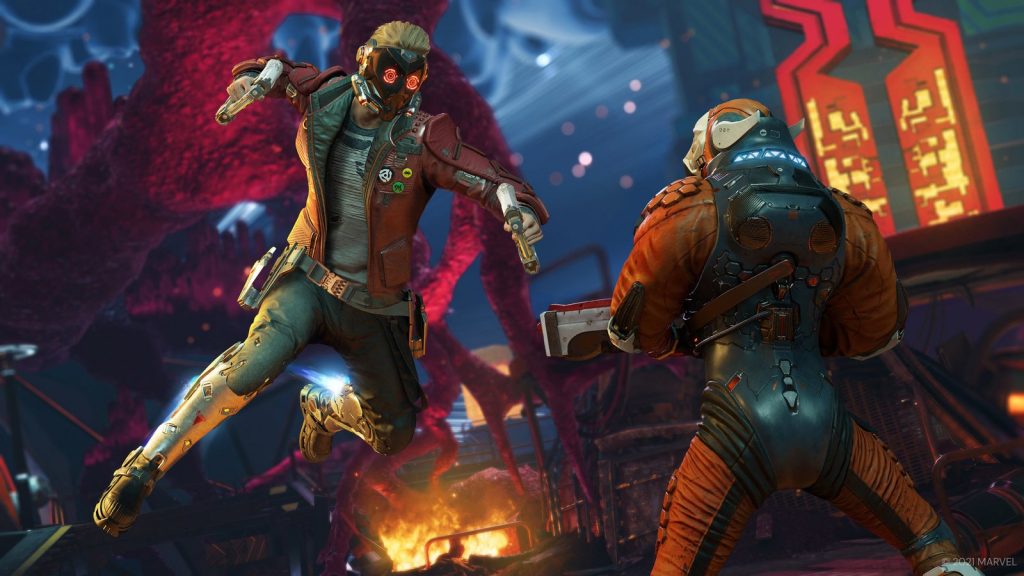
The other four Guardians are controlled by the computer, but you give them orders. Each companion has a set of abilities, and in combat you trigger them on demand: Groot can root enemies in place, Drax can stagger large foes, Gamora deals heavy single-target damage, and Rocket handles area damage. Combining abilities in the right order is the core of combat.
Developers have explained that they kept the companions uncontrollable on purpose. Early in development the game was considered as a multiplayer or co-op project, but the team chose to focus on story, and keeping the other Guardians as distinct AI-driven characters helped their personalities come through. If you could take over Rocket at will, his constant complaining would be your voice, not his.
The Huddle
The game’s most memorable mechanic is the Huddle. When a meter fills during battle, Quill can call the team together. The Guardians express how they are feeling, often badly, and you choose a motivational speech in response. Pick the right tone and the team gets a boost; get it wrong and only Quill does. When a Huddle succeeds, one of the game’s licensed 1980s songs kicks in over the fight, which became one of the most talked-about moments in reviews.
Exploration
Between fights, levels are linear but include side paths, collectibles and outfits. Quill uses a visor to scan the environment, and companions are needed to clear obstacles: Drax lifts heavy objects, Groot builds bridges, Rocket squeezes through small gaps to hack consoles. Rocket also uses workbenches to craft perks for Quill.
Choices and Conversations
The game constantly asks you to make decisions in conversations, from small jokes to significant moral choices. The team remembers what you say. Taking Rocket’s side over Drax’s in an argument may affect how they treat you later, and some decisions change how certain missions unfold.
The results are mostly about character relationships and alternative scenes rather than branching endings. There is one ending, but the route there feels personal. Some choices have surprisingly practical consequences: the game notes, for instance, that if you refuse to deal with the Nova Corps fine, it creates problems later on.
Much of the game’s charm comes from the near-constant dialogue. The Guardians chatter during exploration, insult each other in combat and comment on your decisions. Writers reportedly worried that the nonstop banter might irritate players, but Dugas kept it, and many critics singled it out as a highlight.
The Soundtrack
Music is central to the Guardians identity on screen, and the game takes it just as seriously. It includes licensed 1970s and 1980s songs from artists such as Pat Benatar, Wham!, Iron Maiden and Joan Jett, which play on the Milano, the team’s ship, and during Huddles.
The game also invents a fictional 1980s rock band named Star-Lord, which in this continuity is where Peter Quill got his nickname. Audio director Steve Szczepkowski and sound designer Yohann Boudreault wrote and recorded a full album for the band, titled Space Rider. Richard Jacques’ orchestral score was recorded at Abbey Road Studios and later won the Ivor Novello Award for Best Original Video Game Score.
A streaming mode lets content creators turn off the licensed music to avoid copyright problems, a practical feature that has become more common in music-heavy games.
How It Differs From the Films and Telltale’s Guardians
Guardians of the Galaxy had already received a story game before Eidos-Montréal’s: Telltale Games’ Guardians of the Galaxy: The Telltale Series, released episodically in 2017. Comparing the three versions helps clarify what the 2021 game does differently.
| Marvel Studios films | Telltale Series (2017) | Eidos-Montréal (2021) | |
|---|---|---|---|
| Format | Live-action films | Episodic, choice-driven adventure | Full action-adventure with combat |
| Control | None | Dialogue choices and quick-time events | Star-Lord only, commanding the others |
| Characters | Film cast and designs | Original designs inspired by the films | Original designs and voice cast |
| Music | “Awesome Mix” pop songs | Licensed songs | 1980s licensed songs and a fictional band |
Telltale’s version focused on conversation and short action sequences, in the style the studio had used for other licensed series. Eidos-Montréal kept the choice-heavy dialogue but wrapped it in a much larger action game with real combat, puzzles and exploration. It is also completely standalone; you do not need to know either the films or the Telltale series to follow it.
That freedom from a film’s release date and plot is a key reason the game holds up. It follows the modern model of licensed games: original story, own schedule, recognisable characters. We explain how that model replaced the old one in the rise and fall of the movie tie-in game.
Reception, Sales and Legacy
Critics widely praised the story, characters, voice acting and music, and many described the game as a surprise hit given the low expectations after Marvel’s Avengers. Combat drew more mixed reactions, with some reviewers finding it repetitive and enemies too durable. On Metacritic, the PS5 version scored 80 and the Xbox Series X/S version 84.
The game won Best Narrative at The Game Awards 2021, and at the 25th D.I.C.E. Awards it won Adventure Game of the Year and Outstanding Achievement in Story. Its soundtrack picked up further awards, and the score was nominated for a Grammy.
Commercially, the picture was less rosy at first. In February 2022, Square Enix said the game had failed to meet its sales expectations despite strong reviews. Its audience kept growing afterwards, helped by subscription services, and by November 2022 more than eight million players had engaged with it, including via PlayStation Plus and Xbox Game Pass.
Its legacy is clear: it showed that a single-player, character-driven Marvel game without live-service elements could earn critical acclaim, a lesson that echoes through later licensed games. For many players it remains the definitive interactive version of the Guardians, a team built not on superpowers alone but on arguments, jokes and an excellent mixtape.