The Lord of the Rings Video Games: A Complete History
Middle-earth games from 1982 text adventures to Tales of the Shire, and why book rights and film rights produced two parallel lines of games.
J.R.R. Tolkien’s Middle-earth has been a video game setting for more than four decades, longer than almost any other fantasy world. It has appeared in text adventures, strategy games, hack-and-slash brawlers, open-world action games, survival crafting and even a cosy life simulation. Yet the history of these games is unusually tangled, because for years two different sets of rights existed side by side: rights based on Tolkien’s books and rights based on Peter Jackson’s films.
This article walks through the major eras of Lord of the Rings games, explains why some years produced competing versions of the same story, and brings the history up to date as of October 2026. Mobile, browser and board-game adaptations are left out for space, and the long-running online game is mentioned only briefly.
Book Rights vs Film Rights: Why There Were Two Lines of Games
To understand Middle-earth gaming, start with rights. In 1969, Tolkien sold film and merchandising rights to The Hobbit and The Lord of the Rings. Those rights eventually came to be managed by Saul Zaentz’s company, Tolkien Enterprises (later renamed Middle-earth Enterprises). Games based on the books were licensed through that company.
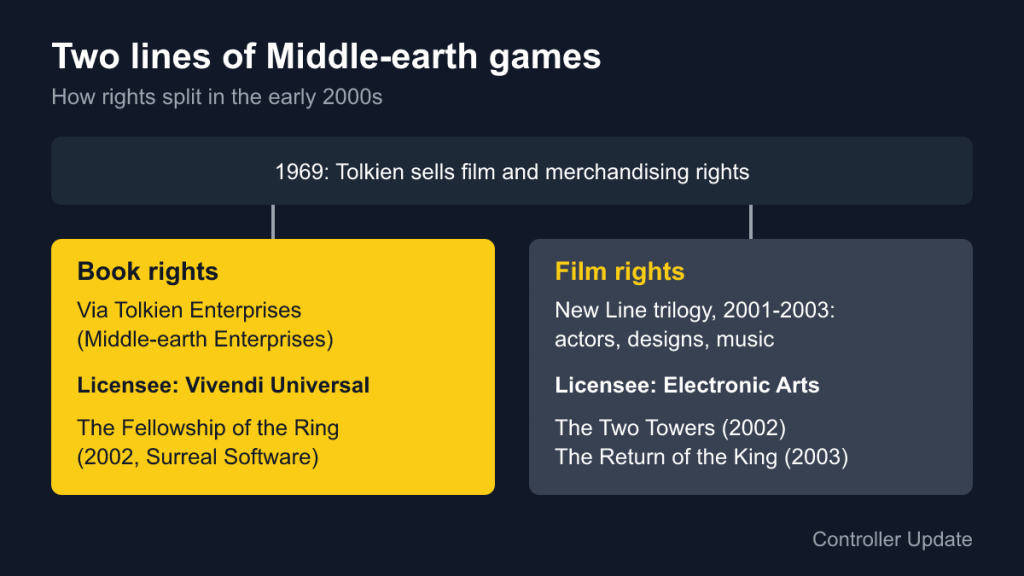
When New Line Cinema produced Jackson’s trilogy, released from 2001 to 2003, a separate category of rights emerged: the right to use the films themselves, including their actors’ likenesses, designs, footage and music. A game based on the books could not simply show Elijah Wood as Frodo or use Howard Shore’s score.
The result, in the early 2000s, was a split. Vivendi Universal Games held rights to make games based on the literary works, while Electronic Arts held the licence for games based on the films. Both companies could make a game called The Fellowship of the Ring, and the results looked and played very differently. For a general explanation of how such deals work, see our guide to how video game licensing works.
The 1980s and Early 1990s: Text Adventures and Early Computers
The first major Middle-earth game was The Hobbit (1982), developed by the Australian studio Beam Software and published by Melbourne House in Europe and Addison-Wesley in North America. It was a text adventure with illustrations, and it became famous for its unusually sophisticated text parser and for non-player characters, such as Thorin and Gandalf, who acted independently. It was a significant hit on home computers such as the ZX Spectrum.
Beam Software followed with Lord of the Rings: Game One (1985), Shadows of Mordor: Game Two (1987) and The Crack of Doom (1989), continuing the adventure-game approach through the trilogy. In 1988, Synergistic Software’s War in Middle Earth, published by Melbourne House, took a more strategic approach, letting players move armies and characters across a map of Middle-earth.
Interplay then produced J.R.R. Tolkien’s The Lord of the Rings, Vol. I (1990) and Vol. II: The Two Towers (1992), role-playing adventures for home computers, with a Super NES version of Volume I in 1994. Beam Software and Papyrus’s Riders of Rohan (1991) rounded out the period. These games are mostly of historical interest today, but they established Middle-earth as a natural fit for adventure and role-playing design.
The 2000s: The Film Boom and the Great Split
The release of the Jackson films transformed the franchise’s commercial value and kicked off the busiest decade for Middle-earth games.
The book-licensed games
Vivendi’s The Fellowship of the Ring (2002), developed by Surreal Software for PlayStation 2 and published under the Black Label Games banner, followed the novel rather than the film. Characters did not resemble the movie actors, and it included book elements left out of the film, such as Tom Bombadil. Vivendi also published War of the Ring (2003), a real-time strategy game by Liquid Entertainment, and The Hobbit (2003), a family-friendly action-adventure by Inevitable Entertainment.
The film-licensed games
EA’s games, by contrast, leaned heavily on the movies. The Two Towers (2002), developed by Stormfront Studios, was a combat-focused action game that transitioned from film footage into gameplay, covering events from the first two films. The Return of the King (2003), developed by EA Redwood Shores, added cooperative play and more of the cast’s voices. Both were big successes and are often remembered as among the better movie games of their era.
EA then broadened the range. The Third Age (2004) was a turn-based role-playing game following new characters alongside the Fellowship’s journey. The Battle for Middle-earth (2004) and The Battle for Middle-earth II (2006), developed by EA Los Angeles, were real-time strategy games recreating the films’ battles; the second game expanded into the war in the North, drawing on more book material after EA secured additional literary rights from Tolkien Enterprises in the mid-2000s. Tactics (2005) brought strategy to the PSP.
EA’s final Middle-earth game under that licence was Conquest (2009), Pandemic Studios’ large-scale battle game, which arrived in January 2009 to a lukewarm reception. EA’s film licence had expired at the end of 2008, and the game rights moved to Warner Bros., which by then owned New Line.
The online world
Alongside these games, Turbine launched The Lord of the Rings Online in 2007. It is still running in 2026 under Standing Stone Games, with expansions such as Legacy of Morgoth (2024) and Kingdoms of Harad (2025).
The Warner Bros. Era (2010–2017)
With Warner Bros. now holding the game rights connected to the films and owning its own publisher, Warner Bros. Interactive Entertainment, Middle-earth games became more varied.
- Aragorn’s Quest (2010), developed by Headstrong Games and TT Fusion, was a family-oriented action game framed as a story told by Samwise Gamgee to his children.
- War in the North (2011), by Snowblind Studios, was a three-player action role-playing game that followed new heroes fighting in the northern regions while the Fellowship travelled south.
- Guardians of Middle-earth (2012), by Monolith Productions, was a console multiplayer battle arena game.
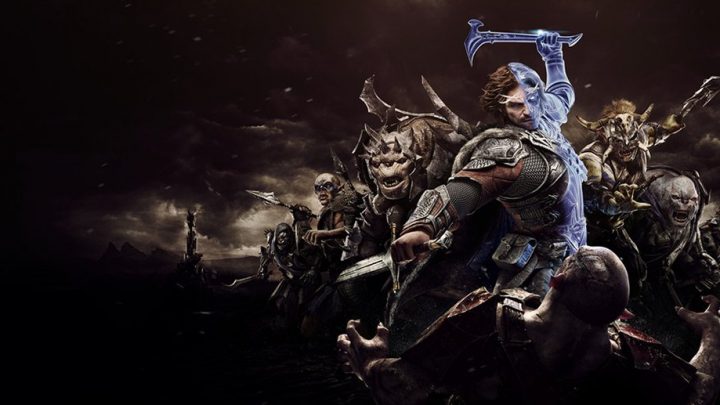
- Middle-earth: Shadow of Mordor (2014) and Middle-earth: Shadow of War (2017), also by Monolith, were open-world action games starring Talion, a Ranger bound to the wraith of the Elf-lord Celebrimbor, set in the years between The Hobbit and The Lord of the Rings. Their headline feature was the Nemesis system, which generated orc rivals that remembered their encounters with the player.
Traveller’s Tales also released LEGO adaptations of both trilogies in this period. Monolith’s Middle-earth games took considerable liberties with Tolkien’s lore, which divided fans even as they were commercially successful. After Shadow of War, there was a long gap in large Middle-earth action games.
A New Owner and New Kinds of Games (2020s)
In 2022, the Swedish group Embracer acquired Middle-earth Enterprises, the rights company descended from Tolkien Enterprises. That made it the owner of the film, merchandising and game rights associated with the works, and it continued to license Middle-earth to outside developers. The 2020s produced a strikingly mixed group of games.
The Lord of the Rings: Gollum (2023)
Daedalic Entertainment’s stealth-adventure game, co-published with Nacon, cast players as Gollum during the years before the main story. Released in May 2023, it received very poor reviews for its visuals, technical issues and design. Daedalic issued a public apology, and the studio later restructured, moving away from developing games in-house.
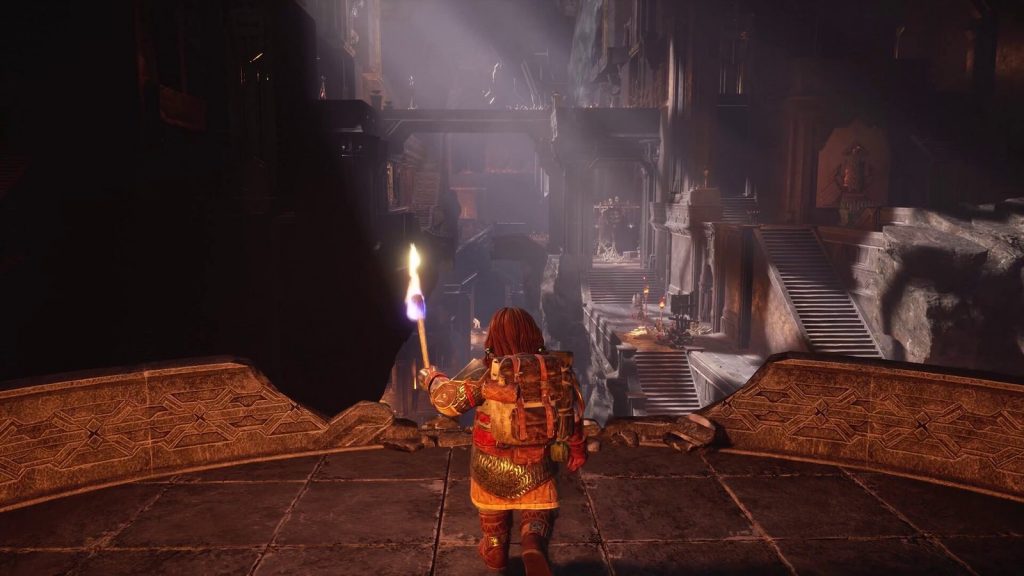
The Lord of the Rings: Return to Moria (2023)
Free Range Games’ survival crafting game, published by North Beach Games, was released in October 2023. Set in the Fourth Age, after the events of the novels, it sends a company of Dwarves to reclaim Moria, mining, building and fighting through procedurally generated depths. It is notable for exploring a period that few adaptations touch.
Tales of the Shire (2025)
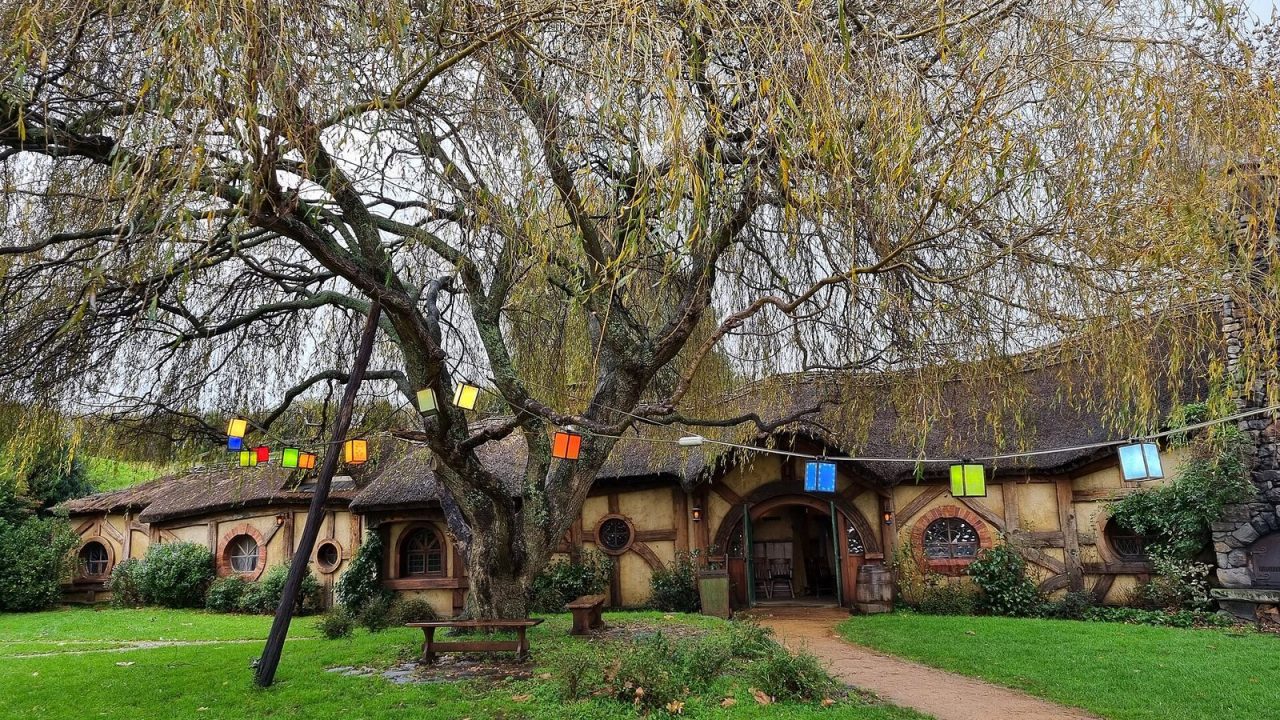
Wētā Workshop, the New Zealand effects company famous for its work on the films, developed this cosy life simulation, published by Private Division. Released on July 29, 2025 for PC, PlayStation 5, Xbox Series X|S and Nintendo Switch, it lets players settle in a Hobbit village, cooking, gardening and befriending neighbours. A Nintendo Switch 2 version followed on March 25, 2026.
Re-releases
Older Middle-earth games have often been hard to buy, partly because of their tangled rights history. In August 2026, Aspyr re-released War in the North as a Legacy Edition for modern platforms, including PlayStation 5, Xbox Series X|S, Nintendo Switch, Nintendo Switch 2 and PC. EA’s Battle for Middle-earth games, by contrast, have long been unavailable to buy legally.
Timeline Table of Major Middle-earth Games
| Year | Game | Developer | Licence basis |
|---|---|---|---|
| 1982 | The Hobbit | Beam Software | Books |
| 1988 | War in Middle Earth | Synergistic Software | Books |
| 1990 | The Lord of the Rings, Vol. I | Interplay | Books |
| 2002 | The Fellowship of the Ring | Surreal Software | Books |
| 2002 | The Two Towers | Stormfront Studios | Films |
| 2003 | The Return of the King | EA Redwood Shores | Films |
| 2004 | The Battle for Middle-earth | EA Los Angeles | Films |
| 2007 | The Lord of the Rings Online | Turbine | Books |
| 2009 | Conquest | Pandemic Studios | Films |
| 2011 | War in the North | Snowblind Studios | Warner Bros. era |
| 2014 | Shadow of Mordor | Monolith Productions | Warner Bros. era |
| 2017 | Shadow of War | Monolith Productions | Warner Bros. era |
| 2023 | Gollum | Daedalic Entertainment | Books |
| 2023 | Return to Moria | Free Range Games | Books |
| 2025 | Tales of the Shire | Wētā Workshop | Books |
What the History Tells Us
Three patterns stand out. First, rights shape design: book-licensed games tend to explore lore and less-seen corners of Middle-earth, while film-licensed games recreate the movies’ spectacle. Second, quality has been extremely uneven, from celebrated games such as EA’s Return of the King and the Battle for Middle-earth pair to commercial failures such as Gollum. Third, the setting is flexible enough to support almost any genre, which is why recent years have seen a survival game, a life simulation and a stealth game appear within a few years of one another.
Common misconceptions
- “All LOTR games are movie games.” Many, especially before 2001 and after 2020, are based on the books alone.
- “Shadow of Mordor follows the books.” Its story is original and diverges from Tolkien’s lore in several places.
- “EA still owns the rights.” EA’s film licence ended at the end of 2008.