The Rise and Fall of the Movie Tie-In Game
Why nearly every 1990s and 2000s blockbuster got a video game, why so many were rushed, which ones succeeded, and why the model faded after the 2000s.

For roughly three decades, a big summer movie came with a predictable set of merchandise: toys, a fast-food promotion, a soundtrack album and a video game on the shelf the same week the film opened. Today that last item is mostly gone. Blockbusters still inspire games, but they rarely arrive as same-week companions to a specific film. This article explains how the movie tie-in game rose, why its reputation sank, which games broke the pattern, and what replaced it.
What Counts as a Movie Tie-In?
A movie tie-in game is a game built to be released alongside a particular film and marketed with it. It typically follows the film’s plot, uses its title and key art, and is scheduled to hit stores within days or weeks of the premiere. That distinguishes it from a broader licensed game, which uses a franchise’s characters and world but tells its own story on its own timetable.
The distinction matters because the release date is what shaped almost everything about tie-ins: their budgets, their scope and their quality. A licensed game can be delayed until it is ready. A tie-in that misses its film loses much of the marketing that justified making it in the first place. For an overview of how licences themselves are negotiated, see our guide to how video game licensing works.
The Early Years and the E.T. Warning
The tie-in model is almost as old as home consoles. Atari’s Raiders of the Lost Ark (1982) for the Atari 2600 was an early example, and the same year produced the most infamous tie-in of all: E.T. the Extra-Terrestrial.
Atari reportedly paid between $20 million and $25 million for the rights. Negotiations finished in late July 1982, and the game needed to be ready for the holiday season, which left designer and programmer Howard Scott Warshaw just over five weeks to build it. The game shipped in December 1982 and became a symbol of the excesses that preceded the North American video game crash of 1983. In 1983, the Alamogordo Daily News reported that Atari had buried truckloads of unsold products in a New Mexico landfill; when the site was excavated in April 2014, E.T. cartridges were among the items found, although they made up only a small share of what was recovered.
E.T. is often blamed for more than it deserves, but it established a lesson the industry would keep relearning: an expensive licence plus an immovable deadline is a risky combination.
The Boom: 1990s to Late 2000s
Despite that warning, tie-ins became a standard part of the blockbuster business. Several forces pushed in the same direction.
- Marketing synergy. A game released with the film shared its trailers, posters and media attention. Publishers did not need to build awareness from scratch.
- Platform proliferation. Each new generation added consoles and handhelds, and publishers often released tie-ins on every one of them, sometimes using several studios at once. Our Transformers games history shows this clearly with the 2007 film game, which appeared on almost every platform of its day.
- Licensors’ expectations. Film studios saw games as another product line, and publishers such as Activision, EA, THQ and Ubisoft competed for the rights to big releases.
- Retail habits. Families shopping for gifts often looked for recognisable names, which made a game based on a current hit an easy sell.
The volume was remarkable. Engadget, in a 2026 retrospective, counted more than 30 licensed movie games released in 2007 alone. In the 1990s, the licences were often divided by platform, so a single film could produce entirely different games on rival consoles. Our Jurassic Park games history describes how the 1993 film produced separate designs from Ocean, BlueSky Software and Sega.
Why So Many Tie-Ins Were Rushed
The reputation of tie-in games as cheap cash-ins was not entirely unfair, but it helps to understand the structural reasons behind it rather than assume developers did not care.
Fixed dates and short schedules
Films are typically produced on a shorter timeline than major games, and their release dates are fixed far in advance. A game team might be brought in after a film was green-lit, leaving perhaps a year or two to build a product that needed to ship on a date nobody could move. When problems emerged, cutting features was the only option.
Limited access to the film
Developers often had to build levels before the film was finished, working from scripts, concept art and incomplete footage. Scenes could be cut or rewritten after the game had already modelled them. Studios also grew protective of their secrets. In an interview with Film Stories, cited by Engadget, Andrew Burrows of Traveller’s Tales recalled that the team working on Transformers: The Game (2007) were “quite a way into development before we even started getting assets.”
Licence costs eating the budget
A publisher that paid heavily for a licence had less left for development, and the licence alone was expected to drive sales. That created an incentive to keep production lean.
Multiple versions at once
Releasing on many platforms at the same time meant splitting work across studios, each with different hardware constraints. The result was often a lead version of decent quality and several weaker editions sharing the same box art.
Approval cycles
Every character model, line of dialogue and marketing image needed the licensor’s sign-off. Approvals take time, and on a tight schedule, time was the scarcest resource.
The Exceptions That Proved It Could Work
Not every tie-in was mediocre. A small number became classics, and they share some revealing traits.
GoldenEye 007 (1997)
Rare’s GoldenEye 007 for the Nintendo 64 is the most famous exception. It was released in August 1997 in Japan and North America, roughly a year and nine months after the film, and development took more than two and a half years. The project began as a different idea, a 2D side-scroller for the Super Nintendo, before the team proposed a 3D shooter for the new console. By missing the film’s release window, Rare gained the time to make something ambitious, and the game sold more than eight million copies. In other words, the best-known tie-in succeeded partly because it was not really a tie-in on the usual schedule.
The Chronicles of Riddick: Escape from Butcher Bay (2004)
Developed by Starbreeze Studios with Vin Diesel’s Tigon Studios and published by Vivendi Universal Games, Escape from Butcher Bay came out on Xbox in June 2004, shortly before the film The Chronicles of Riddick. Crucially, it did not retell the film. It was a prequel to Pitch Black about Riddick’s escape from a prison, which freed the developers from the movie’s plot. Diesel reprised his role and was involved in development. Critics praised its stealth and combat, and some reviewers preferred it to the film it accompanied. It was later included in Assault on Dark Athena (2009) with updated visuals.
Spider-Man 2 (2004) and others
Treyarch’s Spider-Man 2, published by Activision, is often cited for its web-swinging, and Ubisoft’s Peter Jackson’s King Kong (2005) won praise for its atmosphere. Raven Software’s X-Men Origins: Wolverine (2009) is another tie-in that many players remember more fondly than its film.
The common thread is that each found room for its own design: an original story, a mechanic that captured the hero’s appeal, or a schedule that was not purely dictated by the premiere.
Why the Model Faded
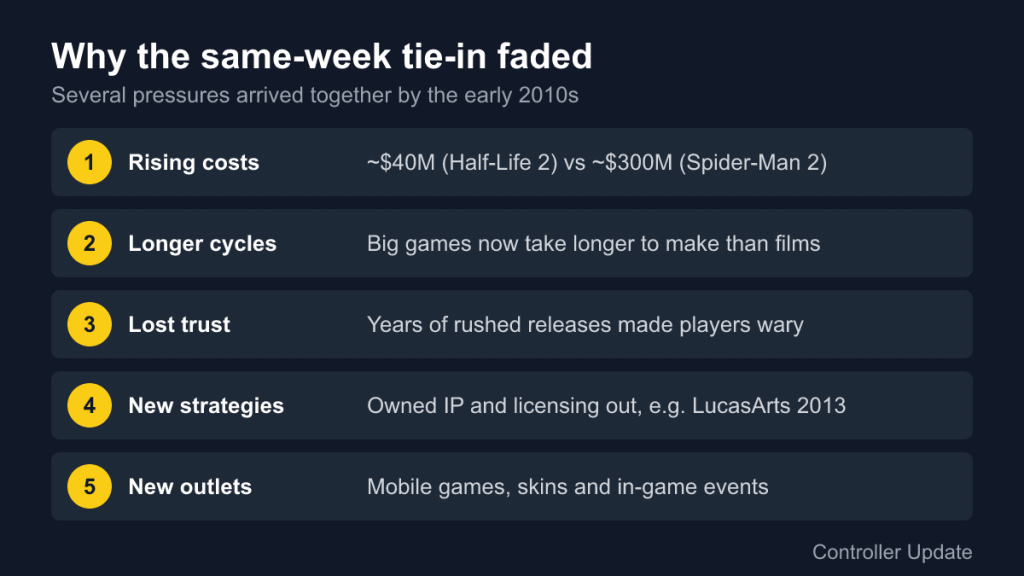
By the early 2010s, the same-week tie-in was disappearing. No single event killed it; several pressures arrived together.
Rising development costs
The move to high-definition consoles dramatically increased the cost of making a full-priced game. Engadget’s retrospective contrasts the reported budget of around $40 million for Half-Life 2 in 2004 with roughly $300 million reported for Marvel’s Spider-Man 2 nearly two decades later. When budgets grew that large, publishers became less willing to bet them on a product whose sales window was tied to one film’s box office performance.
Longer development cycles
Big games now often take far longer to make than films. Matching a game to a film release requires starting before the film is even shot, which multiplies the risk of story changes, delays and reshoots.
Declining trust in the format
Years of rushed releases taught many players to treat tie-ins with suspicion. Reviews mattered more as online coverage grew, and poor scores spread quickly.
Changing publisher strategies
Media companies reorganised their games businesses. Disney, for example, closed LucasArts in 2013 and shifted toward licensing its brands to outside publishers. Many publishers also chose to invest in intellectual property they owned outright, where sequels and spin-offs did not depend on a licence renewal.
New outlets for promotion
Film marketing found cheaper ways into games: mobile titles, character skins in live-service games and limited-time events. Engadget notes that in 2025 the closest equivalents to tie-ins were in-game additions such as Fortnite skins and a Minecraft event, while LEGO adaptations continued as a separate tradition.
What Replaced the Tie-In
Licensed games did not vanish. Instead, the dominant model shifted from adapting a film to building a standalone game in a franchise’s world, on the game’s own schedule.
| Approach | Typical traits | Examples |
|---|---|---|
| Classic tie-in | Follows the film’s plot, ships with the film, many platforms | Transformers: The Game (2007), Iron Man (2008) |
| Standalone licensed game | Original story, longer development, release date set by the game | Hogwarts Legacy (2023), Star Wars Jedi: Fallen Order (2019) |
| Licensed AA revival | Smaller studio, faithful to an older film’s tone | RoboCop: Rogue City (2023) |
| In-game promotion | Skins, events or crossovers in existing games | Character outfits in live-service games |
The standalone model has produced several of the most successful licensed games ever made, precisely because it removed the tie-in’s central constraint. Developers can spend years on a project, invent new characters and still use beloved worlds. The trade-off is that these games are much larger financial bets, so they are rarer, and a failure can be costly for the studio involved.
Lessons From the Tie-In Era
Looking back, a few conclusions stand out.
- Time matters more than the licence. The best tie-ins either had unusually long schedules or stepped away from the film’s plot.
- Original stories age better. Games that retold a movie scene by scene had little reason to exist once the film was on home video; games that added something new kept their audience.
- Licences expire. Many tie-ins are now unavailable digitally because the underlying contracts ended, which makes physical copies the only way to play them.
- Volume hid quality. In a year with dozens of film games, a few strong ones were easy to overlook among weaker releases.
The movie tie-in game was a product of its era: physical retail, short console cycles, modest budgets and studios eager to fill every shelf with a recognisable name. When those conditions changed, the format faded. What remained was the idea at its core, that people want to step inside the worlds they love on screen, and the industry has found slower, more deliberate ways to deliver it.