Warhammer Fantasy and Age of Sigmar Games: A Guide
The Old World or the Mortal Realms? How Warhammer's two fantasy settings differ, and which video games belong to each, from Dark Omen to Total War.
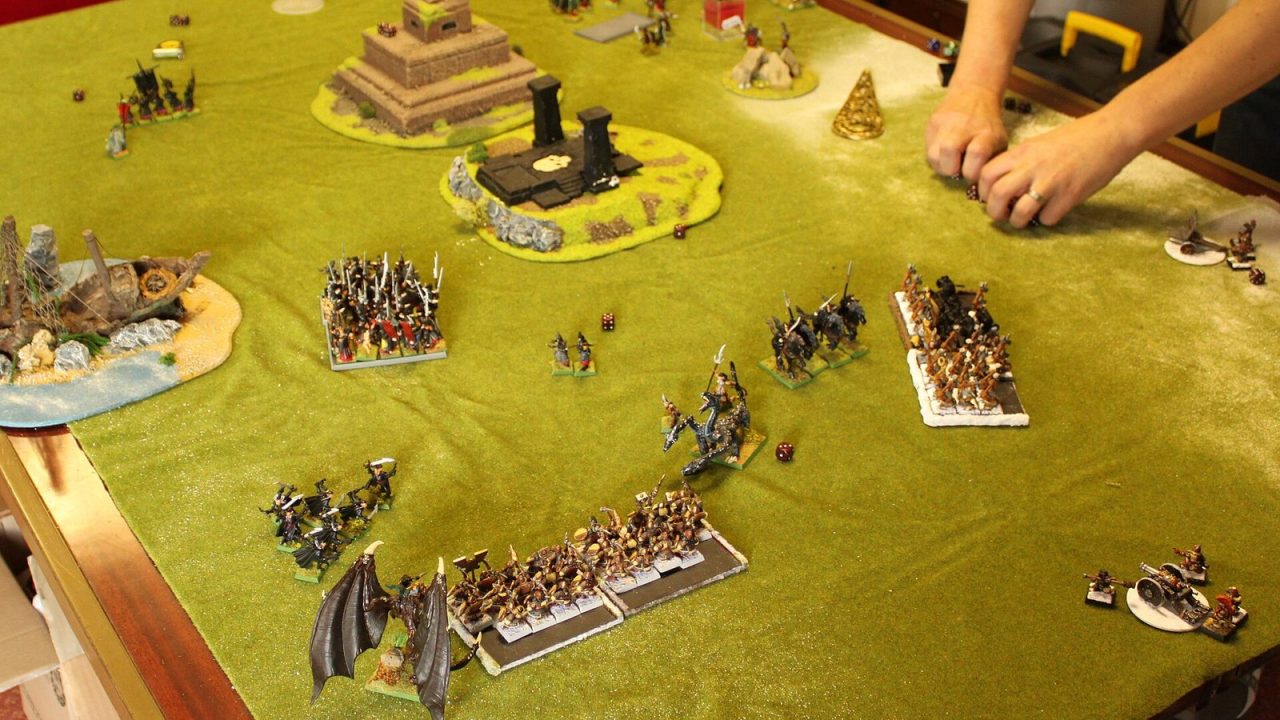
Most people who discover Warhammer through video games meet two very different fantasy universes without realising it. One is the Old World, a grim, gunpowder-and-sorcery version of Renaissance Europe that Games Workshop built over three decades. The other is the Mortal Realms of Age of Sigmar, a mythic, high-fantasy setting that replaced it in 2015. Both carry the Warhammer name, both feature Chaos as the great enemy, and both have their own games. This guide explains how the settings relate and lists the main games by setting and genre, so you know what you are getting into before you start.
If you are looking for the science-fiction side of the brand instead, our guide to Warhammer 40,000 video games covers Space Marine, Dawn of War and the rest of the 41st millennium.
The Old World: Warhammer Fantasy Battle
Warhammer Fantasy Battle, launched by Games Workshop in 1983, was a tabletop wargame set in a world loosely modelled on our own. Its heart is the Empire, a fractious patchwork of human provinces inspired by the Holy Roman Empire, with steam tanks, witch hunters and state troops carrying handguns. Around it lie Bretonnia, an Arthurian kingdom of knights; Kislev, a cold northern realm influenced by Russia and Poland; the mountain holds of the Dwarfs; the forests of the Wood Elves; the island of Ulthuan, home of the High Elves; and the cruel Dark Elves of Naggaroth.
Beneath and around these civilisations lurk the Skaven (rat-men tunnelling under every city), the Greenskins (Orcs and Goblins), the undead Vampire Counts and Tomb Kings, and above all the forces of Chaos, whose four gods (Khorne, Nurgle, Tzeentch and Slaanesh) seek to consume the world from the north. The tone is dark, muddy and often darkly comic: heroes are flawed, plague is everywhere and victory is rarely clean.
In 2015, Games Workshop ended this setting with a storyline called the End Times, in which Chaos finally overwhelms the world. The “World That Was” was destroyed, and the company replaced Warhammer Fantasy Battle with a new game.
Age of Sigmar: The Mortal Realms
Warhammer Age of Sigmar launched in 2015 as that replacement. Its setting is built from the remnants of the destroyed world: eight Mortal Realms, each tied to a type of magic. They are Azyr (heavens), Ghur (beasts), Aqshy (fire), Ghyran (life), Shyish (death), Ulgu (shadow), Hysh (light) and Chamon (metal).
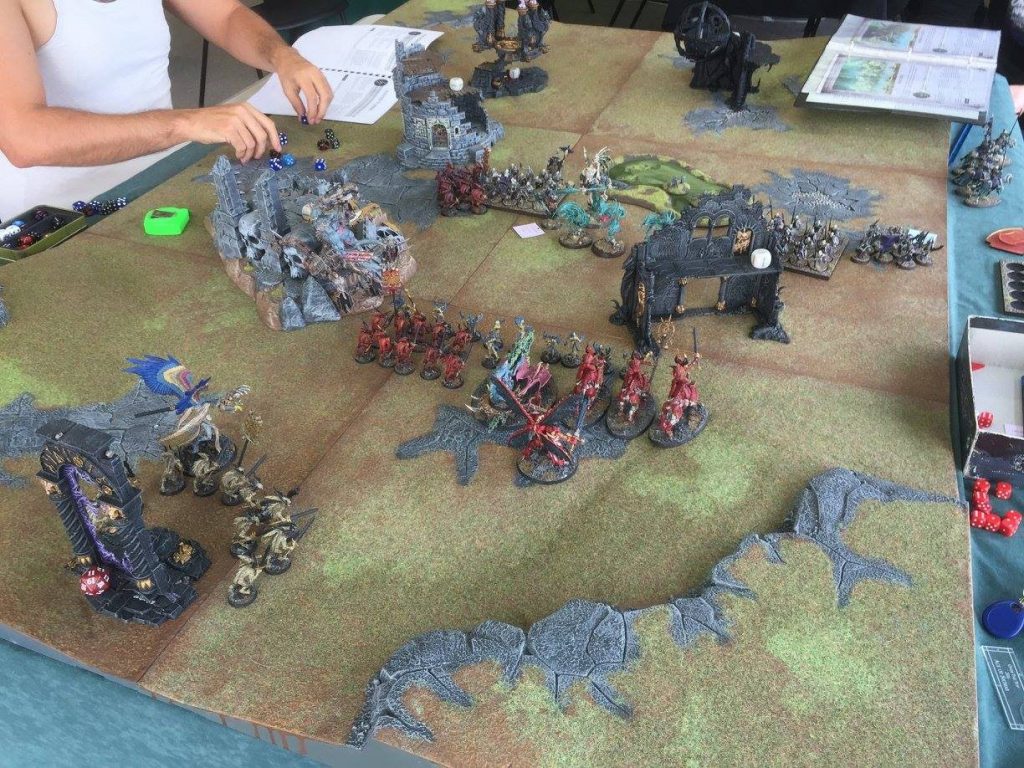
Sigmar, once a mortal hero worshipped as the Empire’s god in the Old World, now rules from Azyr. His signature army is the Stormcast Eternals, warriors forged from the souls of the worthy and sent down in bolts of lightning to fight Chaos. Some familiar factions survive in new forms, such as Skaven, Orruks (the new spelling of Orcs) and the undead, while others are new, such as the Lumineth or the Kharadron Overlords, sky-faring duardin (dwarfs) who fly airships.
The tone is bigger and more mythic than the Old World. Armies are often semi-divine, landscapes are surreal, and the scale ranges across whole planes of existence. Age of Sigmar has gone through several tabletop editions: a second in 2018, a third in June 2021 and a fourth in July 2024.
The Old World Returns
The story did not stay closed. Games Workshop revived the original setting as a tabletop game called Warhammer: The Old World, released in early 2024, set in an earlier period of the setting’s history. It sits alongside Age of Sigmar rather than replacing it.
For video game players, this creates an important rule of thumb: most of the biggest Warhammer fantasy video games are set in the Old World, even those released after 2015, because licensed projects often take years to develop and studios chose the setting their audiences already knew.
Quick Comparison: Which Setting Is Which?
| Old World (Warhammer Fantasy) | Mortal Realms (Age of Sigmar) | |
|---|---|---|
| Introduced | 1983 (tabletop) | 2015 (tabletop) |
| Feel | Low fantasy, grim, Renaissance Europe | High, mythic fantasy across magical planes |
| Main human faction | The Empire | Cities of Sigmar and the Stormcast Eternals |
| Main enemy | Chaos from the north | Chaos, plus Death and Destruction “grand alliances” |
| Best-known games | Total War: Warhammer, Vermintide, Mordheim | Storm Ground, Realms of Ruin |
Old World Games by Genre
Real-time tactics and strategy
The setting’s first major strategy games came in the 1990s. Warhammer: Shadow of the Horned Rat (1995), published by Mindscape, followed Morgan Bernhardt’s mercenary company, the Grudgebringers, fighting through campaigns against the Skaven. Warhammer: Dark Omen (1998), published by Electronic Arts, continued the mercenaries’ story with a 3D battlefield. Both focused on tactical battles with persistent units rather than base building.
Warhammer: Mark of Chaos (2006), developed by Black Hole Entertainment, offered campaigns for the Empire and Chaos, and its expansion Battle March (2008) added Dark Elves and Greenskins and brought the game to Xbox 360.
The definitive strategy treatment of the Old World is Creative Assembly’s Total War: Warhammer trilogy, published by Sega:
- Total War: Warhammer (2016) covered the Old World itself, launching with the Empire, Dwarfs, Greenskins and Vampire Counts, with the Warriors of Chaos offered to early buyers and later as DLC.
- Total War: Warhammer II (2017) moved to the New World, Ulthuan and the Southlands, adding High Elves, Dark Elves, Lizardmen and Skaven.
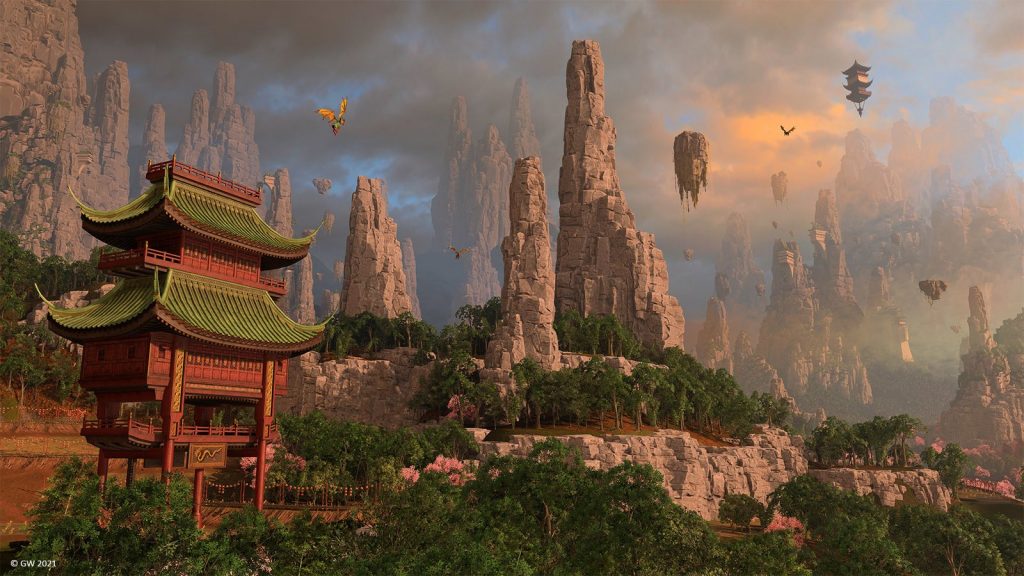
- Total War: Warhammer III (2022) centred on the Realm of Chaos, Kislev and Grand Cathay, a faction Games Workshop had rarely detailed before.
Warhammer III’s Immortal Empires campaign combines the maps of all three games into one enormous world, which is why many fans call them the most complete digital portrait of the setting. This is an overview, not a strategy guide, so for faction tactics you will want dedicated communities.
First-person action
Fatshark’s Warhammer: End Times – Vermintide (2015) is set in the city of Ubersreik during the End Times, as a Skaven horde overruns it. Players take one of five heroes, including the witch hunter Victor Saltzpyre and the dwarf ranger Bardin Goreksson, in close-quarters melee combat. Warhammer: Vermintide 2 (2018) brings the same heroes back to face both Skaven and Chaos forces. The series is famous for weighty melee combat and for capturing the Old World’s grimy atmosphere at street level.
Turn-based tactics
Mordheim: City of the Damned (2015), developed by Rogue Factor, adapts Games Workshop’s skirmish game set in a city shattered by a comet strike. Warbands of mercenaries, Skaven, Sisters of Sigmar and Chaos cultists fight for wyrdstone in ruined streets. It is a faithful, demanding adaptation of the tabletop rules.
Other genres
- Warhammer: Chaosbane (2019), by Eko Software, is a top-down hack-and-slash adventure set after a great war against Chaos in the Old World.
- Man O’ War: Corsair (2017), by Evil Twin Artworks, is a naval action game where you sail the Old World’s seas and ports.
- Blood Bowl, the fantasy football board game, has its own long-running digital series from Cyanide, including Blood Bowl 2 (2015) and Blood Bowl 3 (2023).
- Warhammer Quest adaptations brought the dungeon-crawling board game to mobile and consoles.
The Old World also had an MMO, Warhammer Online: Age of Reckoning, from Mythic Entertainment and EA, which is outside the scope of this guide.
Age of Sigmar Games by Genre
Age of Sigmar has fewer major video games than the Old World, which partly reflects timing: when the new setting launched, several large Old World projects were already in development. The list has grown steadily, though.
- Warhammer Age of Sigmar: Champions (2018), from PlayFusion, is a digital collectible card game.
- Warhammer Underworlds: Online (2020) adapts the competitive Underworlds board game, set in the Age of Sigmar universe.
- Warhammer Age of Sigmar: Storm Ground (2021), developed by Gasket Games and published by Focus Home Interactive, is a turn-based tactics game featuring the Stormcast Eternals, the Nighthaunt and the Maggotkin of Nurgle.
- Warhammer Age of Sigmar: Tempestfall (2021), by Carbon Studio, is a VR action game set in Shyish, the Realm of Death.
- Warhammer Age of Sigmar: Realms of Ruin (2023), developed and published by Frontier Developments, is a real-time strategy game set in Ghur, featuring the Stormcast Eternals, Orruk Kruleboyz, Nighthaunt and Disciples of Tzeentch.
Realms of Ruin is the most substantial attempt yet to give the Mortal Realms a full console and PC strategy game, and it is the natural starting point if you specifically want to see Age of Sigmar’s armies in motion.
Where Should You Start?
Your choice depends mostly on the kind of game you enjoy:
- Grand strategy fans: start with Total War: Warhammer. It is the broadest introduction to the Old World’s factions and lore, and its sequels expand the same map.
- Action fans: Vermintide 2 puts you in the mud and blood of the setting, with distinct characters who bicker throughout.
- Tabletop players: Mordheim and Blood Bowl are the most faithful digital translations of Games Workshop rulesets.
- Age of Sigmar curious: Realms of Ruin for real-time battles or Storm Ground for turn-based tactics.
- Retro enthusiasts: Shadow of the Horned Rat and Dark Omen show how the setting looked on 1990s PCs and the PlayStation.
Common Points of Confusion
“Is Total War: Warhammer set in Age of Sigmar?”
No. The trilogy is set in the Old World, before the End Times. It was released after Age of Sigmar launched, which is why the question comes up so often.
“Did Sigmar exist in the Old World?”
Yes. In the Old World, Sigmar Heldenhammer was the human hero who founded the Empire and was later worshipped as a god. In Age of Sigmar, he is an active deity ruling Azyr. The continuity between the two is one of the setting’s main threads.
“Are Old World games outdated now?”
Not at all. With Warhammer: The Old World back on tabletops since 2024, the original setting is officially active again, and its video games remain the best-known Warhammer fantasy titles.
“Why are there so many small Warhammer games?”
Games Workshop licenses its settings widely to studios of very different sizes, which produces a long list of titles with uneven ambition. We will look at that approach in more detail in a later article on Warhammer licensing.
Two Settings, One Long Shadow
Warhammer’s fantasy games make more sense once you see the timeline: an Old World that was destroyed, a set of Mortal Realms built from its remains, and a revived Old World running alongside them. Video games have followed that path imperfectly, with most big releases rooted in the original setting and Age of Sigmar slowly building its own library. Whichever you choose, you will meet the same constant: Chaos waiting at the edges, and heroes who rarely get a clean victory.