Star Wars Battlefront: The Series History Explained
From Pandemic's 2004 original and the lost Battlefront III to DICE's reboots, the 2017 loot box storm and the 2024 Classic Collection, the full story.
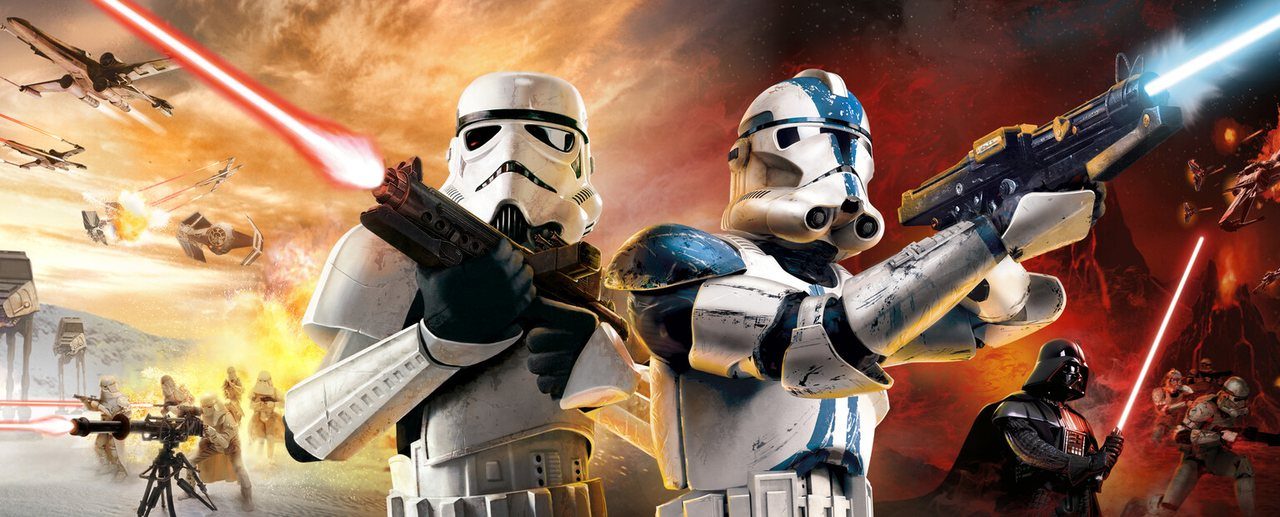
For many players, Star Wars Battlefront is the series that finally made the films’ battles feel playable. Instead of starring as a Jedi hero, you are one soldier among dozens on a battlefield like Hoth or Endor, storming objectives while blaster fire and vehicles fill the screen. Over two decades, the name has passed through two developers, a cancelled third game, two reboots, one of the most significant controversies in modern gaming and a troubled re-release. This article tells that story in order.
Pandemic’s Battlefront (2004)
Star Wars: Battlefront launched on September 21, 2004, developed by Pandemic Studios and published by LucasArts for PlayStation 2, Xbox and PC. Its premise was simple and powerful: large-scale battles across famous locations from both the prequel and original trilogies.
Players chose a faction and a soldier class (infantry, heavy weapons, sniper, pilot and faction-specific units) and fought to capture command posts while draining the enemy’s reinforcement count. Vehicles such as AT-STs, speeder bikes and snowspeeders could be used on many maps. The game covered the Clone Wars (Republic against Separatists) and the Galactic Civil War (Rebels against the Empire), and a Galactic Conquest mode let players fight for control of planets on a strategic map.
The design owed a clear debt to the large-battle shooters of the time, especially DICE’s Battlefield 1942, but the Star Wars setting made it feel fresh. Online play on consoles was still relatively new, and Battlefront’s support for it, along with split-screen and bots, gave it a long life. The game was well reviewed and sold strongly.
Battlefront II (2005): The Peak of the Original Era
Pandemic followed up quickly. Star Wars: Battlefront II was released in Europe on October 31, 2005 and in North America the next day, timed to arrive in the same year as Revenge of the Sith. It expanded the original in almost every direction:
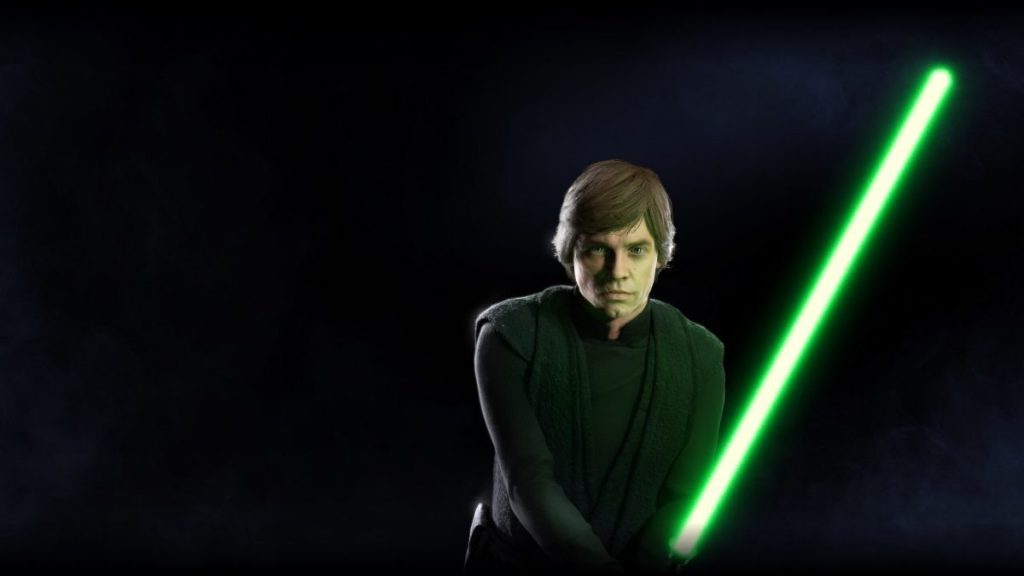
- Heroes and villains. Characters such as Darth Vader, Yoda, Luke Skywalker and Darth Maul could appear on the battlefield, adding the Jedi and Sith that the first game lacked.
- Space battles. Players could fly starfighters, attack capital ships and even land in an enemy hangar to sabotage systems from inside.
- A story campaign. The campaign followed the 501st Legion, told by a veteran clone trooper, from the Clone Wars through the rise of the Empire.
- Improved Galactic Conquest and new maps, including Mustafar, Utapau and Mygeeto.
Battlefront II was a critical and commercial success, and its PC version in particular enjoyed a modding community for years. It is still the game many fans mean when they talk about “classic Battlefront”. Where these campaigns sit on the timeline is explained in our guide to Star Wars games in chronological order.
Two PSP spin-offs followed: Renegade Squadron (2007) by Rebellion Developments and Elite Squadron (2009), which also came to the Nintendo DS.
The Lost Battlefront III
A true third game was in development at Free Radical Design, the British studio known for TimeSplitters. Its headline ambition was seamless transitions between ground and space battles: players could take off from a planet’s surface, fly into orbit and join a space fight without a loading screen.
The project did not survive. Free Radical lost the rights to the game in 2008, and the studio itself went into administration that year. A separate online version, Battlefront Online, was also developed and cancelled around 2010. Over the years, footage and builds of Free Radical’s game have leaked, including a Wii version that surfaced in December 2024, keeping it one of the best-known cancelled Star Wars games.
After that, the series went quiet. LucasArts released other Star Wars games, but no new Battlefront arrived before Disney bought Lucasfilm in 2012 and closed LucasArts’ internal development in 2013.
DICE’s Reboot: Star Wars Battlefront (2015)
When EA signed its exclusive Star Wars licence in 2013, Battlefront was an obvious candidate. The new Star Wars Battlefront, developed by EA DICE (the studio behind Battlefield, the series that had inspired the original), was first teased at E3 2013 and released on November 17, 2015 for PlayStation 4, Xbox One and PC, a month before The Force Awakens reached cinemas.
The reboot was a technical showcase. Using the Frostbite engine and photogrammetry of real props and costumes, DICE recreated Hoth, Endor, Tatooine and Sullust with striking fidelity, and the sound design used familiar effects from the films. Its headline mode, Walker Assault, staged huge battles around AT-AT walkers.
It also drew criticism. The game launched with only four planets and a small roster of heroes, had no single-player campaign, and relied on a paid season pass for much of its later content, which split the player base. The expansions added Bespin, the Death Star and, in December 2016, Scarif from Rogue One. Many players loved the look and feel but felt the package was thin.
Battlefront II (2017) and the Loot Box Controversy
DICE’s sequel was designed to answer those complaints. Star Wars Battlefront II was released on November 17, 2017, co-developed by EA DICE, Criterion Games and Motive Studio. It included all three film eras, more planets, space combat built with Criterion’s input, and no season pass: all post-launch maps and heroes would be free.
It also added a story campaign, developed by Motive, starring Iden Versio, commander of the Imperial special forces unit Inferno Squad. Set between Return of the Jedi and The Force Awakens, it begins with the destruction of the second Death Star and covers the Empire’s Operation: Cinder, and it is part of official Star Wars canon. (For what canon status means, see our explainer on Star Wars canon vs Legends in games.) A free continuation, Resurrection, followed on December 13, 2017.
What went wrong
To fund free updates, the game’s progression was tied to loot crates. Crates contained Star Cards, upgrades that improved abilities, and they could be bought with crystals, a premium currency purchased with real money. That meant paying players could gain gameplay advantages. Heroes such as Darth Vader also had to be unlocked with credits, and players estimated that earning enough for a single hero would take dozens of hours.
During the pre-launch period, an EA community account replied on Reddit that the aim was to give players “a sense of pride and accomplishment” for unlocking heroes. That comment became the most downvoted in Reddit history and was later recognised by Guinness World Records. EA cut hero costs by 75%, then, on November 16, 2017, the day before launch, it disabled microtransactions entirely.
The wider impact
The controversy spread beyond gaming. Belgium’s Gaming Commission investigated loot boxes, and its April 2018 report concluded that paid loot boxes could constitute gambling under Belgian law. The Dutch gambling authority opened its own investigation, and a Hawaii state representative publicly criticised the game’s design. The episode is widely credited with pushing the industry to reconsider paid randomised rewards.
Commercially, EA said in January 2018 that the game had fallen short of its sales target of 10 million copies, attributing part of the shortfall to the controversy.
The redesign
In March 2018, DICE overhauled progression. Star Cards were now earned through playing the classes and heroes you used, crates contained only credits and cosmetics, and crystals could only buy cosmetic items. From there, the game was rebuilt over two years of free updates, adding Clone Wars content, new heroes and the popular large-scale Capital Supremacy mode. A Celebration Edition bundling all cosmetics arrived on December 5, 2019, and the final content update came on April 29, 2020.
By the end, many players regarded it as a good game with a bad launch, and it is still frequently recommended as a way to experience large Star Wars battles. We include it in our list of the best Star Wars games for new players.
The Battlefront Classic Collection (2024)
After DICE’s support ended, the original Pandemic games returned. Star Wars: Battlefront Classic Collection, developed by Aspyr, launched on March 14, 2024 for PlayStation 4 and 5, Xbox One and Series X/S, Nintendo Switch and PC. It bundled the 2004 and 2005 games and added online multiplayer for larger matches, plus content such as extra heroes.
The launch was rough. Players reported only a handful of official servers on launch night, high ping, matchmaking errors and crashes, and the Steam release quickly received overwhelmingly negative user reviews. Aspyr acknowledged critical errors in its network infrastructure and said it was working on fixes, though it did not give a timeline at the time. The episode was a reminder that remastering an older online game involves far more than updating graphics.
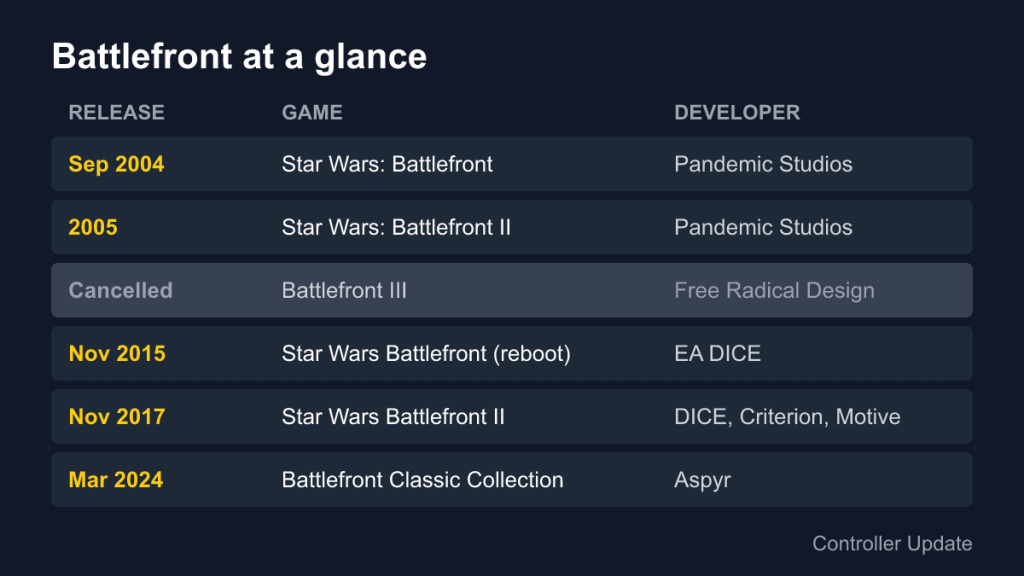
The Series at a Glance
| Game | Release | Developer | Key features |
|---|---|---|---|
| Star Wars: Battlefront | September 2004 | Pandemic Studios | Large ground battles, Galactic Conquest |
| Star Wars: Battlefront II | October/November 2005 | Pandemic Studios | Heroes, space battles, 501st campaign |
| Battlefront III | Cancelled | Free Radical Design | Planned seamless ground-to-space play |
| Star Wars Battlefront | November 2015 | EA DICE | Reboot, Walker Assault, no campaign |
| Star Wars Battlefront II | November 2017 | EA DICE, Criterion, Motive | Iden Versio campaign, loot box controversy, redesign |
| Battlefront Classic Collection | March 2024 | Aspyr | Re-release of the 2004 and 2005 games |
What Battlefront Means for Star Wars Games
Battlefront’s history mirrors the business of Star Wars games. The Pandemic games came from the LucasArts era, when the company published its own titles. The DICE games came from EA’s exclusive deal, with their huge budgets and polished presentation. The Classic Collection belongs to the more recent period, when Lucasfilm works with several partners at once. Through all of it, the series has kept one core promise: you are not the chosen one, just a soldier caught in the middle of a war among the stars. That may be why, even after its controversies, Battlefront remains one of the most requested names whenever fans imagine the next Star Wars game.