X-Men Video Games: A History of Mutants in Gaming
From Konami's six-player 1992 arcade game to X-Men Legends, Destiny and the mutants' modern roles, a history of the X-Men in video games.
The X-Men have a natural advantage in video games: a large cast of heroes with wildly different powers. A game can let you fly as Storm, teleport as Nightcrawler or slash as Wolverine, often in the same level. That variety has produced some of Marvel’s most beloved games, and also some of its most forgettable. This history follows the mutants from the late 1980s to their current place in Marvel’s game line-up, focusing on the action and adventure games that defined the team rather than the fighting games built around them.
The Late 1980s: Rough Beginnings
The X-Men’s first home console outing was The Uncanny X-Men (1989), published by LJN for the NES. It was a top-down action game with a small selection of mutants, and it is remembered mostly for its awkward controls and confusing design, an early example of the licensed games of the era that leaned on the name more than the gameplay.
On home computers, Paragon Software released X-Men: Madness in Murderworld (1989) for the Commodore 64 and PC, in which the team explores a trap-filled amusement park built by the villain Arcade. Neither game had much impact, but they show how early publishers were to see the team’s potential.
For the broader context of Marvel licensing in this period, see our history of Marvel video games.
1992: Konami’s Six-Player Arcade Classic
The X-Men’s breakout game came from arcades. Konami’s X-Men, released in North America in March 1992, was a side-scrolling beat ’em up in the style of the company’s Teenage Mutant Ninja Turtles arcade games. Its six playable heroes were Cyclops, Colossus, Wolverine, Storm, Nightcrawler and Dazzler, and the plot was simple: Magneto has kidnapped Professor X and Kitty Pryde, and the team must fight through waves of Sentinels and villains to rescue them.
Two things made it famous. First, the deluxe cabinet supported six players at once, using two screens side by side (one reflected in a mirror to appear as a single wide display). Most machines supported two or four players, but the six-player version became a legend in arcades. Second, the characters’ designs came from Pryde of the X-Men, a 1989 animated pilot that never became a series, giving the game a distinct look and explaining why Dazzler, a less familiar mutant, joined the line-up.
The game also became known for its strange voice lines and translations, which fans still quote. A home version developed by Backbone Entertainment was released digitally for PlayStation 3 and Xbox 360 in December 2010, followed by mobile versions, but the console releases were removed from stores at the end of 2013, a typical fate for licensed re-releases.
The 16-Bit Era: Platformers and the Animated Series
The early 1990s were a high point for X-Men popularity thanks to the comics boom and the 1992 animated series. Several 16-bit games tried to capture that energy.
- X-Men (1993, Sega Genesis): a side-scrolling action game in which players chose from a handful of heroes and could call others for help. It was notorious for a puzzle that asked players to “reset the computer”, which actually meant pressing the console’s reset button.
- X-Men: Mutant Apocalypse (1994, Super NES): developed by Capcom, a polished action platformer with five playable X-Men, each with stages suited to their powers. It drew on Capcom’s fighting game expertise for its moves and is widely considered the best 16-bit X-Men game.
- X-Men 2: Clone Wars (1995, Sega Genesis): a sequel that added Magneto as a playable character and introduced a story involving the Phalanx, a techno-organic alien threat.
- Game Gear titles: Sega also released handheld games, including X-Men 2: Game Master’s Legacy (1995) and X-Men 3: Mojo World (1996).
In the same period, Capcom produced a string of X-Men fighting games, starting with X-Men: Children of the Atom (1994), which led directly to the Marvel vs. Capcom crossover series. Those are a separate story in the fighting game world, so we only mention them here.
The Movie Era and X-Men Legends
When Bryan Singer’s X-Men film arrived in 2000, Activision held the licence and produced games across genres. Some were fighting games (X-Men: Mutant Academy and its sequels, and X-Men: Next Dimension in 2002), and some were tie-ins to the films.
The most important game of the period, however, was not a tie-in. X-Men Legends, developed by Raven Software and published by Activision, launched on GameCube, PlayStation 2 and Xbox in North America on September 21, 2004. It was an action game viewed from above, in which players controlled a team of four mutants and could switch between them at any time, combining their powers in combos.
Its story followed Alison Crestmere, a teenager who controls volcanic forces and becomes Magma, as she joins the X-Men and learns about the world of mutants. The villains included Magneto and the Brotherhood, Mystique, the anti-mutant General Kincaid and the Shadow King. With 15 playable X-Men and a story built for comics readers, it was the closest a game had come to feeling like a full run of the comic.
X-Men Legends II: Rise of Apocalypse followed in 2005 and expanded the idea in a clever way: the X-Men are forced to ally with Magneto’s Brotherhood against Apocalypse, so members of both teams become playable. It also arrived on PC and PSP. Raven’s formula was so successful that it became the basis for Marvel: Ultimate Alliance (2006), which applied it to the entire Marvel universe. We will cover the Legends and Ultimate Alliance games in more detail in a later article.
Wolverine Takes the Spotlight
As the films made Hugh Jackman’s Wolverine the face of the franchise, solo Wolverine games became common. X2: Wolverine’s Revenge (2003) loosely connected to the second film, and X-Men Origins: Wolverine (2009), developed by Raven Software and released alongside the film of the same name, is still considered one of the stronger tie-ins of its era thanks to its brutal, fast combat. Its success fits a pattern we explore in the rise and fall of the movie tie-in game: tie-ins that found their own design identity aged better than those that simply retold the film.
Meanwhile, X-Men: The Official Game (2006), published by Activision, filled in the story between the second and third films, letting players control Wolverine, Iceman and Nightcrawler. It received mixed reviews.
Insomniac Games’ Marvel’s Wolverine was released for PlayStation 5 on September 15, 2026, to mixed-to-positive reviews. We cover Wolverine’s solo games in their own article later in our schedule.
X-Men: Destiny (2011) and the Quiet Years
X-Men: Destiny, developed by Silicon Knights and published by Activision, was released in North America on September 27, 2011. It took an unusual approach. Instead of playing as established mutants, players chose one of three new characters (Aimi Yoshida, Adrian Luca or Grant Alexander) whose powers emerge during an anti-mutant crisis in San Francisco. The story was written by Mike Carey, then writer of the X-Men: Legacy comic, and players could side with the X-Men or the Brotherhood, leading to different endings.
The concept was promising, but the result was widely criticised for repetitive combat and choices with little consequence. It was Silicon Knights’ last game. The studio later lost a legal dispute with Epic Games over its use of Unreal Engine 3 code, was ordered to destroy unsold copies of Destiny and Too Human, and the game was delisted from digital stores on January 1, 2014.
After Destiny, the X-Men largely disappeared from big standalone games for over a decade. Film rights were part of the reason: the X-Men films were made by 20th Century Fox rather than Marvel Studios, and in the 2010s Marvel’s own promotion focused on the characters it controlled on screen. That changed after Disney acquired much of 21st Century Fox in 2019, bringing the X-Men film rights back under the same roof as Marvel Studios.
The Modern Era: Team Players Again
Recent years have brought the mutants back, though often as part of larger casts rather than in X-Men-branded games:
- Marvel Ultimate Alliance 3: The Black Order (2019) included a large group of X-Men in its roster.
- Marvel’s Midnight Suns (2022), Firaxis’ tactics game, features Wolverine, Storm and Magik among its heroes.
- Marvel Rivals (2024), a team-based shooter, includes several mutants in its line-up, from Magneto to Storm.
- Marvel’s Wolverine (2026) gives one mutant a full-scale, big-budget solo adventure for the first time in many years.
The X-Men are also a fixture of fighting games, including Arc System Works’ Marvel Tōkon: Fighting Souls, though that genre sits outside our focus here.
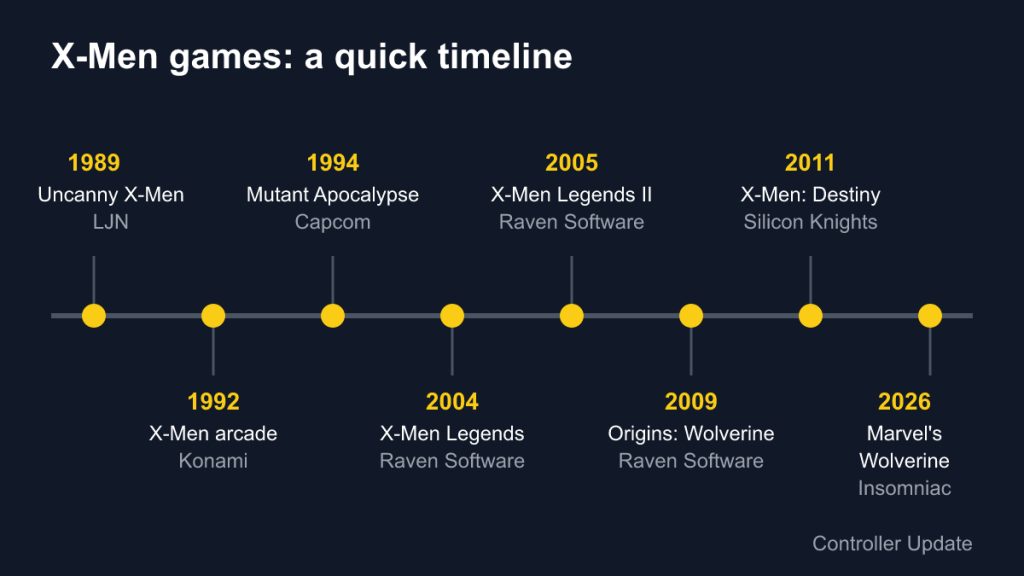
A Quick Timeline
| Year | Game | Developer | Notes |
|---|---|---|---|
| 1989 | The Uncanny X-Men | Published by LJN | First console game |
| 1992 | X-Men (arcade) | Konami | Six-player cabinet |
| 1994 | X-Men: Mutant Apocalypse | Capcom | Best-regarded 16-bit game |
| 2004 | X-Men Legends | Raven Software | Team-based action with Magma as protagonist |
| 2005 | X-Men Legends II: Rise of Apocalypse | Raven Software | X-Men and Brotherhood unite |
| 2009 | X-Men Origins: Wolverine | Raven Software | Well-regarded movie tie-in |
| 2011 | X-Men: Destiny | Silicon Knights | New mutants, delisted in 2014 |
| 2026 | Marvel’s Wolverine | Insomniac Games | PS5 exclusive |
Which X-Men Games Hold Up?
Many classic X-Men games are hard to buy digitally because of expired licences, so you may need original hardware or physical copies. With that caveat:
- X-Men Legends II: the strongest team-based X-Men game, with a story that shows both sides of the mutant conflict.
- The 1992 arcade game: short, chaotic and best with friends, a time capsule of early-1990s arcades.
- X-Men: Mutant Apocalypse: the best pick for fans of tight, classic platforming.
- X-Men Origins: Wolverine: a rare tie-in worth revisiting for its combat.
Why the Mutants Keep Coming Back
X-Men games work best when they embrace the team’s defining strength: many heroes, many powers, and a conflict that is about prejudice and identity as much as punches. Raven’s Legends games understood that, letting players build a squad and see the world from the mutants’ point of view, while Destiny tried and stumbled. With the film rights now consolidated under Disney and a new generation of games featuring the mutants, the X-Men’s history in gaming is far from finished.