From LucasArts to Lucasfilm Games: The Story of Star Wars’ Game Label
How Lucasfilm's games division went from 1982 start-up to LucasArts, closed in 2013 after Disney's purchase, and returned as a licensing label in 2021.
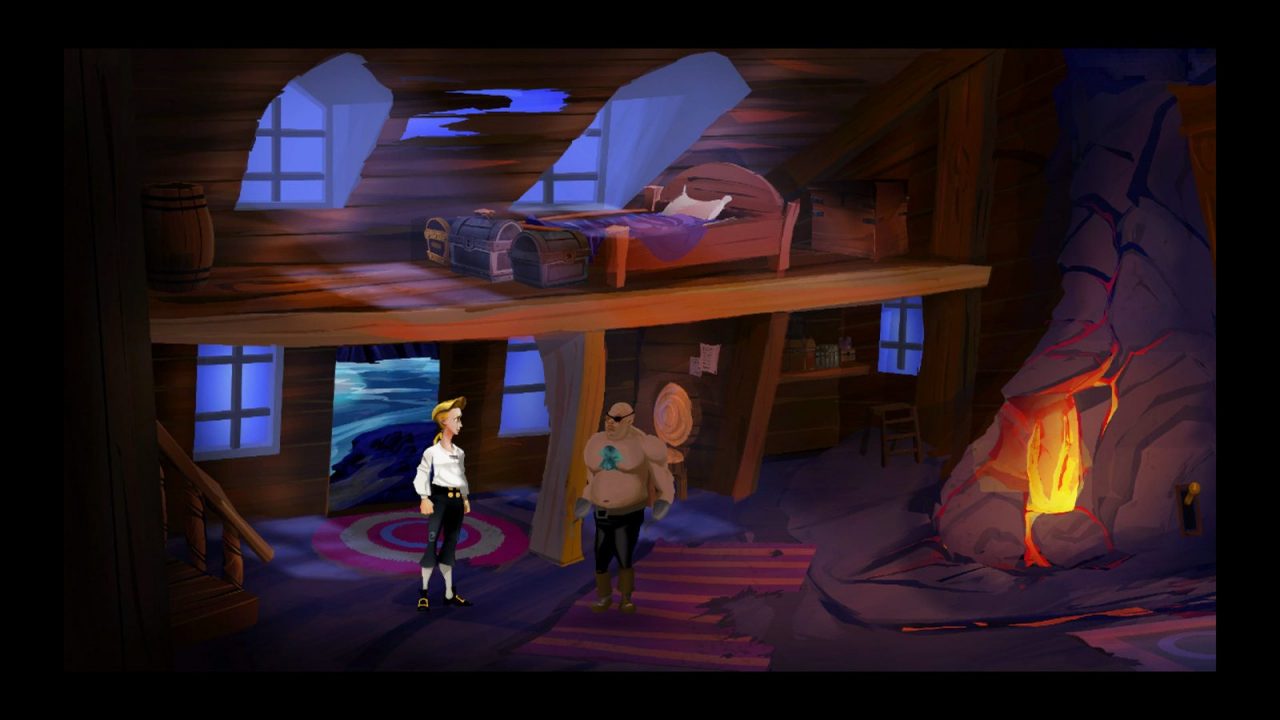
For players who grew up in the 1990s, the LucasArts logo was a promise of quality: it appeared on Monkey Island, Grim Fandango, TIE Fighter and Dark Forces. Today the same company’s games appear under a different banner, Lucasfilm Games, and they are made by outside studios such as Respawn, Massive Entertainment and MachineGames. The path between those two eras runs through a start-up division, a creative golden age, a long period of change, a shutdown and a revival. This article explains each stage and why it matters for the Star Wars and Indiana Jones games you can play now.
1982: Lucasfilm Games Is Born
George Lucas’s company was interested in computers long before it made games. Lucasfilm created a computer division in 1979, and on May 1, 1982 it founded a dedicated games group called Lucasfilm Games. Early funding came in partnership with Atari, and the first projects were technically ambitious rather than tied to films.
Its first games, Ballblazer and Rescue on Fractalus!, were developed in 1984 for Atari’s computers and released by publisher Epyx by May 1985. Notably, these were original ideas, not Star Wars games. At the time, the rights to make Star Wars games were licensed to other companies, so Lucasfilm’s own team concentrated on new concepts. That decision shaped the studio’s identity for years.
Lucasfilm’s computer work had other famous consequences. In 1986, the graphics group was spun off and eventually became Pixar, while the games team stayed and grew.
The Adventure Game Golden Age
In 1986, Labyrinth, based on the Jim Henson film, became Lucasfilm Games’ first adventure game. The following year, Maniac Mansion (1987) introduced SCUMM, an engine and scripting system that let designers build point-and-click adventures efficiently. SCUMM powered a run of classics, including The Secret of Monkey Island (1990) and its sequel.
In 1991, Lucasfilm added iMUSE, a system that let music change smoothly in response to what the player was doing. Monkey Island 2: LeChuck’s Revenge, released that year, was the first game to ship under the LucasArts name, after the games division became part of a new company, LucasArts Entertainment, in 1990. The adventure line continued with Day of the Tentacle, Sam & Max Hit the Road, Full Throttle, The Curse of Monkey Island (1997) and Grim Fandango (1998). Escape from Monkey Island (2000) was the last original LucasArts adventure game.
This period built the studio’s reputation for humour, polish and memorable characters, and it is why many players still associate LucasArts with creativity rather than any single franchise.
Star Wars Comes Home
In 1992, the Star Wars licence reverted to Lucasfilm from Broderbund, and LucasArts began making Star Wars games itself at scale. The results defined the franchise’s gaming identity for a decade:
- Super Star Wars (1992) and its sequels brought the original trilogy to the Super NES as side-scrolling action games.
- X-Wing (1993) and TIE Fighter (1994), by Totally Games, set the standard for space combat games on PC.
- Star Wars: Dark Forces (1995) introduced Kyle Katarn and brought Star Wars into first-person shooters.
- Rogue Squadron (1998), by Factor 5, became a hit on the Nintendo 64.
As the prequel films arrived from 1999, LucasArts’ output leaned heavily toward Star Wars. Some of its best-known games of the 2000s were developed by outside studios and published by LucasArts: BioWare’s Knights of the Old Republic (2003), Pandemic’s Star Wars: Battlefront games (2004 and 2005), and Raven Software’s Jedi Outcast (2002) and Jedi Academy (2003). We cover the Pandemic games in our Battlefront series history.
The balance between original ideas and Star Wars was a recurring tension. In 2002, LucasArts publicly committed that at least half of its releases would be non-Star Wars games, but the franchise remained its commercial engine.
Restructuring and Turbulent Years (2004–2012)
In April 2004, Jim Ward became president and reorganised the company. LucasArts cancelled several projects, reduced its internal development and shifted toward working with external developers and building its own technology. Internally developed games of this era included Star Wars: The Force Unleashed (2008), which combined physics-driven Force powers with a new Star Wars story.
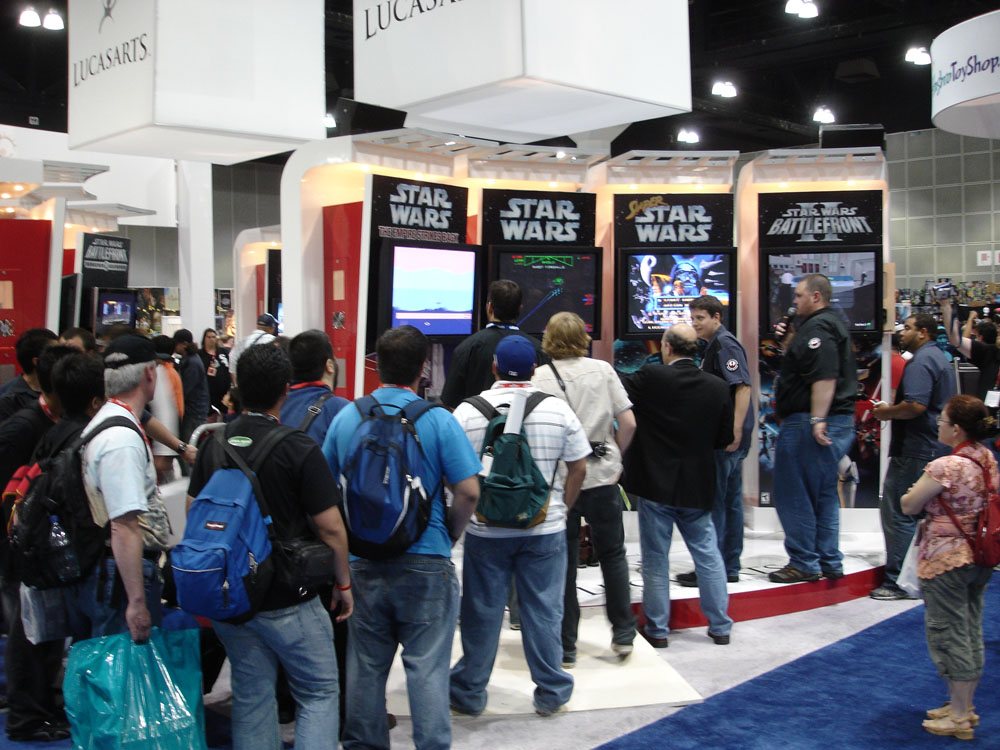
Leadership changed repeatedly afterwards. Ward left in 2008, Darrell Rodriguez took over and left in 2010, and Paul Meegan was named president that year before departing in August 2012. LucasArts also laid off about a third of its employees in September 2010. During this period it revived its classic adventure catalogue, announcing a Special Edition remake of The Secret of Monkey Island in June 2009.
The last game released while LucasArts was still an independent Lucasfilm subsidiary was Angry Birds Star Wars, on November 8, 2012, a licensed collaboration with Rovio.
Disney, the 2013 Closure and EA’s Exclusive Deal
Disney announced its purchase of Lucasfilm in October 2012 and completed it on December 21, 2012. A few months later, on April 3, 2013, Lucasfilm shut down LucasArts’ internal game development, with about 150 staff losing their jobs. Projects in progress, including the much-discussed Star Wars 1313, were cancelled.
Disney chose to move to a licensing model. On May 6, 2013, Electronic Arts announced that it would develop future Star Wars games under an exclusive multi-year licence for core gamers. LucasArts as a name remained mainly as a licensor and catalogue owner.
The EA era produced a smaller number of large games:
| Game | Year | Developer |
|---|---|---|
| Star Wars Battlefront | 2015 | EA DICE |
| Star Wars Battlefront II | 2017 | EA DICE, Criterion, Motive |
| Star Wars Jedi: Fallen Order | 2019 | Respawn Entertainment |
| Star Wars: Squadrons | 2020 | Motive Studio |
| Star Wars Jedi: Survivor | 2023 | Respawn Entertainment |
Critics of the arrangement argued that a single publisher produced too few games over the period, and that several projects, including a Visceral Games Star Wars action game, were cancelled. Supporters pointed to the quality of the Jedi games, which we explain in our article on Jedi: Fallen Order and Survivor. Either way, the exclusive deal is a textbook example of the trade-offs we describe in how video game licensing works.
2021: Lucasfilm Games Returns
On January 11, 2021, Lucasfilm re-established the Lucasfilm Games brand, the name the division had used in the 1980s, as the umbrella for all of its games. It is a licensing and creative oversight label rather than a large in-house developer: Lucasfilm Games works with external studios, approves stories and designs, and coordinates games with the wider franchise.
The big change was that EA was no longer the only Star Wars partner: its exclusivity ended in early 2021, well before the original contract was due to expire in 2024. EA continued with Respawn and other teams, but new partners were announced alongside it:
- Ubisoft and Massive Entertainment: an open-world Star Wars game, released in August 2024 as Star Wars Outlaws.
- Bethesda and MachineGames: a new Indiana Jones game, released in December 2024 as Indiana Jones and the Great Circle.
- Aspyr: a remake of Knights of the Old Republic, announced in September 2021.
- Quantic Dream: Star Wars Eclipse, a narrative game set in the High Republic era, announced in December 2021.
- Skydance New Media: a Star Wars project led by Amy Hennig, reported in April 2022.
- Devolver Digital and Ron Gilbert: Return to Monkey Island (2022), a return for the classic series by its original creator.
Some of these projects have moved forward faster than others, and development of announced licensed games can change significantly, so check official announcements for the current status of any title that has not yet been released.
Why the Name Change Matters for Players
The switch from LucasArts to Lucasfilm Games is not just branding. It reflects three real shifts in how the games are made.
- From developer to licensor. In the 1990s, LucasArts built many of its own games. Today Lucasfilm Games mostly guides external studios, so the developer’s identity (Respawn, Massive, MachineGames) shapes each game’s style.
- From one partner to many. The 2013 exclusive deal concentrated Star Wars games at EA. Since 2021, multiple publishers can work on Star Wars at once, which tends to produce more variety in genre and tone.
- More attention to canon. Because Lucasfilm Games sits inside Lucasfilm, games are coordinated with films, series, books and comics. Since 2014, new Star Wars games are generally part of the official canon unless stated otherwise.
For the classic catalogue, the change has also encouraged re-releases. Many older LucasArts games have returned on modern platforms through partners, often with the original logo on the box, while some titles remain unavailable because of music or technical rights.
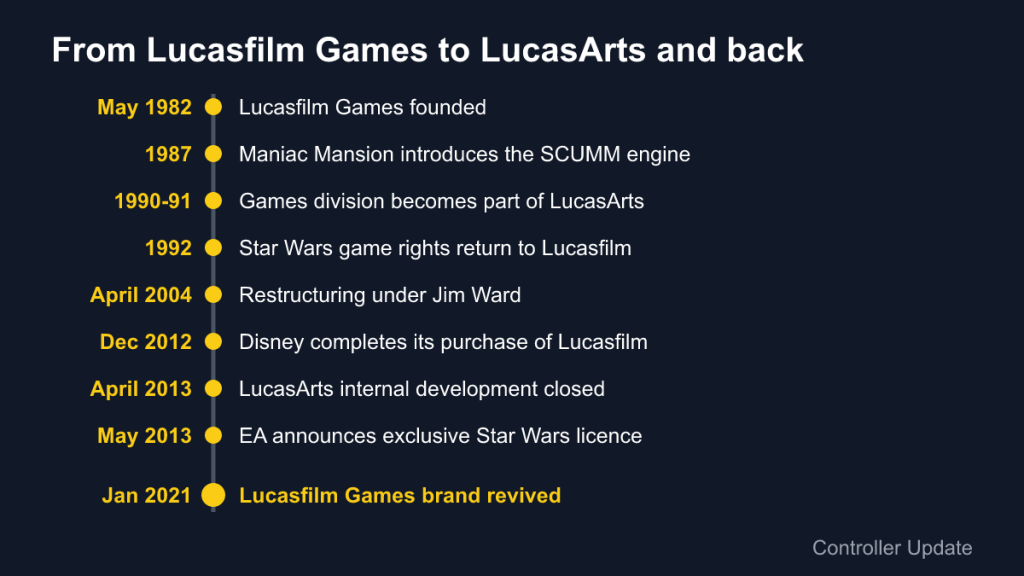
A Quick Timeline
| Date | Event |
|---|---|
| May 1, 1982 | Lucasfilm Games founded |
| 1987 | Maniac Mansion introduces the SCUMM engine |
| 1990–1991 | Games division becomes part of LucasArts Entertainment; first game under the LucasArts name |
| 1992 | Star Wars game rights return to Lucasfilm |
| April 2004 | Restructuring under Jim Ward |
| December 21, 2012 | Disney completes its purchase of Lucasfilm |
| April 3, 2013 | LucasArts internal development closed |
| May 6, 2013 | EA announces exclusive Star Wars licence |
| January 11, 2021 | Lucasfilm Games brand revived |
The Label’s Long Arc
Lucasfilm’s games division has come full circle. It began as a small, experimental team that was not allowed to make Star Wars games, became one of the great creative studios of the 1990s, struggled through the 2000s and closed under new ownership. It returned with its original name, this time as a curator rather than a maker. For fans, the practical takeaway is that the logo on a Star Wars game now tells you who approved it, while the developer’s name tells you what kind of game it will be.