Every Harry Potter Video Game: History from 2001 to Hogwarts Legacy
From EA's film tie-ins of 2001–2011 to Kinect, mobile spin-offs and Hogwarts Legacy: how Harry Potter games followed the films, then broke free of them.

Harry Potter has been a video game franchise for as long as it has been a film franchise. The first game arrived in November 2001, the same month as the first film, and a new game followed almost every movie for a decade. After the final film, the games changed direction: motion-controlled experiments, mobile spin-offs and, eventually, an open-world role-playing game that became one of the biggest releases of the 2020s.
This history covers the main console and PC games in order, the spin-offs that filled the gaps, and the creation of Warner Bros.’ Portkey Games label. LEGO adaptations are noted only briefly, and some smaller mobile titles are left out.
The EA Era Begins: Philosopher’s Stone (2001)
Electronic Arts held the licence for Harry Potter games throughout the film series, from 2001 to 2011. Its approach was to release a game alongside each film, and to commission different studios for different platforms, which means the “same” game often existed in several very different versions.
Harry Potter and the Philosopher’s Stone (released as Sorcerer’s Stone in North America) launched in November 2001. The PlayStation version was developed by Argonaut Games, the PC version by KnowWonder, and the Game Boy Color and Game Boy Advance versions by Griptonite Games. The PC and PlayStation versions were third-person adventures built around exploring Hogwarts, learning spells in lessons, collecting Bertie Bott’s Every Flavour Beans and playing Quidditch. The Game Boy Color version, by contrast, was a turn-based role-playing game.
Because the film was still in production when development began, the earliest games drew on the book and on early production designs as much as the film itself, giving them a slightly different look from the movie.
A second version for newer consoles
The original Philosopher’s Stone did not appear on PlayStation 2, Xbox or GameCube in 2001. EA later filled that gap with a new version developed by Warthog Games, released in 2003, so that console owners could play the full series.
The Middle Years: Chamber of Secrets to Goblet of Fire
Harry Potter and the Chamber of Secrets (2002) followed the same pattern. Eurocom developed the main console versions for PlayStation 2, Xbox and GameCube, while KnowWonder developed the PC version and other teams handled the original PlayStation and handheld versions. The console game was praised for giving players a more open Hogwarts and grounds to explore between story chapters.
In 2003, EA released Harry Potter: Quidditch World Cup, a sports-style spin-off in which players led house teams and then national teams to a world championship. It is the first game dedicated entirely to Quidditch and remained the only one for over two decades.
Harry Potter and the Prisoner of Azkaban (2004), with console versions by EA UK, introduced the ability to switch between Harry, Ron and Hermione, each with distinct abilities, to solve puzzles. It also leaned more heavily on the film’s visual style, reflecting director Alfonso Cuarón’s redesign of Hogwarts.
Harry Potter and the Goblet of Fire (2005), also by EA UK, was a significant change. It abandoned free exploration for a linear, level-based action structure built around the Triwizard Tournament, with support for up to three players cooperating. Some fans missed exploring the castle, while others enjoyed the faster pace. It appeared on a wider range of platforms than any previous entry, including the new Nintendo DS and PSP.
The Late Film Era: Order of the Phoenix to Deathly Hallows
Harry Potter and the Order of the Phoenix (2007) brought back exploration on a large scale. It recreated Hogwarts as a detailed, explorable castle, using the films’ sets and layouts as reference, and its gesture-based spellcasting made particular use of the Wii Remote. It released on both older and new-generation consoles, including PlayStation 3, Xbox 360 and Wii.
Harry Potter and the Half-Blood Prince (2009), developed by EA Bright Light, kept the explorable castle and focused on three activities: potion-making, duelling and Quidditch. It was the last game in the series to emphasise school life.
The final two films brought a sharp change of tone. Harry Potter and the Deathly Hallows – Part 1 (2010) followed Harry, Ron and Hermione on the run, outside Hogwarts, and adopted a third-person shooter style built around cover and combat spells. It was widely criticised for that approach and for its repetitive missions. Deathly Hallows – Part 2 (2011) refined the action, with set pieces culminating in the Battle of Hogwarts, and closed EA’s decade-long run alongside the film series.
How the games followed the films
Across the EA era, the games mirrored the films’ evolution. Early entries are bright and school-focused, with lessons, collectibles and Quidditch. Middle entries borrow more of the films’ cinematography and cast likenesses. The last entries, like the last films, abandon the castle for darker adventures. Because each game had to launch on a fixed film release date, development schedules were tight, which helps explain why quality varied from year to year. Our guide to how video game licensing works explains why such tie-in deals shaped release timing.
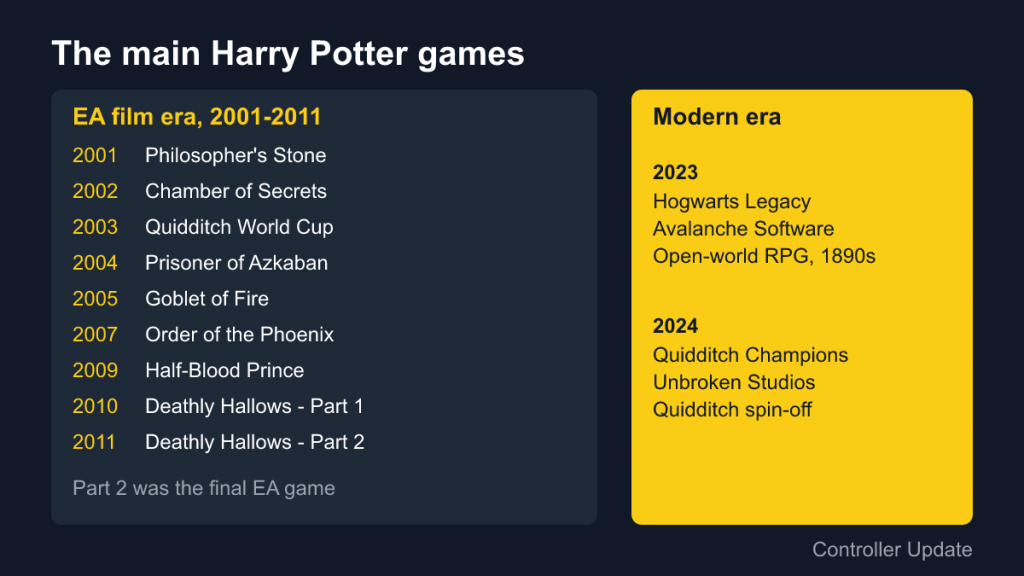
Timeline Table: The Main Harry Potter Games
| Year | Game | Main developer(s) | Notes |
|---|---|---|---|
| 2001 | Philosopher’s/Sorcerer’s Stone | Argonaut, KnowWonder, Griptonite | Different games per platform |
| 2002 | Chamber of Secrets | Eurocom, KnowWonder | Larger explorable grounds |
| 2003 | Quidditch World Cup | EA | Sports spin-off |
| 2003 | Philosopher’s Stone (new version) | Warthog Games | For PS2, Xbox, GameCube |
| 2004 | Prisoner of Azkaban | EA UK | Switchable trio |
| 2005 | Goblet of Fire | EA UK | Linear, co-op action |
| 2007 | Order of the Phoenix | EA | Explorable castle |
| 2009 | Half-Blood Prince | EA Bright Light | Potions, duelling, Quidditch |
| 2010 | Deathly Hallows – Part 1 | EA Bright Light | Shooter-style action |
| 2011 | Deathly Hallows – Part 2 | EA Bright Light | Final EA game |
| 2023 | Hogwarts Legacy | Avalanche Software | Open-world RPG, 1890s |
| 2024 | Quidditch Champions | Unbroken Studios | Quidditch spin-off |
Between the Big Games: Kinect, Wonderbook and LEGO
After the films ended, Harry Potter games became more experimental.
- Harry Potter for Kinect (2012) used Microsoft’s Kinect camera for Xbox 360, letting players act out spells and scenes from all eight films with their bodies.
- Wonderbook: Book of Spells (2012) and Book of Potions (2013) were PlayStation 3 games that used an augmented-reality book accessory, the PlayStation Eye camera and PlayStation Move controller to turn a physical book into an interactive spell manual.
- LEGO Harry Potter: Years 1–4 (2010) and Years 5–7 (2011), from Traveller’s Tales, retold the whole saga with humour and were later remastered for newer consoles.
The Mobile Years and the Birth of Portkey Games
In 2017, Warner Bros. created Portkey Games, a label dedicated to Wizarding World games. It signalled a new strategy: games that let players create their own wizard or witch rather than replaying Harry’s story.
Mobile games dominated the next few years:
- Harry Potter: Hogwarts Mystery (2018), by Jam City, a story-driven mobile game in which players attend Hogwarts as their own student in the years before Harry’s arrival.
- Harry Potter: Wizards Unite (2019), an augmented-reality game by Niantic, the company behind Pokémon Go, with WB Games San Francisco. Its closure was announced in November 2021, and it shut down on January 31, 2022.
- Harry Potter: Puzzles & Spells, a match-three puzzle game from Zynga.
- Harry Potter: Magic Awakened, a collectible-card and duelling game from NetEase, launched in China in 2021 and worldwide in 2023; its servers in the Americas, Europe and Oceania closed in October 2024.
Hogwarts Legacy and Quidditch Champions
Hogwarts Legacy, developed by Avalanche Software and published under the Portkey Games label, launched on February 10, 2023 for PlayStation 5, Xbox Series X|S and PC, with later versions for older consoles, Nintendo Switch and Nintendo Switch 2. Set in the 1890s, it let players create their own fifth-year student and explore Hogwarts, Hogsmeade and the surrounding Highlands. It became one of the best-selling games of its generation. Our Hogwarts Legacy beginner’s guide covers the game in detail.
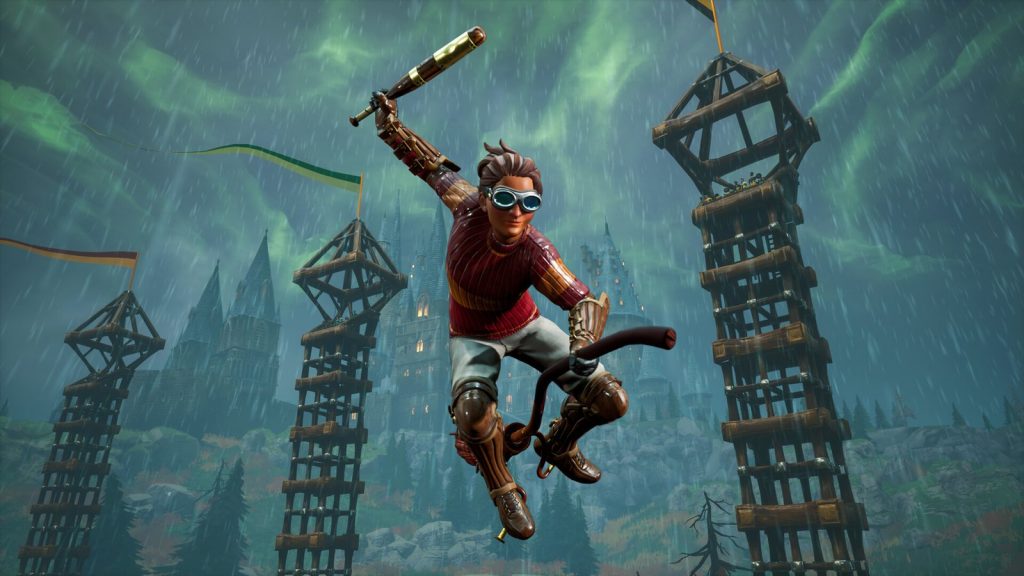
In September 2024, Warner Bros. followed with Harry Potter: Quidditch Champions, developed by Unbroken Studios, a dedicated Quidditch game for consoles and PC. A Nintendo Switch version followed in November 2024. It was the first game devoted to the sport since 2003.
Patterns Across Two Decades
- Exploration versus action. Fans consistently favoured games that let them explore Hogwarts freely, such as Chamber of Secrets, Order of the Phoenix and Hogwarts Legacy, over linear action entries.
- Platform-specific versions. In the early 2000s, the same title could be a different game on each system, a common practice for big licences at the time.
- From replaying the story to living in the world. The shift from Harry as protagonist to player-created characters is the biggest change in the franchise’s history.
Can you still play the old games?
Most of the EA-era games are not sold on modern digital stores, so playing them generally means owning original copies and compatible hardware. The LEGO games and Hogwarts Legacy are the most widely available today.
Frequently Asked Questions
Which Harry Potter game should I play first?
For most players today, Hogwarts Legacy, because it is available on current hardware and does not require knowledge of earlier games. If you want to relive the films’ story, the LEGO games are the most accessible way to do it on modern systems.
Why are there different versions of the early games?
In the early 2000s, consoles and handhelds differed so much in power that publishers often hired separate studios to build a version for each platform. That is why the PC and PlayStation 2 versions of Chamber of Secrets, for example, have different levels and structures.
Was there ever a game based on Fantastic Beasts?
No standalone console game was built around the spin-off films. The first film did receive a Story Pack add-on for the toys-to-life game LEGO Dimensions in 2016.
Who publishes Harry Potter games now?
Warner Bros. Games, mainly through its Portkey Games label, either developing games internally or licensing the setting to partners such as Jam City and Niantic.