How Video Game Licensing Works: IP Holders, Studios and Approvals
Who owns a franchise, who makes the game, and who signs off: a plain-English guide to licensors, licensees, approvals, exclusivity and expiring licences.

When you buy a Star Wars, Marvel or Warhammer game, the logo on the box tells only part of the story. Behind almost every licensed game sits a contract between at least two companies: one that owns the characters and world, and one that builds and sells the game. That relationship shapes what the game can contain, how long it takes to make, which platforms it appears on, and even whether it stays on sale years later.
This article explains how that system works in general terms. It sticks to publicly documented examples and avoids guessing at deal values, which are almost never disclosed. If you have ever wondered why one company seemed to make all the Star Wars games for a decade, or why some licensed games vanish from digital stores, this is the background you need.
The Basic Players: Licensors and Licensees
The licensor is the company that owns the intellectual property (IP): the names, characters, logos, designs, story history and often music and likenesses associated with a franchise. Examples include Disney (through Lucasfilm for Star Wars and through Marvel for Marvel characters), Warner Bros. (for DC and the Wizarding World), Games Workshop (for Warhammer) and Hasbro (for Transformers).

The licensee is the company granted permission to use that IP in a specific product. In games, the licensee is usually a publisher, which finances and markets the game, and which either develops the game with its own studio or hires an external developer. Sometimes the licensee is an independent developer that self-publishes.
A licence is a permission, not a sale. The licensor keeps ownership of the IP and grants rights that are limited in several ways: to certain media (console and PC games, but not mobile, for example), to certain regions, to a set period of time, and sometimes to particular eras, characters or genres.
Third parties inside the licence
A big franchise often depends on rights that the main licensor does not fully control. Actor likenesses and voices, licensed songs, and characters co-owned with other companies may each need separate agreements. This is one reason licensed games can be harder to keep on sale than original games: when any one of these agreements ends, the publisher may have to stop selling the game.
How a Licensed Game Gets Made
Every deal is different, but a licensed game typically passes through a familiar sequence.
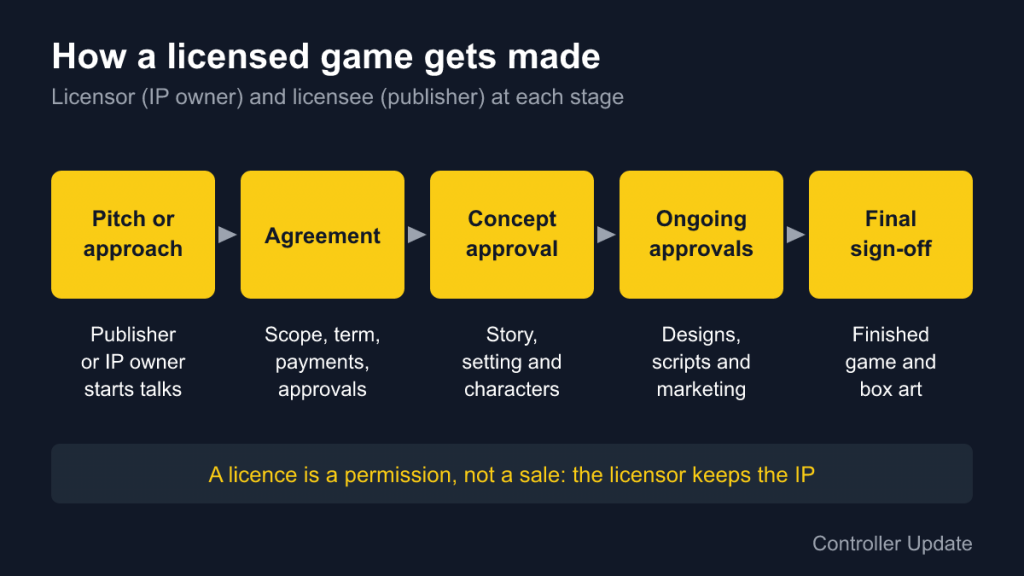
- The pitch or the approach. Either a publisher pitches an idea to the IP owner, or the IP owner looks for a partner suited to a particular kind of game.
- The agreement. The two sides agree on scope (platforms, genre, territories), length of the licence, payments to the licensor and approval rights. Payments commonly involve some combination of upfront guarantees and royalties on sales, but specific figures for major game licences are rarely made public.
- Concept approval. Before full production, the licensor reviews the story, setting and main characters.
- Ongoing approvals. During development, the licensor reviews character designs, dialogue, scripts, marketing materials and sometimes gameplay content.
- Final sign-off. The finished game, its box art and its marketing need approval before release.
The approval process is what makes licensed development distinctive. An original game studio decides for itself what its hero looks like. A licensed studio may need sign-off on how a lightsaber hums, how a superhero’s costume is coloured, or whether a character can say a particular line.
Why Approvals Matter: Story Groups and Canon
For franchises with a strong continuity, the approval process is also about canon. When Lucasfilm reorganised its storytelling in April 2014, it announced that a Lucasfilm Story Group would coordinate new stories across films, television, books, comics and games. That is why modern Star Wars games such as Star Wars Jedi: Fallen Order and Star Wars Outlaws are considered canon: their stories were developed with Lucasfilm’s involvement and fit around the films. Our Star Wars timeline guide shows how those games are slotted between the movies.
Other licensors take different approaches. Games Workshop has a long tradition of allowing games set in Warhammer’s universes that tell their own stories within broad lore rules. Warner Bros.’ Wizarding World games, such as Hogwarts Legacy, were written by the development team and set a century before the books, which avoids contradicting the main story.
Creative freedom versus consistency
The tension in any licence is between freedom and protection. Studios want room to invent characters, change genres and surprise players. Licensors want to protect a brand that may be worth far more in films, toys and theme parks than in any single game. The best licensed games usually come from partnerships where the licensor sets firm boundaries but trusts the developer within them.
Exclusive vs Non-Exclusive Licences
One of the biggest decisions is whether a licence is exclusive. An exclusive licence gives one company sole rights within a defined area; a non-exclusive arrangement allows the IP owner to work with several partners at once.
Case study: EA and Star Wars (2013)
The most famous recent example began in 2013. After acquiring Lucasfilm in 2012, Disney closed LucasArts’ internal development in April 2013 and moved to a licensing model. On May 6, 2013, Disney and Electronic Arts announced a multi-year agreement under which EA would develop and publish new Star Wars games for the core gaming audience across consoles and PC. EA named DICE, Visceral Games and BioWare as studios involved. The announcement did not disclose the length or financial terms of the deal, and Disney kept certain rights, including some mobile and online categories.
The results included DICE’s Battlefront games, Respawn’s Jedi: Fallen Order and Motive’s Squadrons. Critics of the arrangement pointed to its limited variety: for years, a single publisher’s priorities decided which kinds of Star Wars games were made, and several projects, including Visceral’s Star Wars game, were cancelled along the way.
Case study: Lucasfilm Games opens up (2021)
In January 2021, Lucasfilm revived the “Lucasfilm Games” name as the banner for all its games, and within the same week came two announcements from non-EA partners: an Indiana Jones game with Bethesda and MachineGames, and an open-world Star Wars game with Ubisoft’s Massive Entertainment. Coverage at the time widely described this as the end of EA’s exclusivity. EA kept working on Star Wars, and Lucasfilm said it had several projects underway with EA’s teams. The Ubisoft project became Star Wars Outlaws (2024), and the Indiana Jones game became Indiana Jones and the Great Circle (2024).
The shift illustrates the trade-off. Exclusivity can give a partner the confidence to invest heavily, while a multi-partner approach lets the licensor match different genres to studios that specialise in them. For players, it usually means more variety; for the licensor, it means more approvals to manage. If you want a sense of how varied those games are, see our guide to the best Star Wars games for new players.
In-House Licensors: When the Owner Is Also the Publisher
Not every licensed game involves two unrelated companies. Warner Bros. owns both DC and the rights to the Wizarding World games, and it also owns a game publishing division, Warner Bros. Games, with internal studios. In those cases, the “licence” is partly an internal agreement between divisions of the same company, although outside partners and rights holders may still be involved. Warner Bros. created its Portkey Games label in 2017 specifically for Wizarding World games, which signals that the approval relationship still matters even inside one corporation.
Disney has taken the opposite route in recent years: it largely does not develop console games internally, preferring to license its IP to external publishers and developers through its divisions, such as Lucasfilm Games and Marvel Games.
Why Licences Expire and Games Disappear
Licences are time-limited. When one ends, the licensee usually loses the right to keep selling new copies, including digital ones. That is why licensed games are disproportionately affected by “delisting,” the removal of a game from digital storefronts.
Common reasons include:
- The main licence term ends and the publisher and IP owner do not renew it.
- Music or likeness rights expire. Even if the core licence continues, songs or actor likenesses may have separate, shorter agreements.
- The IP owner changes strategy, for example moving a franchise to a new partner.
- The game is a live service that the publisher stops supporting. Crystal Dynamics and Square Enix ended support for Marvel’s Avengers in 2023 and removed it from sale on September 30, 2023.
In most cases, people who already bought the game can keep playing and redownloading it, though online features may be switched off. Delisted licensed games sometimes return when a new agreement is made, often as remasters or collections, which is why classic titles occasionally reappear years after vanishing.
What Licensing Means for Players
- Release timing. Film tie-ins historically had to launch alongside a movie, which often shortened development. Modern standalone licensed games are less bound by film dates.
- Content limits. Some characters may be unavailable because of separate rights, or reserved for films and other products.
- Story consistency. Licensed games in a managed canon tend to avoid huge events that would affect other media.
- Availability. Physical copies of licensed games can become the only way to buy them after a licence ends.
Common Misconceptions
“The IP owner made the game”
Often it did not. Lucasfilm Games acts mainly as a coordinating and approving partner, while games are built by companies such as Respawn, Massive Entertainment or MachineGames.
“Exclusive means forever”
Exclusive deals are time-limited and narrowly scoped. EA’s Star Wars agreement still left some categories with Disney, and it gave way to a multi-partner model within about eight years.
“A delisted game was deleted”
Delisting usually stops new sales; it does not normally remove the game from existing owners’ libraries.