Wolverine Video Games: From 16-Bit to Insomniac’s Marvel’s Wolverine
Every major Wolverine solo game, from LJN's 1991 NES title and Adamantium Rage to X-Men Origins and Insomniac's Marvel's Wolverine, released in 2026.

Wolverine looks like the perfect video game character. He has claws that cut through almost anything, a healing factor that explains why he can survive the punishment players dish out, and a temper that makes all-out combat feel in character. Yet for most of gaming history, his solo games were a mixed bag, and only a couple are remembered fondly. That changed in September 2026, when Insomniac Games released Marvel’s Wolverine on PlayStation 5, the most ambitious game ever built around the character.
This history covers Wolverine’s solo outings from the NES era to Insomniac’s game, looking at how each tried to solve the same design problem: how do you make a nearly unkillable berserker challenging and fun to play? Team games where Wolverine is one hero among many, such as the X-Men Legends series, are covered elsewhere.
The Problem With Adapting Wolverine
Wolverine’s core traits create a puzzle for designers. His healing factor makes him close to invulnerable in the comics, which undermines the threat of enemies. His claws are his main weapon, which makes them hard to limit without breaking the fantasy. And his violence was traditionally toned down for younger audiences, even though the character’s appeal lies partly in how savage he can be.
Each generation of Wolverine games tackled these questions differently: some made the claws cost health, some leaned into regeneration as a gameplay mechanic, and the most recent ones embraced mature ratings to show what the claws actually do.
The 8-Bit and 16-Bit Era
Wolverine (NES, 1991)
Wolverine’s first solo game was Wolverine, developed by Software Creations and published by LJN for the Nintendo Entertainment System in October 1991. Wolverine is trapped on an island by Magneto and Sabretooth and must fight his way through to a confrontation with them.
The game’s most notorious design choice was its treatment of the claws. Extending them drained Wolverine’s energy, which meant the character’s signature weapon actively hurt the player. Energy also drained continuously while touching enemies or hazards, without the brief invulnerability most platformers of the era offered. Fellow X-Men such as Jubilee, Havok and Psylocke could be summoned for advice or help. Retrospectives, including IGN’s look back at Wolverine games, have been unkind to it, citing its difficulty and its loose relationship with the comics.
Wolverine: Adamantium Rage (1994)
Wolverine: Adamantium Rage was released in 1994 for the Super NES and Sega Genesis, published by Acclaim (under the LJN label on Super NES). Unusually, the two versions were developed separately by two London studios, Bits Studios for Super NES and Teeny Weeny Games for Genesis, and they tell different stories.
The Super NES version sends Wolverine to Canada and Japan after a lead about his past, eventually confronting Shinobi Shaw, who has put a contract on his life, and The Hand. The Genesis version focuses on his Weapon X history, pitting him against Lady Deathstrike, Sabretooth and others before he tracks down Shaw. Having two versions with different plots, bosses and level designs under one title was unusual even in the 16-bit era, and it means fans of the character effectively got two separate games.
X-Men: Wolverine’s Rage (2001)
A smaller handheld entry, X-Men: Wolverine’s Rage, was developed by Digital Eclipse and published by Activision for Game Boy Color in May 2001. Lady Deathstrike obtains plans for a weapon capable of melting Wolverine’s adamantium skeleton, and he sets out to stop her. It was a modest side-scroller released as the X-Men films brought new attention to the character.
X2: Wolverine’s Revenge (2003)
The first 3D Wolverine game arrived in April 2003, timed to the release of the film X2. X2: Wolverine’s Revenge was developed primarily by GenePool Software and published by Activision for PlayStation 2, Xbox, GameCube and Windows, with a separate Game Boy Advance version by Vicarious Visions.
Despite its title, the game is not a film adaptation. It tells an original story in which Wolverine has 48 hours to find an antidote to the Shiva Virus in his bloodstream, a search that takes him back to the Weapon X facility in Canada where his adamantium skeleton was bonded. The voice cast was a highlight: Mark Hamill, already famous among animation fans for voicing the Joker, voiced Wolverine, while Patrick Stewart reprised Professor X.
Reviews were mixed. Critics praised the voice acting, story and unlockable content, but criticised slow combat, difficulty spikes and a lack of mid-level checkpoints.
X-Men Origins: Wolverine (2009)
The most celebrated Wolverine game before Insomniac’s arrived as a film tie-in. X-Men Origins: Wolverine was developed by Raven Software and published by Activision, released on May 1, 2009, the same day as the film in North America.
What set it apart was its willingness to be violent. The PlayStation 3, Xbox 360 and PC versions were sold as the “Uncaged Edition” and carried a Mature rating. Combat showed exactly what adamantium claws do, and Wolverine’s own body visibly took damage, with skin and muscle torn away to reveal his metal skeleton before healing back in real time. A rage meter powered stronger attacks and a berserker mode. Hugh Jackman reprised his film role as Wolverine’s voice, although he did not perform motion capture.
The story uses the film’s plot as a backbone but adds a significant amount of new material, expanding on Logan’s time with Team X and the Weapon X program. Many players and critics felt the game was better than the film it was based on, an unusual verdict for a movie tie-in. Our article on the rise and fall of the movie tie-in game explains why that was so rare.
Reviews for the Uncaged Edition were generally positive, praising the violence and visual effects while criticising repetitive combat and a short campaign. The Wii, PS2, PSP and DS versions were handled by other studios, were rated for younger players and reviewed considerably worse.
Why you cannot buy it today
X-Men Origins: Wolverine was removed from digital storefronts on January 1, 2014, when Activision’s Marvel licensing agreement expired. The same expiry took other Activision Marvel titles off sale, a pattern also seen in our history of the Marvel: Ultimate Alliance series. Physical copies remain the main way to play it.
Wolverine in Team Games
Between solo outings, Wolverine became one of the most frequently featured characters in Marvel team games: the 1992 X-Men arcade game, the X-Men Legends and Ultimate Alliance series, and crossover fighting games. Our history of X-Men video games covers those. He was usually one of the most popular picks in those rosters, which helps explain the long-standing appetite for a big-budget solo game.

Insomniac’s Marvel’s Wolverine (2026)
Announcement and development
Marvel’s Wolverine was announced in September 2021 at a PlayStation Showcase, alongside Marvel’s Spider-Man 2. Insomniac Games, the Sony studio best known for Ratchet & Clank and its Spider-Man games, was developing it as a PlayStation 5 exclusive, published by Sony Interactive Entertainment.
Development did not go entirely smoothly in public view. In December 2023, Insomniac was hit by a ransomware attack, and a large amount of development material, including early footage and details of Wolverine, leaked online. Insomniac stated that the breach would not affect production. The leadership team also changed: original creative director Brian Horton left in 2024, and Marcus Smith and Mike Daly took over as creative director and game director.
Release timeline
- September 2021: announced with a short teaser.
- September 24, 2025: gameplay revealed at a State of Play, with a “Fall 2026” release window.
- February 2026: release date confirmed as September 15, 2026.
- September 15, 2026: released worldwide for PlayStation 5.
What the game is
Marvel’s Wolverine is a third-person action game with Liam McIntyre as Logan. It shares a continuity with Insomniac’s other Marvel games but tells a self-contained story, so you do not need to have played the studio’s earlier games. The setup sees Logan drawn into a conflict involving Bolivar Trask and his cybernetic Reavers militia, who are abducting mutants. The journey takes him through locations including Canada, the lawless island nation of Madripoor and Tokyo, and features a mix of familiar X-Men allies and enemies.
True to the lineage of X-Men Origins, the game embraces the character’s brutality, with claw-focused melee combat built around finishers and parrying. Reviews were positive but more reserved than for Insomniac’s previous games: Metacritic scores settled in the mid-to-high 70s. Critics generally praised Liam McIntyre’s performance, the visuals and the combat’s spectacle, while some found the structure linear and the encounters repetitive. Commercially it had a strong launch, topping several national sales charts in its first week.
How the Games Compare
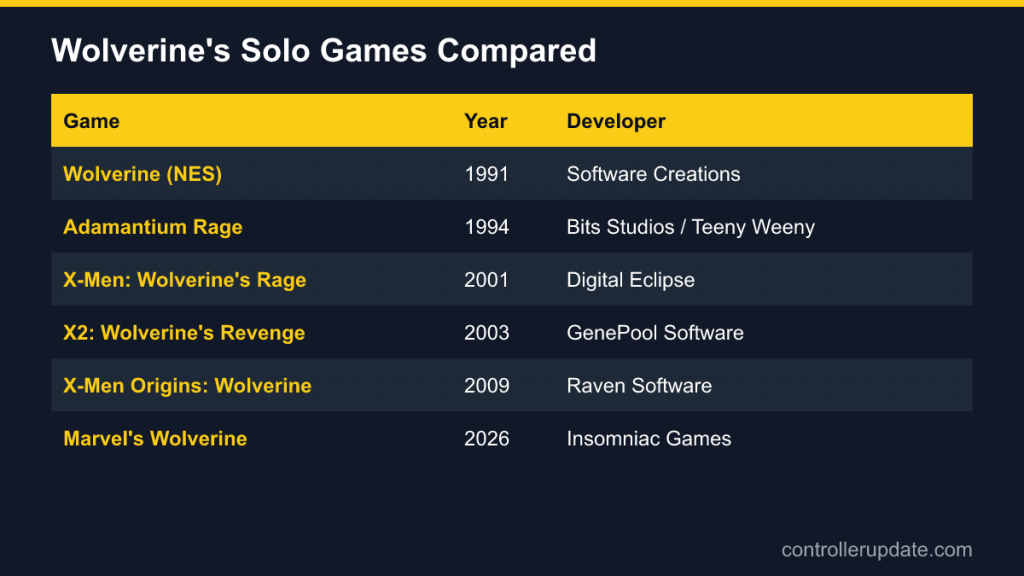
| Game | Year | Developer | Key idea |
|---|---|---|---|
| Wolverine (NES) | 1991 | Software Creations | Claws cost health |
| Wolverine: Adamantium Rage | 1994 | Bits Studios / Teeny Weeny Games | Two different versions with separate stories |
| X-Men: Wolverine’s Rage | 2001 | Digital Eclipse | Handheld side-scroller |
| X2: Wolverine’s Revenge | 2003 | GenePool Software | Original Weapon X story, first 3D solo game |
| X-Men Origins: Wolverine | 2009 | Raven Software | Mature-rated violence, visible healing |
| Marvel’s Wolverine | 2026 | Insomniac Games | Big-budget cinematic action |
The Long Road to a Definitive Wolverine Game
Looking across 35 years, the arc is clear. Early games struggled to reconcile Wolverine’s invulnerability with game difficulty, mostly by limiting him in ways that felt wrong. The 2009 tie-in found an answer by making his healing visible and his violence uncensored, and Insomniac’s game built on that foundation with a far larger budget. Whether Marvel’s Wolverine becomes the definitive take will depend on how it is remembered over the coming years, but it is the first time the character has carried a game of this scale on his own.