Hogwarts Legacy Houses Explained: What Changes With Each House
How sorting works in Hogwarts Legacy and what really differs between Gryffindor, Hufflepuff, Ravenclaw and Slytherin: common rooms, house quests and dialogue.

For many players, the most nerve-racking decision in Hogwarts Legacy happens in the first hour, when the Sorting Hat is lowered onto their character’s head. Fans have argued about their “real” house for decades, and the game leans into that by letting you choose. But how much does the choice actually matter once you start playing? The short answer is that it changes your home in the castle, one quest line and a scattering of dialogue, while the main story, abilities and open world stay the same.
This guide explains how sorting works, what each house gives you, and what stays identical regardless of where you end up. It is about story and atmosphere, not character optimisation, so there are no build recommendations here.
How Sorting Works in Hogwarts Legacy
Hogwarts Legacy, developed by Avalanche Software and released by Warner Bros. Games in February 2023, puts the player in the role of a new fifth-year student arriving at Hogwarts in the 1890s. Our beginner’s guide covers the overall structure; sorting is one of the earliest story beats.
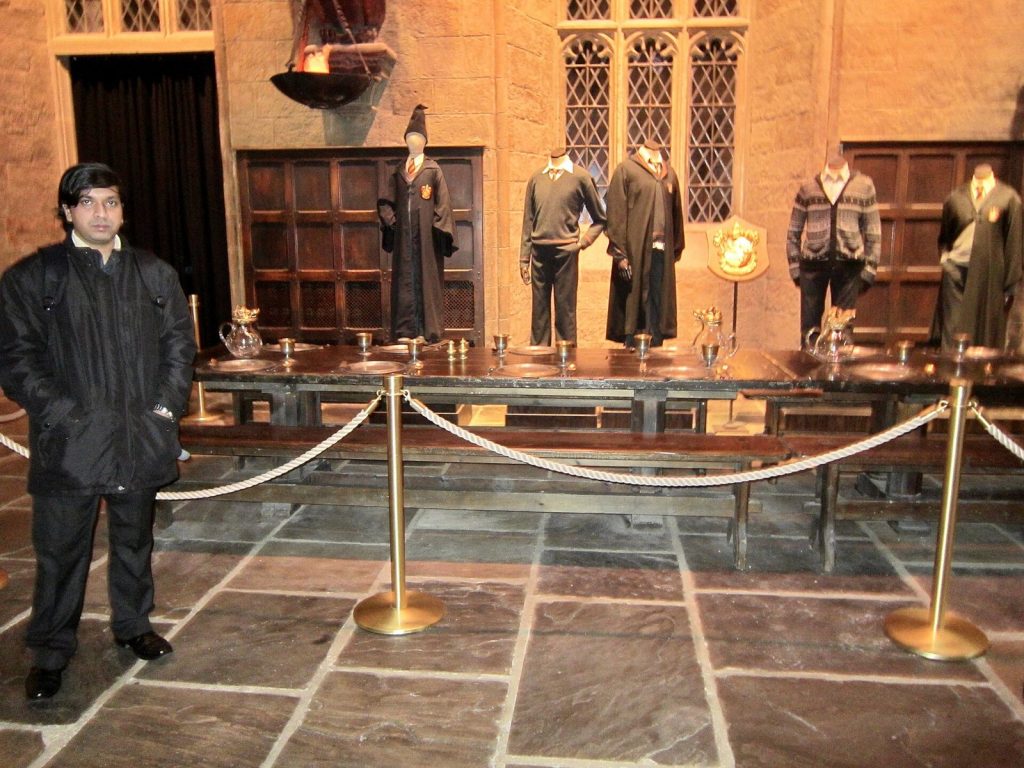
When your character reaches the Great Hall after the game’s opening, the Sorting Hat asks a few questions about your preferences and personality. Your answers lead the Hat to suggest a house, but you are not bound by its recommendation. You can accept the Hat’s suggestion or choose a different house directly, which means the decision is entirely in your hands. This echoes the books, where Harry asks the Hat not to put him in Slytherin and it respects his choice.
The game also offered a way to bring an existing house over from the Wizarding World fan website by linking accounts, so players who had already been sorted online could carry that result into the game. Either way, the choice is permanent for that save file. If you want to see a different house, you need to start a new game.
What Stays the Same Whatever You Choose
Before getting into the differences, it helps to be clear about how much is shared. Your house does not change:
- The main story. The plot about ancient magic, Ranrok and Victor Rookwood unfolds the same way regardless of house. Our explainer on the Hogwarts Legacy story covers that plot in full.
- Classes and spells. Every student attends the same lessons and can learn the same spells.
- Companions. Sebastian Sallow and Ominis Gaunt (Slytherin), Poppy Sweeting (Hufflepuff) and Natsai Onai (Gryffindor) are available to everyone, whatever your own house.
- The open world. Hogsmeade, the Highlands, the Forbidden Forest and the rest of the castle are all accessible on the same terms.
- The ending. Your house wins the House Cup at the end of the year regardless of which one it is.
In other words, house choice is primarily about flavour and belonging, not about locking you out of major content.
The Four Common Rooms
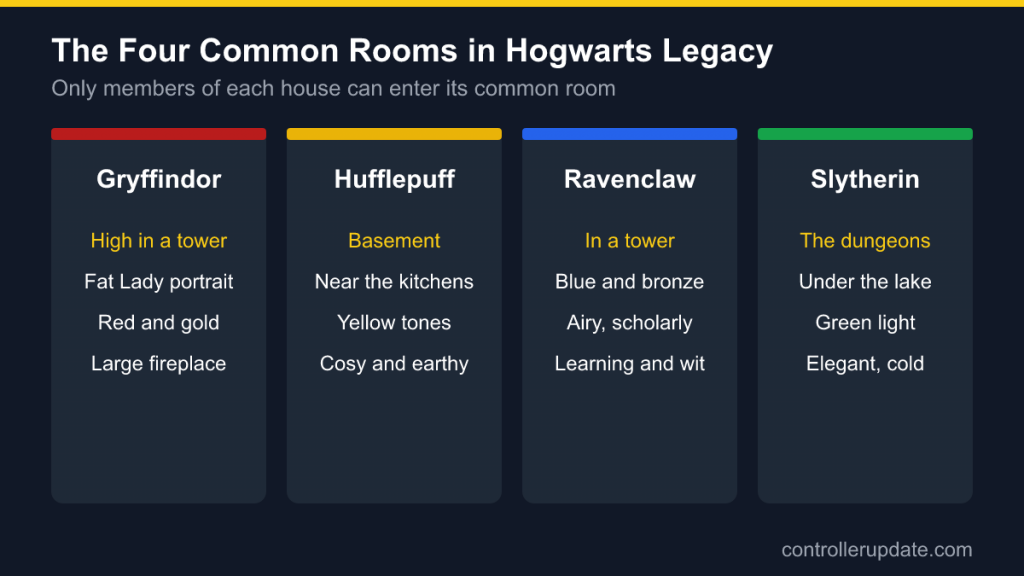
The most visible difference is where you live. Each house has its own common room, and only members of that house can enter it. Each has its own design, atmosphere and music, built to match the descriptions and depictions fans know.
Gryffindor
Gryffindor’s common room sits high in a tower, entered through the portrait of the Fat Lady. It is decorated in red and gold with a warm, lived-in feel, a large fireplace and medieval architecture. It is the most familiar of the four for anyone who grew up with the films, since it is where Harry and his friends spend so much of their time.
Hufflepuff
Hufflepuff’s common room is in the basement near the castle kitchens. True to the books’ description, it is cosy and earthy, with round shapes, yellow tones and plants. It was one of the common rooms fans were most curious to see, because it had never been depicted on film.
Ravenclaw
Ravenclaw’s common room is in one of the castle’s towers, with a blue and bronze colour scheme and an airy, scholarly character. It reflects the house’s association with learning and wit.
Slytherin
Slytherin’s common room is in the dungeons, under the Black Lake, with green light filtering through its windows. It has an elegant, slightly cold atmosphere that matches how the house has been portrayed since Chamber of Secrets.
The common rooms are also where you are surrounded by housemates, and some ambient conversations and characters vary accordingly. Beyond the different look, they serve the same practical function in gameplay.
The House-Exclusive Quests
The single biggest gameplay difference is a house-exclusive quest. Each house has one, and all four lead to the same point in the main story: an encounter connected with the ghost of Richard Jackdaw, a former student whose journal the player follows in the main quest. So while the path differs, the destination does not.
| House | Quest | Quest giver | What it involves |
|---|---|---|---|
| Gryffindor | The Hunt for the Missing Pages | Nearly Headless Nick | Errands for the house ghost that lead to the Headless Hunt and a graveyard |
| Hufflepuff | Prisoner of Love | Portrait of Eldritch Diggory | Investigating a past conviction, including a visit to Azkaban |
| Ravenclaw | Ollivander’s Heirloom | Gerbold Ollivander | Tracking down a stolen heirloom wand, with a puzzle at the Owlery |
| Slytherin | Scrope’s Last Hope | Scrope, the headmaster’s house-elf | Recovering a Black family heirloom from a guarded cave |
Gryffindor: The Hunt for the Missing Pages
Nearly Headless Nick, still a ghost in the 1890s as he is in Harry’s era, recruits Gryffindor players. The quest has a playful, spooky tone, sending you on errands that tie into the ghostly Headless Hunt that Nick so famously wants to join in the books. It ends in a graveyard where Jackdaw’s ghost can be summoned.
Hufflepuff: Prisoner of Love
Hufflepuff players are approached by the portrait of Eldritch Diggory, a former Minister for Magic who shares a surname with Cedric Diggory from the books. He suspects that a prisoner was wrongly convicted of a crime connected to Jackdaw. With an Auror, the player travels to Azkaban to uncover the truth. It is the only way to visit the wizarding prison in the game, and many reviewers considered it the strongest of the four house quests because of its darker storyline.
Ravenclaw: Ollivander’s Heirloom
Ravenclaw students are sent by Gerbold Ollivander, the wandmaker in Hogsmeade, to investigate an ancient family wand that was stolen long ago. The quest involves a puzzle in the Owlery, where statue pieces need to be assembled and placed correctly to reveal what happened to the wand. It is generally seen as the shortest and simplest of the four.
Slytherin: Scrope’s Last Hope
Slytherin players find a series of mysterious notes that lead them to Scrope, the house-elf serving Headmaster Phineas Nigellus Black. Scrope wants to recover a Black family heirloom to present to the headmaster. The search leads to a cave with enemies and light puzzles, making it the most combat-focused house quest. It also adds a little more texture to the Black family, a name that matters a great deal in the later books.
Dialogue and Smaller Differences
Beyond the common rooms and quests, house choice affects a range of small details:
- Robes and colours. Your character’s school uniform reflects your house colours, and house scarves and banners follow suit.
- Some dialogue. Certain characters respond differently depending on your house, and a handful of conversations acknowledge it directly. These are flavour lines rather than branches that change outcomes.
- Housemates. The students you see in your common room and at your house table reflect your house.
- Small quest details. A few side quests have minor variations, such as items or clues found in different locations depending on your house.
None of these alters the structure of the game. They are there to make your house feel like home.
Common Misconceptions
Because sorting carries so much emotional weight for fans, a few misunderstandings come up frequently:
- “Slytherin players get a dark storyline.” They do not. The main story is the same for every house, and the darker choices in the game come from companion quests and the ending, not from house membership.
- “Some houses get better spells.” Spells and abilities are not tied to house.
- “You miss out on companions from other houses.” All four main companions can be befriended by everyone.
- “You can switch houses later.” There is no way to change house within a save. A new game is required.
- “Your house affects the House Cup.” Every player’s house wins at the end of the year, so there is no wrong choice on that front.
How the Game Uses the Houses as World-Building
The houses in Hogwarts Legacy do something the earlier games mostly could not. EA’s Harry Potter tie-ins from 2001 to 2011 followed Harry, who is always in Gryffindor, so other houses were seen only from the outside. Our history of Harry Potter video games shows how closely those games tracked the films. Hogwarts Legacy is built around an original student, which frees it to treat all four houses as places to belong.
The result is that Hufflepuff and Ravenclaw, which were barely depicted in the films, finally got a full on-screen presence, complete with their own common rooms and stories. For many fans, that alone was a reason to replay the game in a second house.
Which House Should You Pick?
Because the differences are mostly cosmetic and narrative, the best answer is simply the house you feel most attached to. If you are planning more than one playthrough, the house quests are a good way to decide the order. Hufflepuff’s Azkaban trip and Slytherin’s Black family story are the most substantial, Gryffindor’s ghost errands lean into fun Harry Potter lore, and Ravenclaw’s is the shortest.
Whichever you choose, you will see the same castle, take the same lessons and face the same threats. What changes is where you go to sit by the fire at the end of the day, and for many players that is exactly what sorting is supposed to mean.