Marvel’s Avengers (2020): What Happened to the Game
The full arc of Marvel's Avengers: its 2017 tease, Kamala Khan campaign, post-launch heroes, monetisation rows, end of support and 2023 delisting.
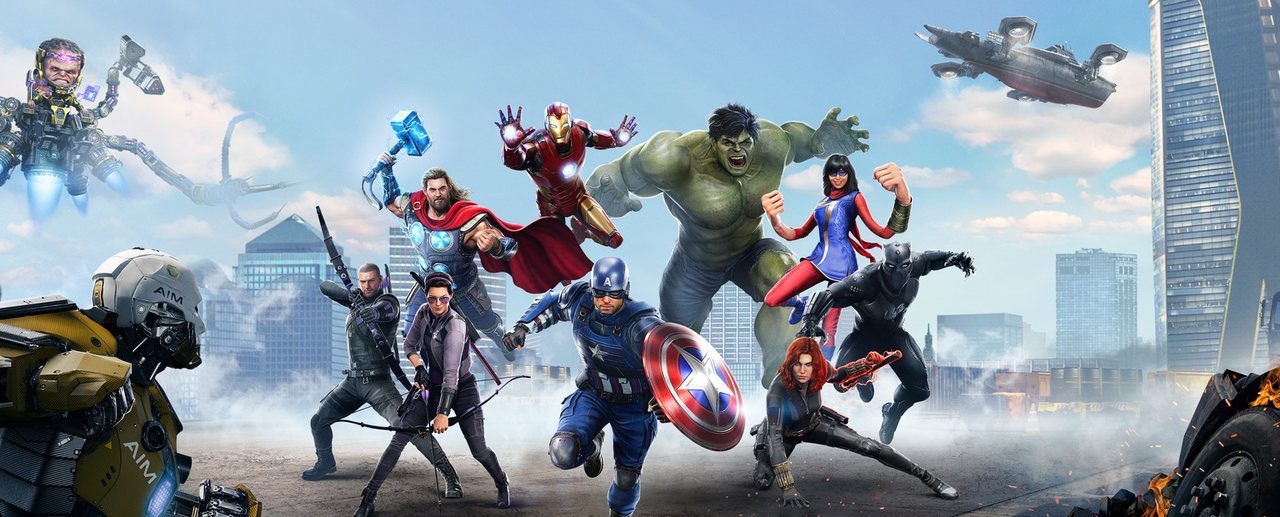
When Square Enix and Crystal Dynamics revealed Marvel’s Avengers on stage at E3 2019, it looked like one of the safest bets in gaming. Marvel’s film universe was at the peak of its popularity, Avengers: Endgame had just become a box office phenomenon, and the studio behind the modern Tomb Raider games was building a big-budget Avengers game with years of planned updates. Four years later the game was gone from digital stores, its support ended and its developer under new ownership.
This history follows the game from its first teaser to its delisting, covering the campaign, the post-launch heroes, the controversies and why it ended. It sticks to documented facts and announcements rather than speculation about what went on behind closed doors.
The Announcement: The Avengers Project
The game’s story begins in January 2017, when Marvel Entertainment and Square Enix released a short teaser for what was then called The Avengers Project. The announcement was part of a broader partnership between the two companies, and Crystal Dynamics, then a Square Enix studio, was named as lead developer with support from Eidos-Montréal. It came during a period when Marvel Games was pairing specific characters with specific studios, a strategy described in our history of Marvel video games.
Little more was shown until Square Enix’s E3 press conference on June 11, 2019, where the game was revealed in full under its final name, along with a release date of May 15, 2020. The reveal confirmed two key points. First, the game would have its own original take on the heroes, with new character designs and voice actors rather than the faces of the Marvel films. Second, it would be built as a long-term live-service game, with new heroes and story content added after launch at no extra cost, funded by cosmetic purchases.
The reaction to the reveal was mixed. Some fans felt the characters looked too much like generic stand-ins for the film versions without being either, while others welcomed a fresh interpretation. The voice cast included Nolan North as Iron Man, Laura Bailey as Black Widow and Sandra Saad as Kamala Khan.
Launch and the Reassemble Campaign
In January 2020, the game was delayed from May to September to give the team more time for polish. A public beta in August 2020 reportedly drew more than six million players. The game launched on September 4, 2020 for PlayStation 4, Xbox One, Windows and Google Stadia, with versions for PlayStation 5 and Xbox Series X/S following on March 18, 2021 as free upgrades for existing owners.
The game had two main parts: a single-player story campaign called Reassemble, and the Avengers Initiative, a cooperative mode built around repeatable missions and loot-based character progression.
The campaign story
The campaign opens on A-Day, a celebration in San Francisco where the Avengers unveil a new headquarters and a helicarrier powered by an experimental energy source. The event turns into disaster: an attack and explosion devastate the city, Captain America is believed killed, and a mysterious mist spreads across the area. People exposed to it develop superhuman abilities, becoming what the game calls Inhumans, and the public blames the Avengers. The team disbands.
Five years later, the scientific organisation AIM (Advanced Idea Mechanics) has stepped into the vacuum, presenting itself as a protector while hunting down and imprisoning Inhumans. The story is told largely through Kamala Khan, a teenage Avengers fan who gained shape-shifting powers on A-Day. Kamala uncovers evidence that the disaster was not what it seemed and sets out to bring the scattered Avengers back together.
Kamala’s role was the campaign’s most praised element. As a fan herself, she provides a viewpoint that makes reuniting Iron Man, Hulk, Black Widow, Thor and the rest feel earned. The main villains are AIM’s leadership, including George Tarleton, who becomes MODOK, and scientist Monica Rappaccini. Reviewers widely considered the campaign the strongest part of the game, with its warmth and character work drawing particular praise.
The Avengers Initiative and Post-Launch Heroes
After the campaign, the game shifted into its live-service mode. Players could team up with friends or AI companions in missions across a range of environments, collecting gear that improved their heroes’ power level. This was where most of the game’s long-term content was meant to live.
Crystal Dynamics added six heroes after launch, each with their own story operation:
| Hero | Release | Notes |
|---|---|---|
| Kate Bishop | December 8, 2020 | First post-launch hero |
| Clint Barton (Hawkeye) | March 18, 2021 | “Future Imperfect” storyline |
| Black Panther | August 17, 2021 | “War for Wakanda” expansion |
| Spider-Man | November 30, 2021 | PlayStation exclusive |
| Jane Foster (The Mighty Thor) | June 28, 2022 | Second Thor variant |
| Bucky Barnes (Winter Soldier) | November 29, 2022 | Final hero added |
War for Wakanda was the largest of the additions, adding a new region and a story pitting Black Panther against the villain Klaw. The PlayStation-exclusive status of Spider-Man attracted criticism from players on other platforms when it was announced, since the game had been marketed as an Avengers experience for all.
The pace of new content was slower than many players had hoped. Six heroes over roughly two years, alongside new missions and events, struggled to keep a large player base engaged in a genre where competitors updated more frequently.
The Monetisation Controversies
The game’s business model drew criticism almost from the start. While new heroes were free, the game sold cosmetic outfits and emotes through a marketplace and a hero-by-hero “challenge card” system similar to a battle pass. Critics and players objected to the volume of paid cosmetics in what was also a full-price game.
Tensions grew in 2021. A March 2021 update significantly lengthened the time required to level up heroes, and later that year Square Enix introduced paid boosts that sped up experience progression. Following a backlash from players who saw this as making the game grindier and then charging to skip the grind, the paid XP boosts were removed on November 3, 2021.
Periodic bugs and balance problems added to the frustration. None of these issues was unique to Marvel’s Avengers, but together they shaped the public perception of a game struggling to find its audience.
Reception and Sales
Reviews were mixed. On Metacritic, the original platform versions scored in the mid-to-high 60s, with the PlayStation 5 version reaching 73. Critics generally praised the campaign, Kamala Khan and the feel of individual heroes, while criticising repetitive missions, the loot system, technical problems and the endgame.
Commercially, the game sold millions of copies, around three million by November 2020 according to reported figures, but this was well below what Square Enix needed for a project of its scale. In its financial reports, Square Enix recorded a significant loss associated with the game, and the company’s president later described it publicly as a commercial disappointment.
In May 2022, Square Enix announced the sale of several Western studios, including Crystal Dynamics and Eidos-Montréal, to Embracer Group. Square Enix continued to publish the game for a time before Crystal Dynamics took over that role. The sale was part of a wider restructuring rather than a decision about Avengers alone, but it removed the game’s original corporate backer.
End of Support and Delisting
On January 20, 2023, Crystal Dynamics announced that it would end support for Marvel’s Avengers. The key dates were:
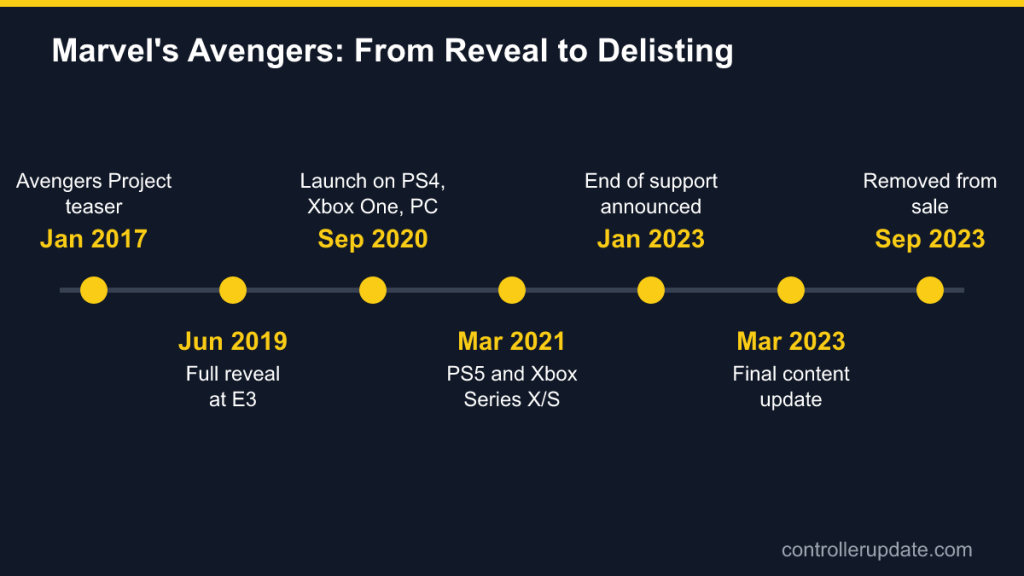
- March 31, 2023: the final content update. Most premium cosmetic items from the marketplace, challenge cards and other sources were made available free to all players, and the marketplace stopped selling items.
- September 30, 2023: the game was removed from sale on digital storefronts.
Crystal Dynamics said that the single-player and multiplayer modes would remain playable for people who already owned the game after support ended, while warning that it could not guarantee that this would remain the case forever or that future issues would be fixed. Players could still access the game through their existing digital libraries, and physical copies continued to work.
Licensed games often disappear from sale when the agreement allowing them to be sold ends or the publisher stops supporting them, and Marvel’s Avengers is now one of the clearest modern examples of a licensed game leaving digital storefronts within a few years of release.
What the Game Left Behind
Marvel’s Avengers is often discussed as a cautionary tale about live-service ambitions applied to a story-driven licence. The campaign showed that Crystal Dynamics could write likeable, distinct versions of familiar heroes, and Kamala Khan in particular won over many players who had never read her comics. The live-service structure, by contrast, struggled to deliver enough varied content quickly enough to keep players engaged.
The contrast with another Square Enix Marvel game is striking. A year later, Eidos-Montréal released Marvel’s Guardians of the Galaxy as a purely single-player story game with no microtransactions. Our explainer on Marvel’s Guardians of the Galaxy covers how differently it approached a Marvel team. Many critics noted that the Guardians game delivered exactly what fans had hoped Avengers would be, even though it too underperformed commercially.
Common questions
- Can you still play Marvel’s Avengers? Owners who bought it before the delisting can still download and play it, subject to the developer’s warning that this is not guaranteed indefinitely.
- Is the campaign complete? Yes. The Reassemble campaign has a full story with an ending, and the post-launch operations add further chapters.
- Is it connected to the Marvel films? No. It is an original continuity with its own designs and cast, inspired by the comics as much as the films.
The Bigger Lesson
The game’s arc mirrors a broader shift in big-budget licensed games. Around 2017, publishers saw live-service models as the way to justify the cost of major licences. By 2023, several high-profile attempts had struggled, and the industry’s enthusiasm for applying that model to story-driven superhero games had cooled considerably. Marvel’s Avengers did not fail because players disliked the Avengers; it struggled because its structure asked a story-focused audience to commit to a long-term loot game. Its campaign remains a reminder of what worked.