Suicide Squad: Kill the Justice League Explained
Rocksteady's 2024 game explained: the premise, the four playable villains, its Arkhamverse setting, the four post-launch seasons and the end of new content.

For more than a decade, Rocksteady Studios was synonymous with one thing: Batman. Its Arkham trilogy set the standard for superhero games, so when the studio’s next project was revealed in 2020, expectations were enormous. Suicide Squad: Kill the Justice League turned out to be something very different from what many fans had imagined: a four-player, live-service open-world shooter in which a team of villains is sent to assassinate the world’s greatest heroes.
This explainer covers what the game is, its premise and characters, how it connects to the Arkham games, the seasons released after launch and how support came to an end. It sticks to documented facts and announcements.
What the Game Is
Suicide Squad: Kill the Justice League was developed by Rocksteady Studios and published by Warner Bros. Games. It launched on February 2, 2024 for PlayStation 5, Xbox Series X/S and Windows, with owners of the Deluxe Edition able to start a few days earlier.
It is a third-person action shooter set in an open-world Metropolis. The player controls one of four members of Task Force X, better known as the Suicide Squad, and can switch between them in solo play or team up online with up to three other players. Traversal is a big part of the experience: each character has a distinctive way of moving around the city, and combat mixes gunfire with movement-based attacks.
Crucially, the game was designed as a live-service title. It required a constant internet connection at launch, featured gear-based progression and a battle pass, and was planned to receive new playable characters and story content through seasonal updates.
The Premise: Villains Versus the Justice League
The story begins with an alien invasion. Brainiac has come to Earth and taken over Metropolis, and he has brainwashed most of the Justice League to serve him. Superman, Batman, the Flash and Green Lantern (John Stewart) are all under his control, turning the planet’s protectors into its greatest threat.
With few options left, Amanda Waller, the ruthless head of Task Force X, sends in her expendable team of supervillains. Each has a bomb implanted in their head, which Waller can detonate if they disobey or try to escape. Their mission is simple and outrageous: kill the Justice League.
The story tracks the squad as they hunt the corrupted heroes one by one through Metropolis, fighting Brainiac’s forces along the way. Wonder Woman, who has not been brainwashed, appears as an ally for part of the story. The tone is darkly comedic, with the squad’s bickering and banter providing much of the personality, alongside some genuinely grim moments for long-time fans of the heroes.
Why the premise is so unusual
Superhero games almost always ask players to protect a city. Kill the Justice League flips that expectation twice over: the player characters are criminals, and the bosses are the heroes. Each Justice League member is built as a major encounter themed around their powers, so the Flash’s speed, Green Lantern’s constructs and Superman’s sheer strength each create a different kind of fight. That structure is also why the game drew such strong reactions from fans of the characters. Seeing the Squad bring down heroes they had played as for years was the hook of the marketing, and for some players it was exactly the reason they stayed away.
The setting adds to the contrast. Metropolis is presented as a city already lost, with Brainiac’s ships and invasion forces spread across its districts, rather than the bright, optimistic home Superman is usually defending.
The Four Playable Characters
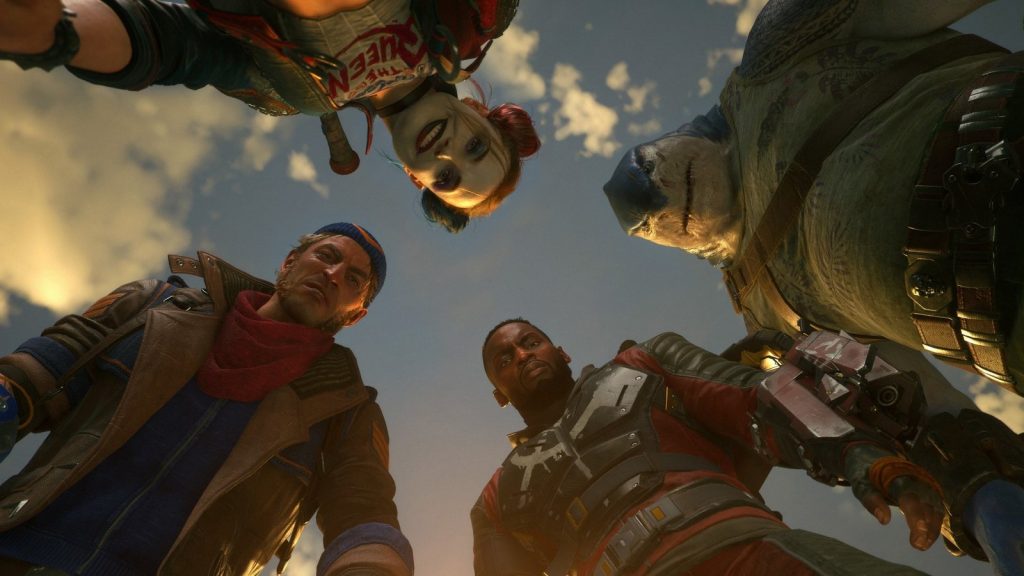
The game’s four playable characters are drawn from the Suicide Squad’s best-known line-up:

| Character | Who they are | How they move |
|---|---|---|
| Harley Quinn | The former psychiatrist turned chaotic criminal, a fixture of the Arkham games | Grappling hook and a drone she swings from |
| Deadshot | An elite assassin who never misses | A jetpack for hovering and boosting |
| King Shark | A hulking shark-man with enormous strength | Huge leaps and ground-pound landings |
| Captain Boomerang | An Australian thief with a boomerang-based arsenal | Teleport-dashing using a Speed Force gauntlet |
Each character has their own set of weapons, abilities and personality, and the team’s banter is one of the most praised parts of the game. The cast of villains also brings back familiar faces from the Arkham series, giving fans continuity with Rocksteady’s earlier work.
The Arkhamverse Connection
Kill the Justice League is set in the Arkhamverse, the shared continuity of Rocksteady’s Arkham games, taking place five years after Batman: Arkham Knight. That placement means characters such as Harley Quinn carry history from the earlier games, and Batman’s role here is directly connected to the version players knew from the trilogy.
This connection was one of the most debated aspects of the game. Fans who had followed the Arkham story for years were confronted with a sequel in which Batman and other heroes are antagonists to be killed. Some appreciated the bold choice; others felt it was a disappointing way to close the book on characters they had invested in. This article stays focused on Kill the Justice League itself rather than the Arkham games, which have their own extensive history.
Kevin Conroy’s final performance
The game includes Kevin Conroy’s final performance as Batman. Conroy, who voiced the character for three decades across animation and games including the Arkham series, died in November 2022. His work in Kill the Justice League was released posthumously, and the game includes a tribute to him.
Delays and Launch
The game had a long road to release:
- August 2020: announced at DC FanDome with a planned 2022 release.
- March 2022: delayed to early 2023.
- December 2022: dated for May 26, 2023 at The Game Awards.
- February 2023: Rocksteady confirmed that the game would require a constant internet connection, drawing criticism.
- April 2023: delayed again, to February 2, 2024.
- December 2023: Rocksteady said an offline mode would be added after launch.
- February 2, 2024: full launch.
The game launched to mixed reviews, with Metacritic scores in the low 60s. Critics often praised the writing, character animation, performances and traversal, while criticising repetitive mission design, the loot-focused structure and the live-service elements. Many reviewers felt the story’s strengths were undercut by gameplay that asked players to repeat similar objectives across the city.
The Post-Launch Seasons
Rocksteady released four seasons of post-launch content in 2024, each adding a new playable character and a new alternate-reality setting, sometimes called an elseworld, that the squad visits:
| Season | Release | New character | Setting |
|---|---|---|---|
| Season 1 | March 28, 2024 | The Joker | Joker Earth |
| Season 2 | July 25, 2024 | Mrs. Freeze | Frozen Earth |
| Season 3 | October 1, 2024 | Lawless | Fear World |
| Season 4 | December 10, 2024 | Deathstroke | Medieval Earth |
The Joker added in Season 1 is not the Arkham trilogy’s Joker but an alternate-universe version. Mrs. Freeze is likewise an alternate-universe take on the Mr. Freeze story, and Lawless is a newer DC character from the comics. Season 2 was briefly delayed from its originally announced date.
Season 4 also delivered the long-promised offline mode, allowing the game to be played without an internet connection, which addressed one of the earliest complaints.
Commercial Results and the End of New Content
The game did not meet expectations commercially. Warner Bros. Discovery said publicly that the game had fallen short, and the company’s results were reported to include an impairment of roughly $200 million connected to it. Rocksteady later went through layoffs.
In June 2024, Warner Bros. said the four-season roadmap would be completed. In December 2024, reports confirmed that Season 4 would be the final major content drop, with Rocksteady’s active support ending in January 2025. The game remains available to play, including offline, but no new seasons or characters are planned.
The arc echoes the fate of other licensed live-service games. Our history of Marvel’s Avengers describes a similar trajectory: a big superhero licence, a well-received story campaign, a structure that struggled to retain players, and support that ended within a few years. Kill the Justice League’s run was shorter still, ending less than a year after launch.
Where It Sits in DC Gaming History
Kill the Justice League is the most expensive attempt so far to build a game around the Justice League, even if it casts them as targets. For context on DC’s wider game history beyond Batman, including earlier Justice League games and cancelled projects, see our guide to DC video games beyond Batman. Superman’s role as the game’s most powerful enemy is also an interesting footnote to the long struggle to make him work as a playable hero, covered in our history of Superman video games.
Common questions
- Do you need to have played the Arkham games? No. The story is understandable on its own, though the Arkham trilogy adds context for Harley Quinn and Batman.
- Can you play solo? Yes. You can play alone, switching between the four characters, and Season 4 added a full offline mode.
- Is the story complete? The main campaign has a conclusion, and the four seasons add further chapters, but no more story content is planned after Season 4.
- Is it connected to the Suicide Squad films? No. It is part of the Arkhamverse continuity, not the films.
Why It Matters
Suicide Squad: Kill the Justice League will likely be remembered as a turning point. It showed both the potential and the risk of applying the live-service model to a beloved single-player studio and a story-heavy licence. Its writing, performances and traversal earned real praise, yet its structure failed to hold an audience long enough to justify its scale. For Rocksteady, Warner Bros. Games and the industry at large, it became one of the clearest lessons of the 2020s about matching a licence to the right kind of game.