Marvel: Ultimate Alliance and X-Men Legends Series History
From Raven's X-Men Legends to Team Ninja's Ultimate Alliance 3: the rosters, stories, Doctor Doom, Civil War and Infinity Stones, plus delistings and re-releases.
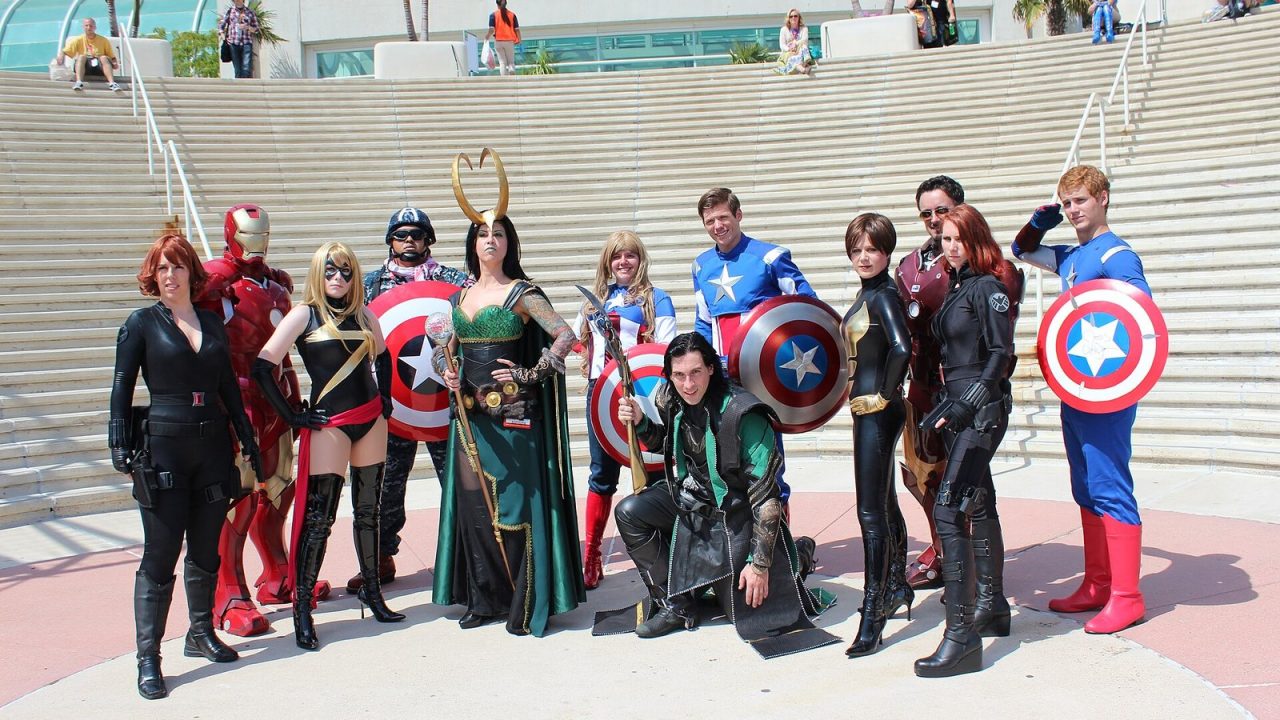
Before Marvel’s films made team-ups a box office habit, a run of Activision games let players put together their own Avengers, X-Men and Defenders in a single party. The X-Men Legends games and the Marvel: Ultimate Alliance series that grew out of them are some of the most loved Marvel games ever made, partly because of their sheer number of characters and partly because they are surprisingly hard to buy today.
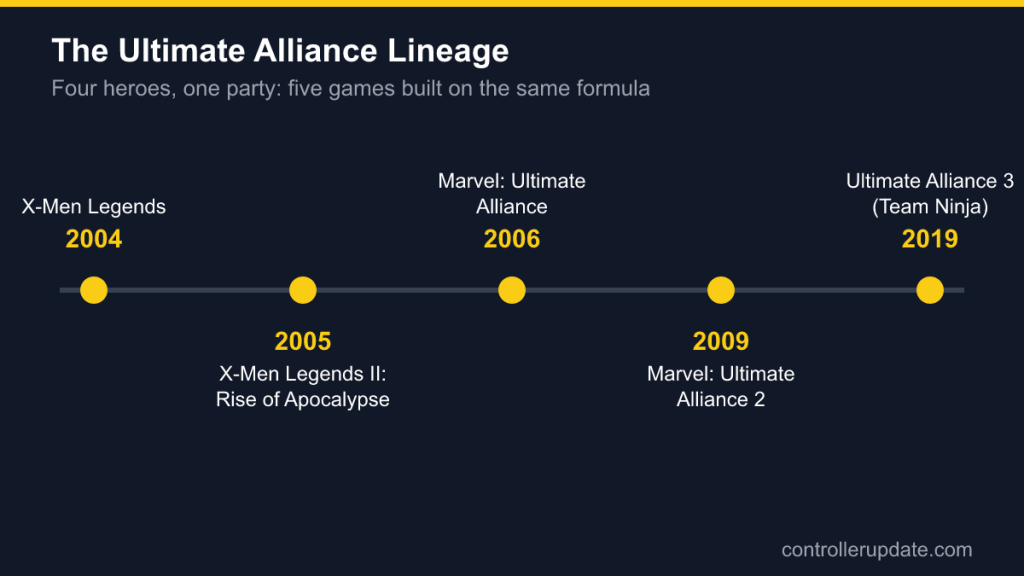
This history covers the five main games, from Raven Software’s first X-Men Legends in 2004 through Team Ninja’s Marvel Ultimate Alliance 3 in 2019, with a look at their stories, rosters and the licensing problems that pulled several of them from sale.
The Formula: Four Heroes, One Party
All five games share a basic structure. You control a team of four characters from an isometric, top-down camera, switching between them at any moment while the others are handled by the computer or by other players. Each hero has their own powers, and the fun comes from combining them: freezing enemies with one hero and shattering them with another, or pairing up characters with comic history together. The games are often described as action role-playing games because heroes gain levels and unlock powers, but their appeal is mostly about the joy of seeing so many Marvel characters together.
Raven Software, a veteran Activision studio, developed the first three games in the lineage. The series also sits within the broader story of Activision’s long run with the Marvel licence, which our history of Marvel video games covers in context.
X-Men Legends (2004)
X-Men Legends arrived in 2004 for PlayStation 2, Xbox and GameCube, with an N-Gage version following in 2005. It was developed by Raven and published by Activision.
The story is told through a new recruit, Alison Crestmere, a teenage mutant with the power to control volcanic activity who takes the codename Magma. She arrives at the X-Mansion, giving players a newcomer’s view of the team and the Danger Room. The main threat is Magneto, whose plan, launched from his base on Asteroid M, would plunge the Earth into darkness. Along the way the X-Men deal with the Brotherhood of Mutants and other classic foes.
The game had fifteen playable X-Men and a striking cel-shaded art style that echoed the comics. Reviews were generally positive, particularly for the Xbox version, with praise for the combat and art and criticism for the computer-controlled allies.
X-Men Legends II: Rise of Apocalypse (2005)
The sequel, X-Men Legends II: Rise of Apocalypse, followed in 2005. Its big hook was an unlikely alliance: the X-Men team up with Magneto’s Brotherhood to stop Apocalypse, the ancient mutant who has risen to power. That premise opened the roster to villains like Magneto and Sabretooth, giving players a mixed team for the first time.
Rise of Apocalypse refined the formula with a bigger roster and more varied locations. It remains a favourite among X-Men fans, though like its predecessor it has not been re-released on modern platforms. For a wider look at mutant games, see our history of X-Men video games.
Marvel: Ultimate Alliance (2006)
Raven then took the formula to the entire Marvel universe. Marvel: Ultimate Alliance launched on October 24, 2006 for PlayStation 2, Xbox and Xbox 360, with versions for PlayStation 3 and Wii following in November 2006 as part of those consoles’ launch windows. PSP, Windows and Game Boy Advance versions were also released, mostly handled by other studios.
The story: Doctor Doom and the Masters of Evil
The plot pits a newly assembled team of heroes against Doctor Doom and his Masters of Evil. Doom’s group launches attacks across the globe while Doom pursues a much bigger goal. In the later stages, it emerges that Doom has stolen the power of Odin, and Uatu the Watcher warns that unrestrained use of that power will destroy the universe. The heroes travel through a wide range of famous Marvel locations, from the S.H.I.E.L.D. Helicarrier to Asgard, Atlantis and Mephisto’s realm, before the final confrontation.
The roster
Marvel: Ultimate Alliance offered more than twenty playable characters in its base game, including Captain America, Iron Man, Thor, Spider-Man, Wolverine, Elektra, Deadpool, Blade and many more, with additional characters added on some versions and through downloadable content. The game rewarded players for building teams with comic history together: forming the classic Fantastic Four, for example, earned a team bonus. Alternate costumes based on different comic eras let fans choose their favourite version of each hero.
Critics were generally positive, praising the gameplay and the depth of the character list. For many players, this was the first time they could put Ghost Rider, Captain America and Ms. Marvel in the same party.
Marvel: Ultimate Alliance 2 (2009)
The second Ultimate Alliance game moved development away from Raven. Vicarious Visions developed the PlayStation 3 and Xbox 360 versions, n-Space developed the PlayStation 2, Wii and Nintendo DS versions, and Savage Entertainment handled the PSP port. It launched in North America on September 15, 2009.
The story: Civil War
Ultimate Alliance 2 adapted Marvel’s big comic events of the time. It opens with a covert strike on Latveria, drawing on the Secret War storyline, then moves into Civil War. After a disaster in the town of Stamford, the US government passes the Superhuman Registration Act, requiring heroes to reveal their identities and work under government oversight.
The game’s defining feature is that the player picks a side. The pro-registration side is led by Iron Man and Mister Fantastic, and the anti-registration side by Captain America and Luke Cage. That choice changes the missions you play and the ending. The final chapters bring in a new threat, a nanite-driven menace called the Fold, which forces the divided heroes to deal with the consequences of their conflict.
Fusion powers
Ultimate Alliance 2 introduced fusions, team attacks that combined two heroes’ powers into a new move. Every playable character had a fusion with every other playable character, which made experimenting with team combinations rewarding. A classic example is Captain America bouncing Storm’s lightning off his shield.
Team Ninja’s Ultimate Alliance 3 (2019)
A decade passed before the series returned, and when it did, the publisher had changed. Marvel Ultimate Alliance 3: The Black Order was developed by Koei Tecmo’s Team Ninja and published by Nintendo as a Nintendo Switch exclusive, released on July 19, 2019. It was the first game in the series made without Activision.
The story is a fresh start with no connection to the earlier games’ continuity. Thanos and his lieutenants, the Black Order, are hunting the six Infinity Stones, and the Guardians of the Galaxy are drawn in at the start before Earth’s heroes join the effort. The plot clearly drew on the popularity of the Infinity Stones storyline in the Marvel films of the time, while keeping its own comic-inspired designs.
The base game offered 36 playable characters. A paid Expansion Pass added more in three themed packs: Curse of the Vampire (Marvel Knights, September 2019), Rise of the Phoenix (X-Men, December 2019) and Shadow of Doom (Fantastic Four, March 2020), the last of which added a post-game story. Free updates added further characters, including Cyclops and Colossus.
Reviews were mixed to positive, with a Metacritic score of 73. Critics enjoyed the roster and the spectacle but felt the series had not evolved much since the 2000s. It sold around 1.6 million copies by the end of 2022.
Delistings and Re-Releases
The series is a well-known example of licensed games disappearing from digital stores. The history is a little tangled:
| Game | Original release | Later availability |
|---|---|---|
| X-Men Legends | 2004 | Not re-released on modern platforms |
| X-Men Legends II | 2005 | Not re-released on modern platforms |
| Marvel: Ultimate Alliance | 2006 | Re-released 2016 (PC, PS4, Xbox One); removed from digital stores July 2018 |
| Marvel: Ultimate Alliance 2 | 2009 | Re-released July 2016 (PC, PS4, Xbox One); removed from digital stores July 2018 |
| Marvel Ultimate Alliance 3 | 2019 | Nintendo Switch exclusive |
The 2016 re-releases, ported by Zoë Mode and published by Activision, brought the first two Ultimate Alliance games to PlayStation 4, Xbox One and PC. They were an unexpected return, since Activision’s broader Marvel deal had long since ended, and they lasted only about two years. In July 2018, both were pulled from digital storefronts because of licensing issues. Earlier, some downloadable content for Ultimate Alliance 2 had also come and gone from online stores, and its multiplayer servers were later shut down.
The result is that, as of 2026, the easiest way to play the classic games is through original physical copies and hardware or through backward compatibility where a console supports the original disc. The same pattern of licensed games vanishing from sale shows up repeatedly across Marvel and other franchises, as the story of Marvel’s Avengers also shows.
Why the Series Still Matters
The X-Men Legends and Ultimate Alliance games did something that few Marvel games before them had: they treated the Marvel universe as a single, shared playground. Players could build dream teams, mix heroes from different corners of the comics and see them interact through banter, bonuses and fusions. That idea is now commonplace thanks to the films, but in 2004 and 2006 it was a real novelty in games.
They also capture a particular moment in licensed game history. Activision’s Marvel era produced dozens of games, and many have since vanished from sale. The Ultimate Alliance series is one of the clearest reminders that a well-loved licensed game can become hard to buy for reasons unrelated to its quality.
Common questions
- Do the stories connect? X-Men Legends I and II share a continuity, and Ultimate Alliance 1 and 2 form a loose sequence. Ultimate Alliance 3 is a reboot with its own story.
- Are the games connected to the films? No. They draw on the comics, though Ultimate Alliance 3’s Infinity Stones plot clearly reflects the film era.
- Where should a newcomer start? Ultimate Alliance 3 is the only one still sold digitally. Fans of the classic games usually recommend the original Ultimate Alliance as the best-rounded entry.