Warhammer 40,000 Video Games: A Guide to Where to Start
A map of Warhammer 40,000 games by genre, a short primer on the setting, and the best starting point for each kind of player.
Warhammer 40,000 has more video games than almost any other tabletop franchise. Games Workshop’s grim far-future setting has been adapted into third-person action games, real-time strategy, first-person shooters, turn-based tactics, role-playing games, space battles and more. For someone curious about the universe, the sheer number of options can be bewildering, and quality across the catalogue varies widely.
This guide offers a map. It begins with a short primer on the setting so that the names make sense, then walks through the main genres with the standout games in each, and ends with recommendations based on what kind of player you are. It deliberately stays at overview level: no build advice, faction tier lists or strategy tips, just where each game fits and why you might start there. Dates and statuses are current as of October 2026.
A Two-Minute Primer on the Setting
Warhammer 40,000 began in 1987 as a tabletop miniatures wargame by the British company Games Workshop. It is set in the 41st millennium (with recent material moving the timeline into the 42nd), in a galaxy where humanity is ruled by the Imperium of Man, a vast, decaying, theocratic empire devoted to the God-Emperor, who sits motionless on the Golden Throne on Terra.
The Imperium is besieged on all sides. The forces of Chaos, gods of a parallel dimension called the Warp, corrupt humans and lead traitor legions against the Imperium. Alien species include the brutal, cheerful Orks, the ancient and proud Aeldari, the robotic Necrons awakening from millions of years of sleep, the expansionist T’au and the all-consuming swarms of the Tyranids.
The Imperium’s most famous soldiers are the Space Marines, genetically enhanced super-warriors in power armour, but it also fields the vast human armies of the Astra Militarum, the tech-priests of the Adeptus Mechanicus, the Inquisition and many other organisations. The tagline sums up the tone: “In the grim darkness of the far future, there is only war.” The setting is bleak, operatic and often darkly comic, and most games lean into that atmosphere.
Action Games: The Space Marine Series
If you want to feel like a Space Marine, the Space Marine games are the obvious place to start.
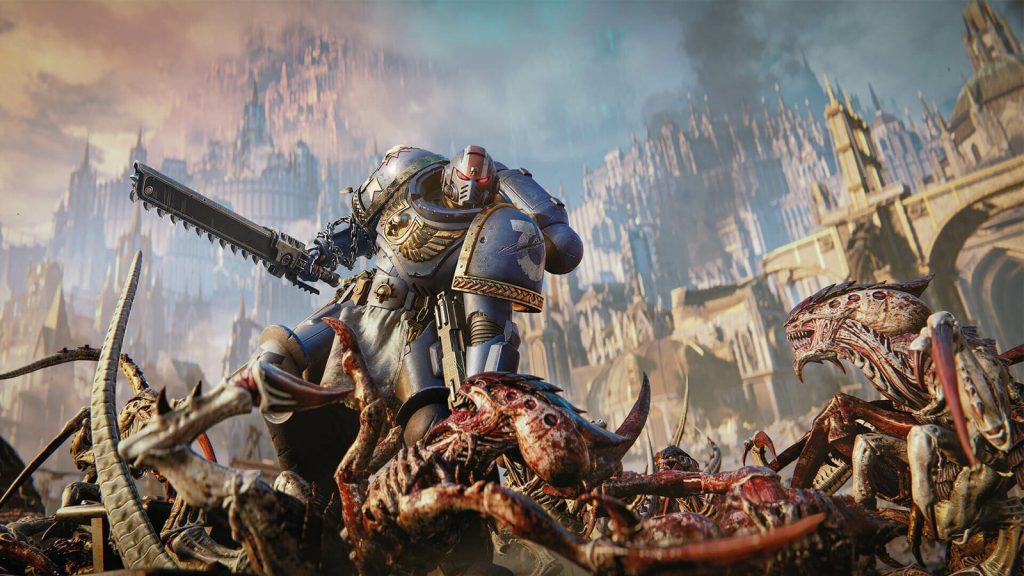
- Warhammer 40,000: Space Marine (2011) – Developed by Relic Entertainment and published by THQ, it follows Captain Titus of the Ultramarines defending a Forge World from an Ork invasion, and later from Chaos. It mixes third-person shooting and close-quarters melee, and it is notable for its “health from aggression” design: executing enemies restores health, which pushes players forward rather than behind cover.
- Warhammer 40,000: Space Marine 2 (2024) – Developed by Saber Interactive and published by Focus Entertainment, released on September 9, 2024. Titus returns, a century later, to face the Tyranids and Chaos. Its huge swarms of enemies and spectacular scale made it one of the best-selling Warhammer games ever, and for many people it was their first Warhammer experience.
Space Marine 2’s campaign can be played solo, with AI-controlled squadmates Brother Chairon and Sergeant Gadriel, or with up to two friends taking their places, and there are separate online modes. Newcomers can start with the sequel without having played the original, as the story introduces Titus clearly. The gap between the games is part of the plot: after the first game, Titus spent around a century under suspicion and in the custody of the Inquisition before being restored to the Ultramarines as a Primaris Space Marine, a newer and larger type of warrior introduced into the lore in recent years.
The two games also show how the setting’s timeline has moved. The first is set in the classic 41st millennium; the sequel takes place in the early 42nd millennium, during a new Tyranid war, reflecting changes Games Workshop made to the tabletop story.
Real-Time Strategy: Dawn of War
For many long-time fans, Warhammer 40,000 gaming means Dawn of War. Relic Entertainment’s series turned the tabletop’s armies into fast real-time battles with cinematic animations and memorable voice acting.
- Dawn of War (2004) and its expansions Winter Assault, Dark Crusade and Soulstorm – Base-building RTS centred on squads and territory control.
- Dawn of War II (2009) and its expansions – A shift toward smaller-scale squad tactics and role-playing elements, with a campaign following the Blood Ravens chapter.
- Dawn of War III (2017) – Published by Sega, it blended both earlier styles with hero units and received a mixed response.
- Dawn of War IV – Developed by KING Art Games and published by Deep Silver. Originally set for September 17, 2026, it was delayed in August 2026 to December 3, 2026 on PC.
If you enjoy strategy, the original Dawn of War with its expansions remains the classic entry point. Other strategy options include Warhammer 40,000: Gladius – Relics of War (2018), a turn-based 4X game, and Battlefleet Gothic: Armada (2016), which focuses on huge, slow-moving space battleships.
Turn-Based Tactics: Mechanicus and Chaos Gate
Turn-based tactics games are among the most consistently praised Warhammer adaptations.
- Warhammer 40,000: Mechanicus (2018) – Developed by Bulwark Studios, it casts you as a tech-priest commanding the Adeptus Mechanicus as they explore Necron tombs. Its strange, devout tone and its soundtrack are often singled out.
- Warhammer 40,000: Mechanicus II (2026) – Bulwark’s sequel, published by Kasedo Games, launched on May 21, 2026 for PC, PlayStation 5 and Xbox Series X|S, with campaigns for both the Adeptus Mechanicus and the Necrons.
- Warhammer 40,000: Chaos Gate – Daemonhunters (2022) – Complex Games’ tactics game follows the Grey Knights, an elite chapter devoted to fighting daemons, against a plague spreading through the galaxy.
These games suit players who like planning a battle one move at a time and who enjoy the setting’s lore and atmosphere.
First-Person Shooters: Boltgun and Darktide
Boltgun
Warhammer 40,000: Boltgun (2023), developed by Auroch Digital and published by Focus Entertainment, is a fast, retro-styled shooter inspired by 1990s classics. You play a Space Marine blasting through hordes of Chaos forces with chunky pixel-style visuals. It is short, loud and accessible, and it is an easy, low-commitment way into the setting.
Darktide
Warhammer 40,000: Darktide, by Fatshark (the studio behind the Vermintide games), is a four-player first-person action game set in the hive city of Tertium on the planet Atoma Prime. You play as prisoners turned agents of the Inquisition, battling a Chaos plague cult. It launched on PC on November 30, 2022, reached Xbox Series X|S on October 4, 2023 and PlayStation 5 on December 3, 2024. Its greatest strength is atmosphere: it shows ordinary human life in the Imperium better than most games.
Role-Playing: Rogue Trader
Warhammer 40,000: Rogue Trader (2023), developed by Owlcat Games, was billed as the first classic-style computer role-playing game set in the 40K universe. You play a Rogue Trader, one of the Imperium’s licensed merchant-explorers, inheriting a dynasty and a void ship in the Koronus Expanse. The game features turn-based combat, a large cast of companions and branching choices that let you lean toward pious devotion, pragmatic heresy or ruthless dogma. Released on December 7, 2023 for PC, PlayStation 5 and Xbox Series X|S, it is the best way to experience the political and social side of the Imperium in depth.
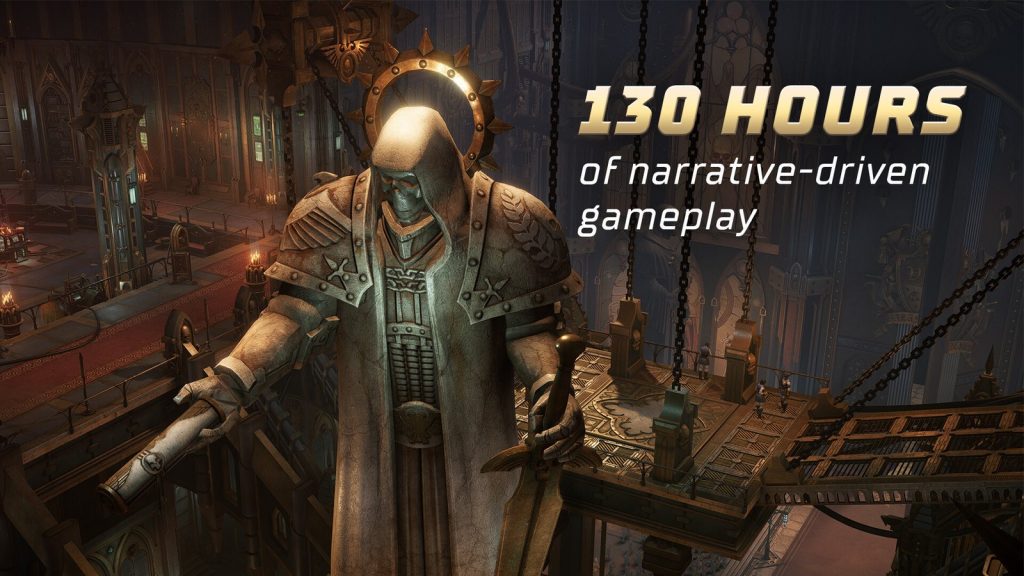
It is a long, demanding game, so it is better as a second or third Warhammer game than as a first, unless you already love role-playing games.
Where to Start: Recommendations by Taste
| If you like… | Start with | Why |
|---|---|---|
| Big-budget action | Space Marine 2 (2024) | Modern, spectacular, easy to pick up |
| Classic RTS | Dawn of War (2004) and expansions | The series that defined 40K gaming for many fans |
| Turn-based tactics | Mechanicus (2018) | Compact, distinctive and widely praised |
| Retro shooters | Boltgun (2023) | Short, intense and low-commitment |
| Story and choices | Rogue Trader (2023) | Deepest look at the setting’s politics |
| Atmosphere with friends | Darktide (2022) | Ordinary humans in a decaying hive city |
The default recommendation
If you are unsure, start with Space Marine 2. It introduces Space Marines, Tyranids and Chaos in a single cinematic campaign, explains the basics of the setting without lore homework, and is available on current consoles and PC. If you discover you love the lore, branch out to Rogue Trader or Mechanicus; if you love the battles, try Dawn of War.
Why There Are So Many Games, and Why Quality Varies
Games Workshop licenses Warhammer widely, working with studios of very different sizes rather than giving one publisher exclusive control. That approach produces an unusually broad catalogue, from big-budget games to small experimental projects, but also means quality is uneven. Many smaller titles are perfectly fine but forgettable. Sticking to the games named in this guide is a reliable way to avoid disappointment. For the general mechanics of how licences like this are structured, see our explainer on how video game licensing works.
Common mistakes for newcomers
- Assuming every game shares one story. Most games tell standalone stories with their own characters. Only a few, such as the Space Marine pair, are direct sequels.
- Starting with the most complex game. Rogue Trader and the Dawn of War II campaign assume patience with dense systems.
- Confusing 40K with Warhammer Fantasy. Games like Total War: Warhammer and Vermintide are set in a different, fantasy universe, not the far future.
- Worrying about lore. No game requires prior reading. The setting is explained as you play.
Frequently Asked Questions
Do I need to know the tabletop game?
No. The video games are designed to stand on their own, though tabletop players will recognise units and factions.
Which Warhammer 40,000 games are on consoles?
Space Marine 2, Darktide, Rogue Trader, Boltgun and Mechanicus II are among the major titles available on current consoles. Dawn of War has always been PC-focused.
Is the setting suitable for younger players?
Warhammer 40,000 is violent and dark in tone, and most of its games carry mature or teen ratings. Check the local rating for each game.