Star Wars Canon vs Legends: What It Means for the Games
Why Lucasfilm split Star Wars into canon and Legends in 2014, which games fall on each side, and how ideas from older games found their way back.

If you read about Star Wars games for long, you will run into two words: canon and Legends. A game like Knights of the Old Republic is “Legends.” A game like Star Wars Jedi: Fallen Order is “canon.” The labels can sound like a verdict on quality, but they are really about continuity: which stories the official Star Wars timeline treats as having happened.
This article explains where the split came from, how to tell which side a game belongs to, which major games sit on each side, and how characters and ideas from older games have crossed back into the official story. It also covers a few grey areas that often cause confusion.
What Happened in April 2014
Before 2014, Star Wars had a huge body of stories outside the films, known as the Expanded Universe. Novels, comics, role-playing books and video games had built decades of history before, between and after the movies. Lucasfilm loosely tracked how these stories fitted together, but George Lucas had always treated his films as the definitive version, and the Expanded Universe was never binding on them.
When Disney acquired Lucasfilm in 2012 and began planning a new film trilogy set after Return of the Jedi, it faced a problem: the Expanded Universe had already told stories about that period, including the fates of Luke, Leia and Han. Planning new films around all of that material would have constrained them enormously.
On April 25, 2014, Lucasfilm announced its solution on StarWars.com. The existing Expanded Universe would be rebranded as Star Wars Legends and kept in print under that banner. From then on, the six films released at that point and the animated series The Clone Wars would be the fixed reference points that all new stories must match. Lucasfilm also formed a story group to oversee and coordinate creative development across films, television, books, comics and games, so that new stories would form a single, connected continuity.
The announcement also stressed that creators of new Star Wars stories would have full access to the Expanded Universe as source material. In other words, Legends was no longer binding, but it could still be mined for ideas.
How Continuity Worked Before the Split
It is easy to forget that the old Expanded Universe already had its own rules. Lucasfilm kept an internal continuity database, known as the Holocron, maintained by Leland Chee, and it sorted material into tiers. The films and George Lucas’s own statements sat at the top; the Expanded Universe sat beneath them and was treated as official unless the films contradicted it. Further tiers covered material such as the online Star Wars Galaxies game and stories considered non-canonical altogether.
In practice, that meant game stories could be overruled at any moment. The prequel films, for example, contradicted several details established in earlier books and games about the Clone Wars and the Jedi. Games tried to fit around the films, but nothing obliged the films to fit around the games.
Games had another complication: player choice. When a game such as KOTOR lets you end the story as a hero or a villain, the Expanded Universe had to declare one outcome official. Later books and games treated a light-side male Revan as the canonical version, for instance. This sort of decision is one reason modern canon games tend to feature fixed protagonists such as Cal Kestis and Kay Vess, with limited branching that affects the wider timeline.
How to Tell Whether a Game Is Canon
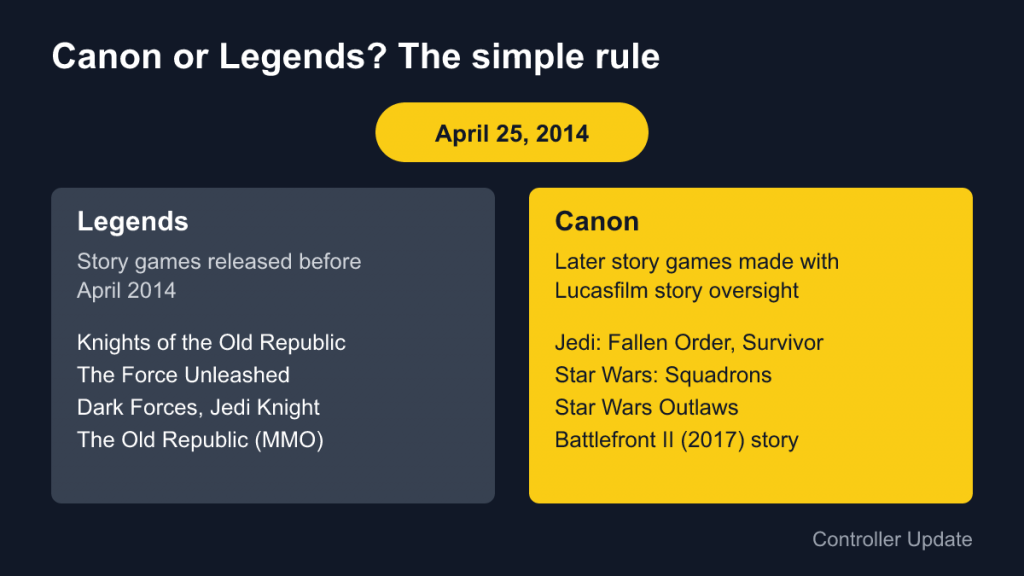
A simple rule covers most cases:
- Released before April 2014: Legends, regardless of quality or popularity. This includes every LucasArts-era story game.
- Story games released afterwards and developed with Lucasfilm’s story oversight: canon.
There are exceptions and nuances. Many post-2014 games do not tell a fixed story at all, so the canon question barely applies to them. The LEGO games retell the films with jokes and are not considered part of the continuity. Multiplayer modes that let characters from different eras fight each other are gameplay, not history. And for some new releases, Lucasfilm does not make a formal statement at all, so fans rely on official guides, StarWars.com coverage and the game’s integration with other media.
Online games that straddle the line
Star Wars: The Old Republic, launched in 2011, has continued to receive story content long after the split. It belongs to the Legends continuity, since it was built on the history established by the KOTOR games and is set in Legends’ version of the ancient past.
Major Canon Games
These story-driven games are part of today’s official continuity.
| Game | Year | Setting |
|---|---|---|
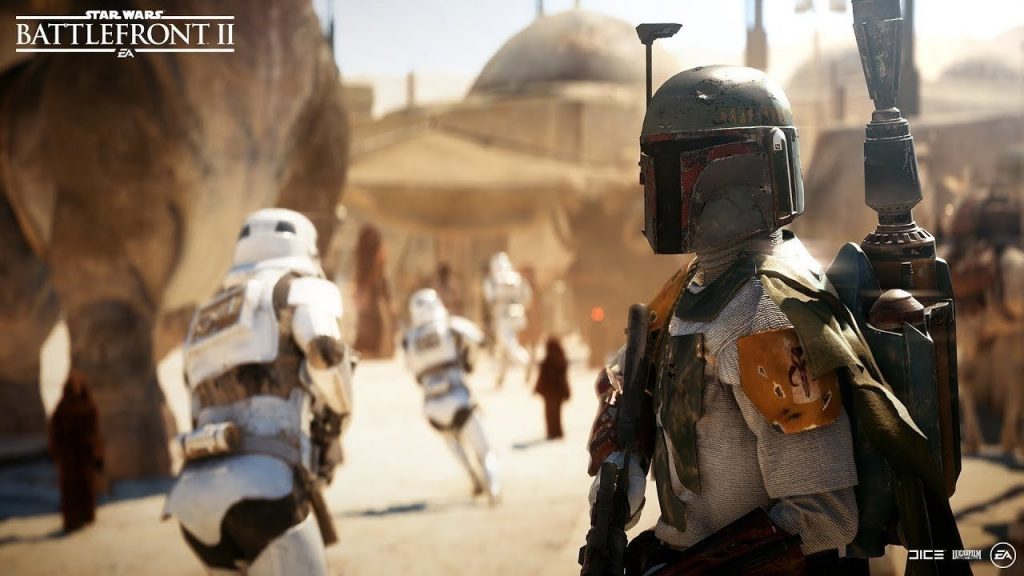
| Star Wars Battlefront II (campaign) | 2017 | From the Battle of Endor into the sequel era |
| Star Wars Jedi: Fallen Order | 2019 | Imperial era, five years after Order 66 |
| Vader Immortal (VR) | 2019 | Imperial era |
| Star Wars: Squadrons | 2020 | Mainly after the Battle of Endor |
| Tales from the Galaxy’s Edge (VR) | 2020 | Sequel era |
| Star Wars Jedi: Survivor | 2023 | Imperial era |
| Star Wars Outlaws | 2024 | Between Empire and Return of the Jedi |
What these games have in common is that their stories were built around the films and series rather than in parallel. Battlefront II‘s campaign, for example, shows the Empire’s collapse after Endor and connects to the sequel trilogy; its heroine Iden Versio also appears in the tie-in novel Battlefront II: Inferno Squad. In Squadrons, General Hera Syndulla of Star Wars Rebels plays a role in the New Republic’s command. For more on Respawn’s games, see our guide to Jedi: Fallen Order and Survivor.
How canon games connect to other media
Canon games often share characters with other media. Saw Gerrera, introduced in The Clone Wars and played by Forest Whitaker in Rogue One, appears in Fallen Order. The novel Star Wars Jedi: Battle Scars (2023) fills the gap between the two Jedi games. That cross-pollination is exactly what the story group was set up to manage.
Major Legends Games
Some of the most beloved Star Wars games ever made are Legends.
- Dark Forces (1995) and the Jedi Knight series (1997–2003) – Kyle Katarn’s journey from mercenary to Jedi Master.
- Knights of the Old Republic (2003) and KOTOR II (2004) – Revan, Malak and the Old Republic era.
- Republic Commando (2005) – Delta Squad’s missions in the Clone Wars.
- The Force Unleashed (2008) and The Force Unleashed II (2010) – Darth Vader’s secret apprentice, Starkiller, and a different account of the Rebel Alliance’s founding.
- Shadows of the Empire (1996), Rogue Squadron (1998) and Bounty Hunter (2002) – Stories set around the films that were part of the old Expanded Universe.
- Battlefront (2004) and Battlefront II (2005) – Pandemic’s games, whose campaign framing is Legends.
Many of these games remain easy to play. Several have been re-released by Aspyr and Nightdive Studios for modern consoles, including the Battlefront Classic Collection (2024) and a remaster of Dark Forces (2024). The Legends label has not hurt their availability.
How Game Ideas Re-Entered Canon
The 2014 announcement explicitly kept the door open for old ideas, and canon has walked through it many times. Some examples connected to games:
- Dark Troopers. The Empire’s robotic soldiers from Dark Forces returned in the second season of The Mandalorian (2020), reimagined as droids linked to Moff Gideon rather than to the game’s General Mohc.
- Delta Squad. The commandos of Republic Commando make a brief appearance in the third season of The Clone Wars, in the episode “Witches of the Mist,” so the squad exists in canon even though its game does not.
- Malachor. The ancient Sith world from KOTOR II became the setting of the second-season finale of Star Wars Rebels.
- The Inquisitors. Not a game invention, but a Legends concept from a 1990s role-playing sourcebook that became central to canon through Rebels and later to the Jedi games.
These crossings are usually reinterpretations rather than straight transplants. A Legends character’s name, design or concept can return in a new form while the events of the original game remain non-canon.
What has not crossed over
Some famous game characters have not been brought into canon as of October 2026, including Revan from KOTOR, Kyle Katarn and Starkiller. Fans regularly speculate about their return, and a KOTOR remake has been in development for years, but until a canon story actually features them, they remain Legends characters.
Why the Distinction Matters for Players
For most players, canon status matters less than whether a game is good. But the labels are useful in three situations.
- Planning a play order. If you want a consistent story, stick to one continuity. Our chronological guide marks each game’s status.
- Understanding contradictions. The Force Unleashed tells a version of the Rebellion’s founding that differs from canon sources such as Rebels and Andor. Knowing it is Legends explains the discrepancy.
- Following characters across media. Canon games link to novels, comics and series. If you enjoyed a canon game, related books or shows will continue the story.
Common Misunderstandings
“Legends means the games were cancelled or deleted”
No. Legends games, books and comics remain available, and many have been re-released.
“Everything released after 2014 is canon”
Not necessarily. Multiplayer battles, LEGO retellings and games without a fixed story are not part of the timeline in any meaningful sense.
“Canon games are better”
Quality has nothing to do with it. KOTOR and Jedi Outcast are frequently ranked among the best Star Wars games, and both are Legends. If you are new and choosing what to play, our list of the best Star Wars games for new players mixes both.