Star Wars Flight Games: From X-Wing to Squadrons
From Atari's 1983 vector arcade cabinet to Squadrons in 2020: how Star Wars starfighter games evolved and how each handled cockpit versus arcade flying.
The trench run at the end of A New Hope may be the single most influential sequence in the history of video games. It gave developers a target almost from the moment the film left cinemas: put the player in the cockpit, fill the screen with TIE fighters and let them take the shot. Over four decades, Star Wars flight games have split into two broad traditions. One treats the starfighter as a machine to be managed, with power routing, targeting computers and shield settings. The other treats it as a fast, cinematic ride through the films’ biggest battles.
This history walks through the major starfighter games in order, from Atari’s 1983 arcade cabinet through the PC simulators of the 1990s, Factor 5’s console trilogy and EA’s Star Wars: Squadrons, with a look at what made each distinct.
Where It Began: Atari’s 1983 Arcade Game
Atari’s Star Wars arcade game, designed by Mike Hally and released in 1983, is the ancestor of every game on this list. It is a first-person rail shooter built with colour vector graphics, the glowing line art that also powered games like Battlezone. You steer a crosshair with a yoke-style controller while your X-wing follows a fixed path.
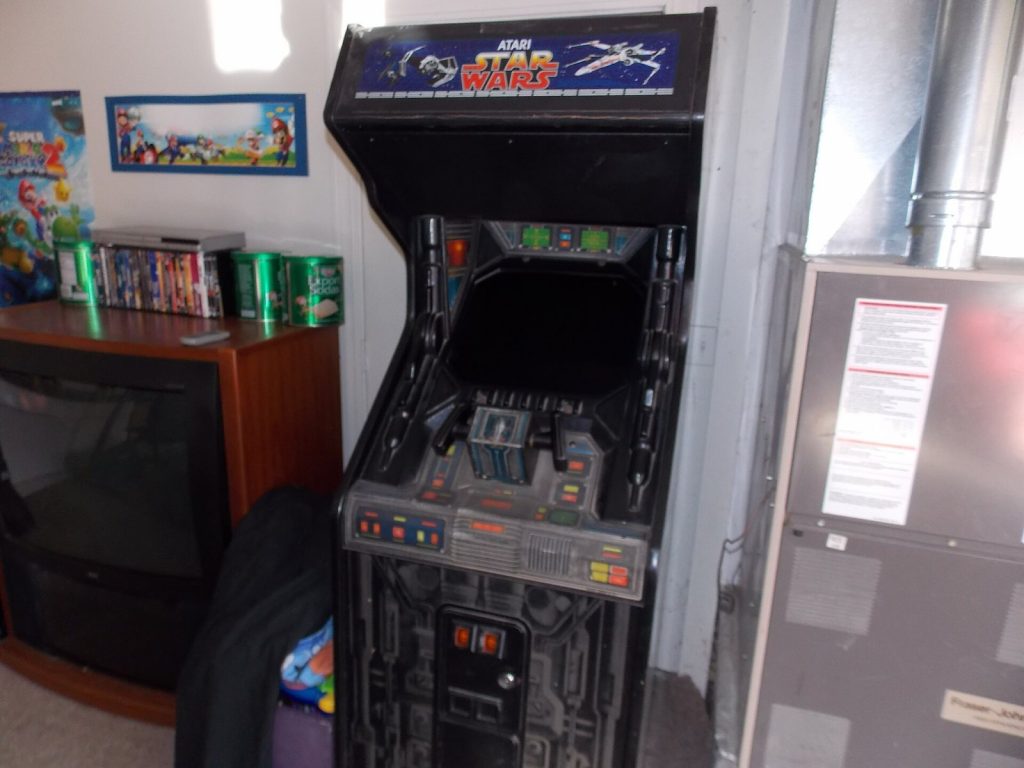
Each wave repeats three sequences from the film’s climax: a dogfight with TIE fighters in space, a low pass over the Death Star’s surface towers and the trench run itself, ending with a proton torpedo fired into the exhaust port. Synthesised speech echoed lines from the film’s cast, which was a striking touch for the time.
The game was a major hit, Atari’s best-selling arcade release of 1983, and home ports followed from Parker Brothers, Domark and Broderbund. A sequel, The Empire Strikes Back, appeared in arcades in 1985 as a conversion kit, adding a Hoth battle against AT-ATs. Decades later, the magazine Next Generation called the original “probably the best licensed game ever,” a remarkable compliment for a game built around a single scene.
The Simulator Era: X-Wing and TIE Fighter
In 1993, Lawrence Holland’s studio Totally Games, working for LucasArts, released Star Wars: X-Wing for MS-DOS. Holland had previously made World War II flight games for LucasArts, and X-Wing carried that sensibility into space. It was a true space combat simulator rather than a rail shooter.
The defining idea was energy management. Your fighter had a limited power supply that you could route between lasers, shields and engines. Pump everything into lasers and you could shred enemies but recharge shields slowly; push power to engines and you could outrun trouble but fight weakly. Add in target selection, wingman orders and mission objectives that went beyond “shoot everything,” and X-Wing felt like being an actual pilot in a war rather than a hero in a movie. Its campaigns followed the Rebel Alliance in the run-up to and through the Battle of Yavin, and it won a 1994 Origins Award.
TIE Fighter: flying for the Empire
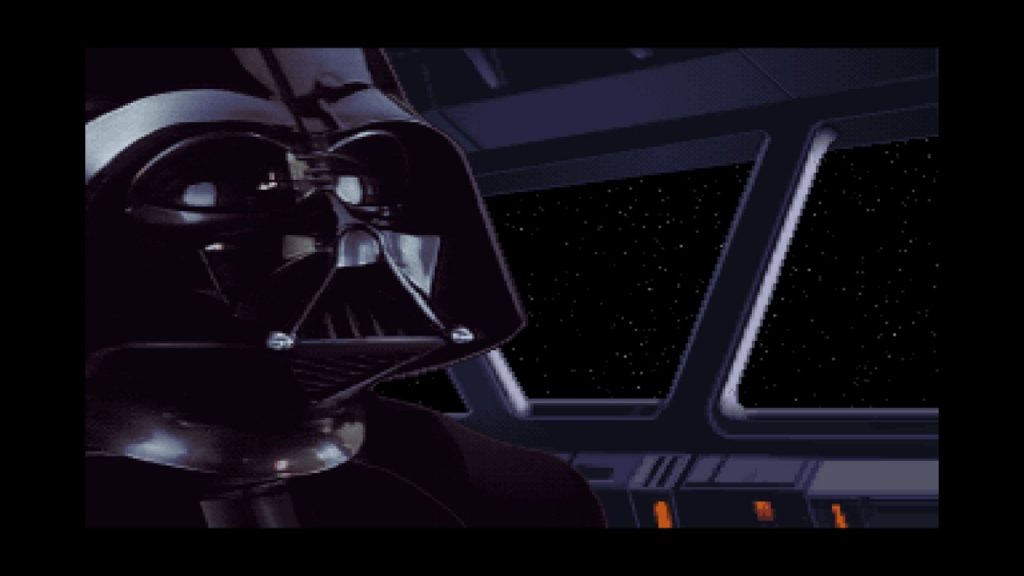
Star Wars: TIE Fighter, released on July 20, 1994, flipped the perspective. Designed by Holland and Edward Kilham, it puts you in the cockpit of an Imperial pilot in the period between The Empire Strikes Back and Return of the Jedi. Supplementary material named the pilot Maarek Stele, and much of the story places him under Grand Admiral Thrawn, with later expansions focused on rooting out an Imperial traitor.
TIE Fighter is often considered the best of the series and one of the best PC games ever made. PC Gamer ranked it first in a 1997 list of the 50 best games of all time. Part of its appeal was the story: it presents the Empire from the inside as an institution that sees itself as keeping order, and much of the campaign involves fighting pirates, rebels and rogue Imperial factions rather than simply hunting heroes. It also refined the mechanics, adding a more advanced targeting computer and more involved mission structures. A 1995 Collector’s CD-ROM edition added higher resolution graphics, voiced briefings and the game’s two expansions.
X-Wing vs. TIE Fighter and X-Wing Alliance
Two more Totally Games titles followed. X-Wing vs. TIE Fighter (1997) was built around online multiplayer, a forward-looking choice that left its single-player offering thinner until the Balance of Power expansion added story campaigns. X-Wing Alliance (1999) returned to narrative, casting the player as Ace Azzameen, a member of a family freight business who is drawn into the Rebellion. Its highlights included flyable multi-crew ships and a climax at the Battle of Endor aboard the Millennium Falcon.
After Alliance, the PC space simulator side of Star Wars largely went quiet for two decades. The classic games returned to sale digitally in October 2014 via GOG.com, which introduced the series to a new generation of PC players.
The Console Era: Factor 5’s Rogue Squadron Trilogy
While Totally Games was making simulators, German developer Factor 5 took a different direction. Star Wars: Rogue Squadron launched in December 1998 for Windows and Nintendo 64, co-developed with LucasArts. It was faster, more arcade-like and built for a controller.
Rather than energy management, Rogue Squadron focused on short, objective-based missions on planetary surfaces, flown largely in a third-person view behind the ship. Luke Skywalker forms the squadron with Wedge Antilles, and most of the story sits between A New Hope and The Empire Strikes Back. The Nintendo 64 version was one of the first games to use the console’s Expansion Pak to run at a higher resolution, and the game sold over a million copies.
Rogue Leader: the GameCube showpiece
Star Wars Rogue Squadron II: Rogue Leader launched on November 18, 2001, as a North American launch title for Nintendo’s GameCube. Where the first game invented side missions around the films, Rogue Leader recreated the films’ signature battles directly: the Death Star trench run, the defence of Echo Base on Hoth and the space battle over Endor. Its visuals were a showcase for the new hardware and are still often cited as some of the most impressive of that console generation.
Rebel Strike
Star Wars Rogue Squadron III: Rebel Strike followed in 2003, again on GameCube. It expanded beyond the cockpit with on-foot and vehicle sections, which drew a more mixed response than its flying missions. Its most loved feature was a two-player cooperative mode covering the missions of Rogue Leader, letting a second player share the battles that had made the previous game famous. Rebel Strike was the last entry in the trilogy, and the games have not been re-released on modern platforms.
The Gap Years
After 2003, dedicated starfighter games became rare. Space combat appeared inside larger games instead: Pandemic’s Battlefront II (2005) added space battles where players could fly fighters and board capital ships, and DICE’s later Battlefront games included starfighter modes too. Our history of the Battlefront series covers those modes in context. Other games, like LucasArts’ Star Wars: Starfighter (2001) and its follow-up, set in the prequel era, also kept the idea alive on consoles. But a full-scale successor to X-Wing or Rogue Squadron did not arrive for many years.
Part of the reason was the industry’s shift toward broader action games and online shooters, and part of it was licensing. After Disney acquired Lucasfilm and LucasArts stopped developing games in 2013, EA held exclusive rights to make console and PC Star Wars games. Our story of the LucasArts to Lucasfilm Games transition explains that period.
Star Wars: Squadrons (2020)
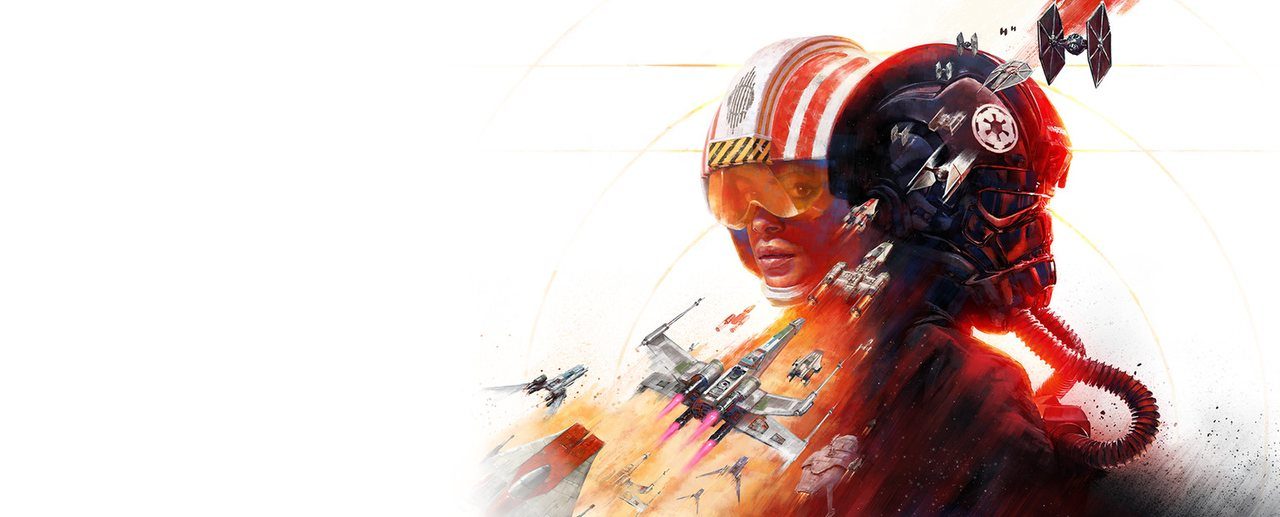
EA’s Motive Studio revived the cockpit tradition with Star Wars: Squadrons, released on October 2, 2020 for PlayStation 4, Xbox One and Windows. It was directed by Ian Frazier and arrived as a smaller-scale, focused game rather than a massive release.
Squadrons is set after Return of the Jedi, in the aftermath of the Battle of Endor. Its campaign alternates between two squadrons: the New Republic’s Vanguard Squadron and the Empire’s Titan Squadron. The story centres on Project Starhawk, a New Republic battleship built using salvaged Star Destroyer parts, which Vanguard tries to complete while Titan tries to destroy it. Swapping sides between missions is a clear nod to the X-Wing and TIE Fighter era.
Squadrons is played entirely from inside the cockpit, with instruments and displays modelled as part of the ship rather than overlaid on screen. Power routing returned, letting players shift energy between lasers, engines and shields, with the Empire’s TIE fighters handling it differently from New Republic ships. Each side has four ship classes: fighter, interceptor, bomber and support, and a later update added the B-wing and TIE Defender.
Multiplayer offered Dogfight, a five-versus-five team mode, and Fleet Battles, in which teams push through waves of enemies to destroy the opposing capital ships. The game supported cross-play, HOTAS flight stick setups on all platforms and virtual reality on PC and PlayStation VR. It was later enhanced for PS5 and Xbox Series consoles.
Cockpit Versus Arcade: How the Series Handled Control
Looking across the history, the games can be sorted by how they approach control and immersion:
| Game | Year | Developer | Style |
|---|---|---|---|
| Star Wars (arcade) | 1983 | Atari | On-rails cockpit shooter |
| X-Wing | 1993 | Totally Games | Cockpit simulator with power management |
| TIE Fighter | 1994 | Totally Games | Cockpit simulator, Imperial campaign |
| X-Wing vs. TIE Fighter | 1997 | Totally Games | Multiplayer-focused simulator |
| Rogue Squadron | 1998 | Factor 5 | Arcade, third-person, planetary missions |
| X-Wing Alliance | 1999 | Totally Games | Story-led simulator |
| Rogue Leader | 2001 | Factor 5 | Cinematic recreations of film battles |
| Rebel Strike | 2003 | Factor 5 | Arcade flying plus on-foot missions, co-op |
| Squadrons | 2020 | Motive Studio | Cockpit-only, power management, VR |
The simulator games reward learning systems: knowing when to divert power to shields, choosing targets and managing wingmen. The arcade games put the emphasis on spectacle and feel, with mission design built around set-piece moments from the films. Squadrons tried to bridge the two, keeping the cockpit and power management of the simulators while making the controls workable on a standard gamepad.
Which One Should You Play?
- For the classic simulator experience: TIE Fighter remains the most admired, though its age shows in visuals and interface. Modern players may need patience with its controls.
- For a modern cockpit game: Squadrons is the easiest to get into today and the only one built around VR.
- For film battles and spectacle: Rogue Leader is the reference point, though it requires original GameCube-era hardware.
- For history: the 1983 arcade game shows how much of the genre’s DNA was set by a single cabinet built around a single scene.
If you are new to Star Wars games generally, our guide to the best Star Wars games to start with puts Squadrons in context with other entry points.
Why Starfighter Games Keep Coming Back
The appeal has stayed remarkably consistent since 1983. Star Wars space battles are built on the language of World War II aerial combat, with squadrons, wingmen, bombing runs and dogfights, and that translates naturally into game mechanics. Each era has reinterpreted it for its own hardware: vectors for the arcade, polygons and joysticks for 1990s PCs, cinematic set pieces for early 2000s consoles and VR cockpits for the 2020s. The trench run is still waiting at the heart of almost every one of them.