Dark Forces and Jedi Knight: The Kyle Katarn Series History
From Dark Forces in 1995 to Jedi Academy in 2003: the developers, Kyle Katarn's story, how lightsaber combat evolved and the modern re-releases.
Before Star Wars games routinely let players wield a lightsaber, there was Kyle Katarn: a former Imperial officer turned mercenary who began his career with a blaster and ended it as a Jedi Master teaching the next generation. Across five games released between 1995 and 2003, the Dark Forces and Jedi Knight series moved from a first-person shooter with no Force powers to some of the most celebrated lightsaber combat in the franchise’s history. This article follows the series game by game, covering who made each one, what happened in Kyle’s story and how the games are available today.
Series Overview
| Game | Release | Developer | Protagonist |
|---|---|---|---|
| Star Wars: Dark Forces | 1995 (PC, Mac); 1996 (PlayStation) | LucasArts | Kyle Katarn |
| Star Wars Jedi Knight: Dark Forces II | October 9, 1997 (Windows) | LucasArts | Kyle Katarn |
| Jedi Knight: Mysteries of the Sith | February 17, 1998 (Windows expansion) | LucasArts | Kyle Katarn and Mara Jade |
| Star Wars Jedi Knight II: Jedi Outcast | March 28, 2002 (Windows) | Raven Software | Kyle Katarn |
| Star Wars Jedi Knight: Jedi Academy | September 16, 2003 (Windows) | Raven Software | Jaden Korr |
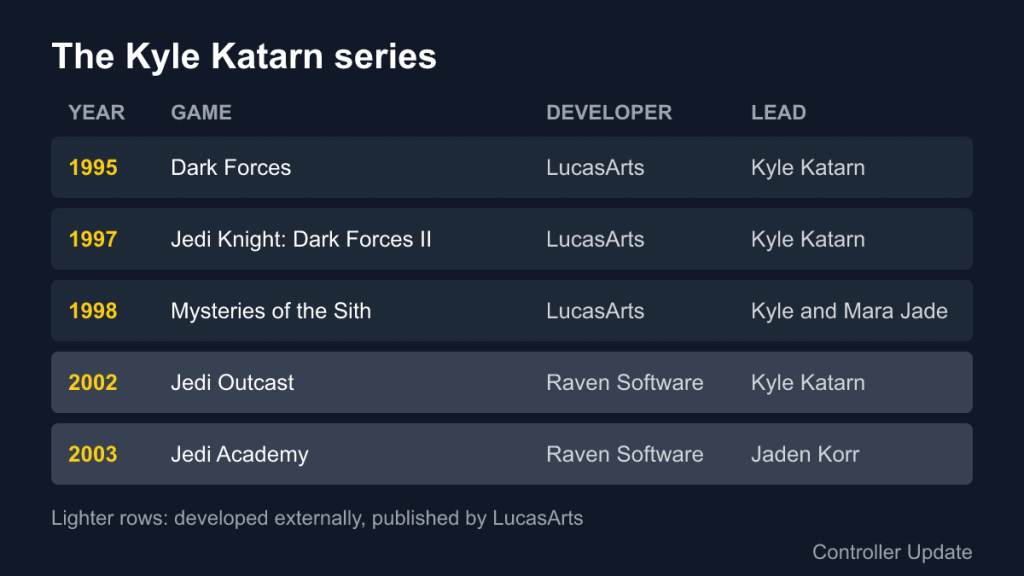
The first three were made in-house by LucasArts during its creative peak in the 1990s; the last two were developed externally by Raven Software and published by LucasArts, with Activision handling Jedi Academy outside North America. Our history of LucasArts and Lucasfilm Games explains how the company’s approach changed between those periods.
Dark Forces (1995): A Star Wars Shooter With Ideas
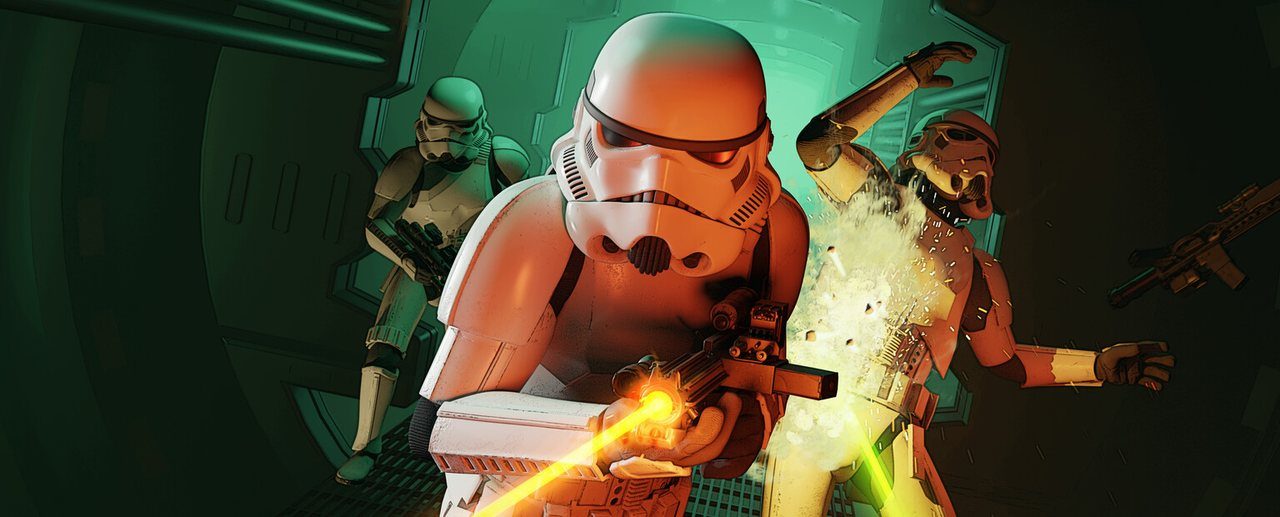
When Star Wars: Dark Forces launched for MS-DOS and Mac in 1995, first-person shooters were dominated by Doom, and many expected LucasArts to make a Doom clone with stormtroopers. Instead, the team led by Daron Stinnett built a new technology, the Jedi engine, which added features many shooters of the time lacked: looking up and down, jumping, crouching, and levels with multiple floors stacked on top of each other. Puzzles and environmental hazards gave missions more variety than simply clearing rooms.
The story introduced Kyle Katarn, a mercenary working for the Rebel Alliance. The opening mission has Kyle steal the plans for the Death Star, a role that was later contradicted in the official timeline. Most of the game focuses on a new Imperial threat: the Dark Trooper Project, a programme to build armoured battle droids, overseen by General Rom Mohc. Kyle’s pilot ally, Jan Ors, supports him throughout. The campaign takes Kyle across many locations, including Jabba the Hutt’s ship and, finally, Mohc’s flagship, the Arc Hammer.
There are no lightsabers and no Force powers. Kyle is just a skilled soldier with a blaster, which gave the game a grounded feel that set it apart from later entries. Critics praised the PC and Mac versions, while the 1996 PlayStation version was criticised for its choppy frame rate.
Jedi Knight: Dark Forces II (1997): Enter the Lightsaber
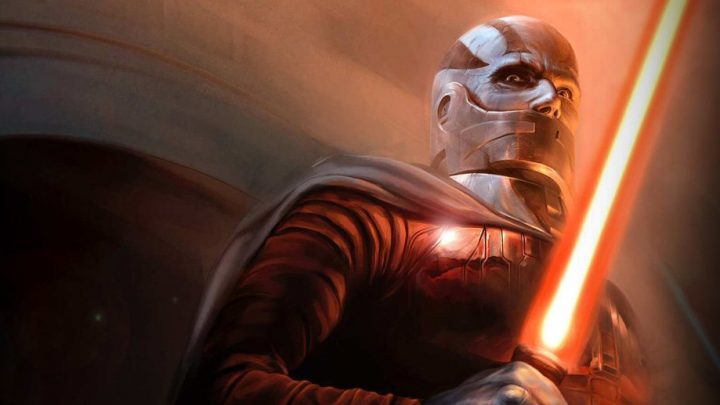
Star Wars Jedi Knight: Dark Forces II, released on October 9, 1997 for Windows, transformed the series. Directed by Justin Chin, it replaced the Jedi engine with the new Sith engine, which supported true 3D environments and hardware acceleration. Its two headline additions were the lightsaber and Force powers, and it allowed players to switch to a third-person camera, which suited melee combat.
The story
Set a year after Return of the Jedi, the game sees Kyle discover that he is Force-sensitive. His father, Morgan Katarn, had been murdered by the Dark Jedi Jerec, who is seeking the Valley of the Jedi, a place of immense Force power where the spirits of fallen Jedi gather. A Jedi named Qu Rahn, also killed by Jerec, guides Kyle. Kyle must face Jerec and his followers, a group of Dark Jedi, before they reach the valley.
Light and dark paths
Jedi Knight introduced a moral choice to the series. Whether Kyle follows the light or the dark side depends on how the player behaves (such as harming non-hostile characters) and which Force powers they choose. The ending changes accordingly.
Live-action cutscenes
Between levels, the story was told through full-motion video with live actors, with Jason Court playing Kyle. These sequences were typical of late-1990s PC games and are a large part of the game’s period charm today. Several publications named Jedi Knight their game of the year for 1997.
Mysteries of the Sith (1998): Mara Jade Takes Over
The expansion Mysteries of the Sith, released on February 17, 1998, is set several years after Jedi Knight. Kyle has become a Jedi teacher, and one of his students is Mara Jade, a character from Timothy Zahn’s novels. Partway through, players switch to controlling Mara as Kyle is drawn toward the dark side while investigating ancient Sith power. It extended the lightsaber and Force mechanics and was the first time the series let players control someone other than Kyle.
Jedi Outcast (2002): Raven’s Lightsaber Revolution
After a gap of four years, the series moved to Raven Software, an experienced shooter developer that used id Software’s id Tech 3 engine (the technology behind Quake III Arena). Star Wars Jedi Knight II: Jedi Outcast was released for Windows on March 28, 2002, with Mac, GameCube and Xbox versions later that year.
The story
At the start, Kyle has given up the Force and his lightsaber, fearing how close he came to the dark side. When his partner Jan Ors is apparently killed by the Dark Jedi Desann, Kyle returns to the Valley of the Jedi to regain his powers. His hunt takes him across the galaxy, including Cloud City, where Lando Calrissian appears, and to Luke Skywalker’s Jedi Academy on Yavin 4. Desann’s plan involves an army of Force-enhanced soldiers, the Reborn, and his apprentice Tavion. The story ends with Kyle defeating Desann at the academy.
Why the combat mattered
Jedi Outcast’s lightsaber system was its defining feature. Players could switch between three stances: fast, medium and strong. Each had different speeds, damage and special moves, and sabers could deflect blaster fire back at enemies. Combat against other lightsaber users felt like a real duel rather than a trade of blows, and the multiplayer duels became a long-running community favourite.
In 2013, after LucasArts closed, Raven briefly released the game’s source code; it was soon removed, but community projects built on it to keep the game running on modern systems.
Jedi Academy (2003): Passing the Torch
Star Wars Jedi Knight: Jedi Academy followed on September 16, 2003, with Xbox and Mac versions later that year. It is the only main entry in which the player never controls Kyle Katarn. Instead, you create your own student, Jaden Korr, choosing species, gender and appearance, and designing a lightsaber. Kyle is your instructor at Luke Skywalker’s academy.
The story, set two years after Jedi Outcast, pits the academy against the Disciples of Ragnos, a Dark Jedi cult led by Tavion, who tries to resurrect the ancient Sith Lord Marka Ragnos. Like Jedi Knight, it offers light and dark paths with different endings.
Jedi Academy expanded lightsaber options: in addition to the three stances, players could unlock dual sabers and a double-bladed saberstaff. Its multiplayer modes, including Capture the Flag, Power Duel and Siege, kept the community active for years. It remains the final game in the series; no Jedi Knight III or later entry followed.
Kyle Katarn’s Story in Canon Terms
All five games belong to Star Wars Legends, the label Lucasfilm gave to pre-2014 stories. The clearest example of the difference is the Death Star plans: in Dark Forces, Kyle steals them, while the canon film Rogue One (2016) tells a different story of how the Rebellion obtained them. Characters and ideas from the series appear in later Legends novels and comics, but Kyle’s adventures as described in the games are not part of the current official timeline. For the broader picture, see our explainer on Star Wars canon vs Legends in games, and for where each game sits relative to the films, our chronological guide to Star Wars games.
Modern Re-Releases
Several games in the series are easy to play today:
- Jedi Outcast was ported by Aspyr to Nintendo Switch and PlayStation 4 on September 24, 2019.
- Jedi Academy followed on Switch and PS4 on March 26, 2020.
- Dark Forces Remaster, developed by Nightdive Studios, arrived in February 2024 on modern consoles and PC, with updated visuals and support for modern controls. According to Wikipedia’s article, the original Dark Forces was removed from Steam in April 2026, while the remaster remains available.
- Jedi Knight: Dark Forces II and Mysteries of the Sith remain PC-only and have not received console releases.
Fan projects have also helped. The Force Engine, a community re-implementation of the Jedi engine, reached version 1.0 in December 2022, and community ports keep the Raven games running on current PCs.
Why the Series Still Matters
The Dark Forces and Jedi Knight games trace the evolution of Star Wars action games in miniature. They started with a soldier and a blaster, added the Force and lightsaber, then built a combat system detailed enough that players still debate stances and duels two decades later. Kyle Katarn’s arc, from mercenary to Jedi to teacher, also gave the series an unusually complete character journey. Modern Star Wars games owe it a clear debt: whenever a game lets you deflect blaster fire or duel a Dark Jedi, it is following a path that Kyle walked first.