
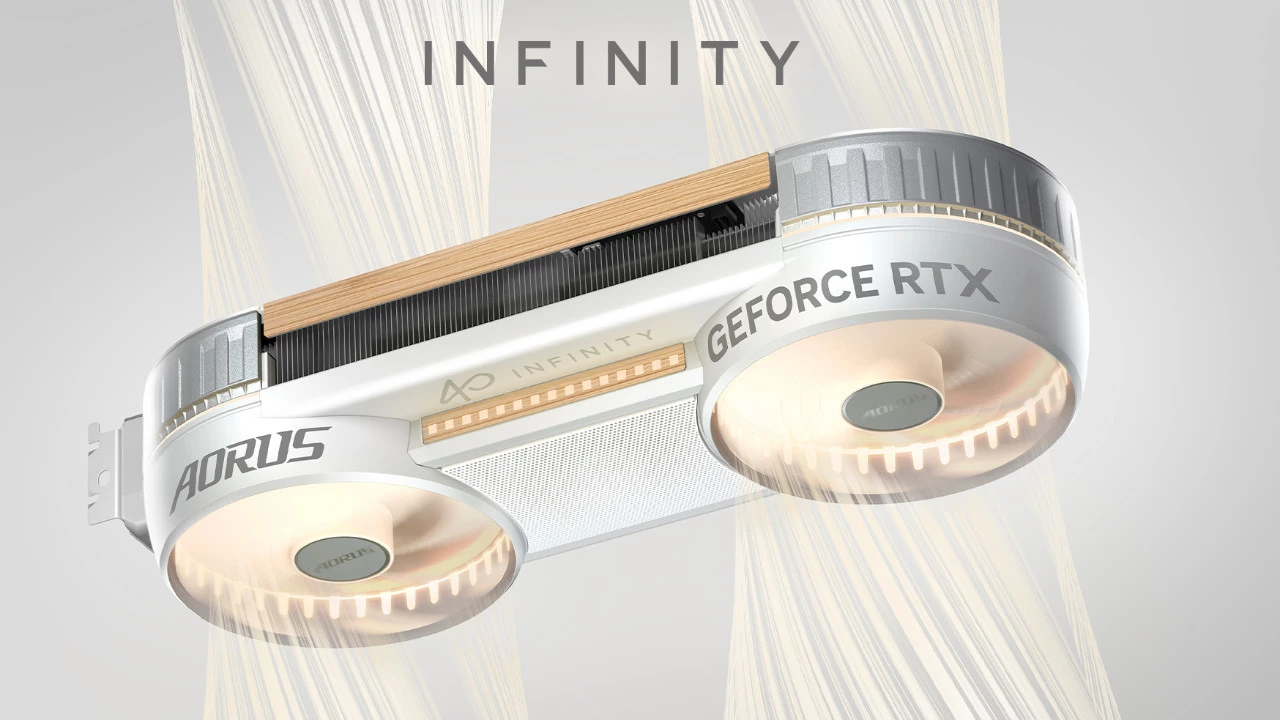
A fascinating teardown of the Gigabyte AORUS GeForce RTX 5080 Infinity Wood graphics card by enthusiasts from the Chiphell community has unveiled some remarkably unconventional engineering solutions from the manufacturer. The disassembly reveals design choices that push the boundaries of traditional graphics card architecture, showcasing how manufacturers are innovating to meet the demanding thermal and performance requirements of NVIDIA’s latest Blackwell architecture.
The AORUS RTX 5080 Infinity represents Gigabyte’s premium offering in the enthusiast graphics card segment. What makes this particular teardown noteworthy is the discovery of an unusually large cutout in the printed circuit board, a design decision that has sparked considerable discussion among hardware enthusiasts and industry observers alike. This approach demonstrates how graphics card manufacturers are increasingly willing to adopt radical engineering solutions to optimize cooling performance and power delivery in high-end consumer products.
Revolutionary PCB Design Breaks Convention
The most striking feature revealed during the teardown is the massive cutout in the graphics card’s PCB. This unconventional approach serves multiple purposes in modern graphics card design. By removing material from the circuit board where it isn’t structurally or electrically necessary, manufacturers can create direct pathways for heat dissipation and allow cooling solutions to make more intimate contact with heat-generating components. The NVIDIA RTX 5080, based on the Blackwell architecture, features a TDP of 360 watts, making efficient thermal management absolutely critical for sustained performance.
Graphics card PCB design has evolved dramatically over the past decade. Traditional designs featured solid boards with components arranged in relatively straightforward layouts. However, as GPU power consumption has increased from under 200 watts to well over 300 watts in flagship models, engineers have been forced to reconsider every aspect of card design. The cutout approach, while visually unusual, represents a practical solution to the challenge of cooling increasingly power-hungry processors while maintaining compact form factors that fit within standard PC cases.
Gigabyte’s AORUS Legacy of Innovation
Gigabyte’s AORUS brand has consistently positioned itself at the forefront of enthusiast-grade hardware design. The AORUS lineup typically features premium cooling solutions, enhanced power delivery systems, and aesthetic elements that appeal to gaming enthusiasts and content creators. The RTX 5080 Infinity Wood variant specifically incorporates unique design elements, including wood-textured accents that give the card a distinctive appearance in the increasingly competitive custom graphics card market.
The RTX 5080 sits as the second-tier offering in NVIDIA’s current generation lineup, positioned below the flagship RTX 5090 but still representing exceptional performance capabilities. Built on TSMC’s advanced 4nm process node, the GPU delivers substantial improvements in ray tracing performance and AI-accelerated features compared to its predecessor. For context, the RTX 5080 features 10,752 CUDA cores and 16GB of GDDR7 memory, representing a significant generational leap in specifications that demands equally advanced cooling solutions to fully exploit.
Thermal Engineering in Modern GPUs
The thermal challenges facing modern graphics cards cannot be overstated. With power densities reaching unprecedented levels, the ability to efficiently transfer heat away from the GPU die and surrounding voltage regulation modules determines whether a card can maintain its rated boost clocks under heavy load. The large PCB cutout discovered in the AORUS RTX 5080 Infinity likely allows the heatsink assembly to extend through the board itself, creating a more direct thermal pathway.
Industry analysts note that this type of aggressive engineering is becoming more common as manufacturers compete not just on raw performance metrics but also on thermal efficiency, noise levels, and long-term reliability. Cards that run cooler under load typically maintain higher boost frequencies, deliver more consistent frame rates, and experience less thermal stress on components, potentially extending their operational lifespan. The Chiphell community’s detailed examination provides valuable insight into how leading manufacturers approach these complex engineering challenges in practice.
Expert Opinion: The PCB cutout design in Gigabyte’s AORUS RTX 5080 Infinity represents a broader industry trend toward thermal-first engineering in high-performance graphics cards. As GPU power consumption continues climbing toward 400+ watts in consumer products, we can expect even more radical design departures from traditional PCB layouts. Manufacturers who master these innovative cooling approaches will hold significant competitive advantages in the premium segment where performance margins are measured in single-digit percentages.