
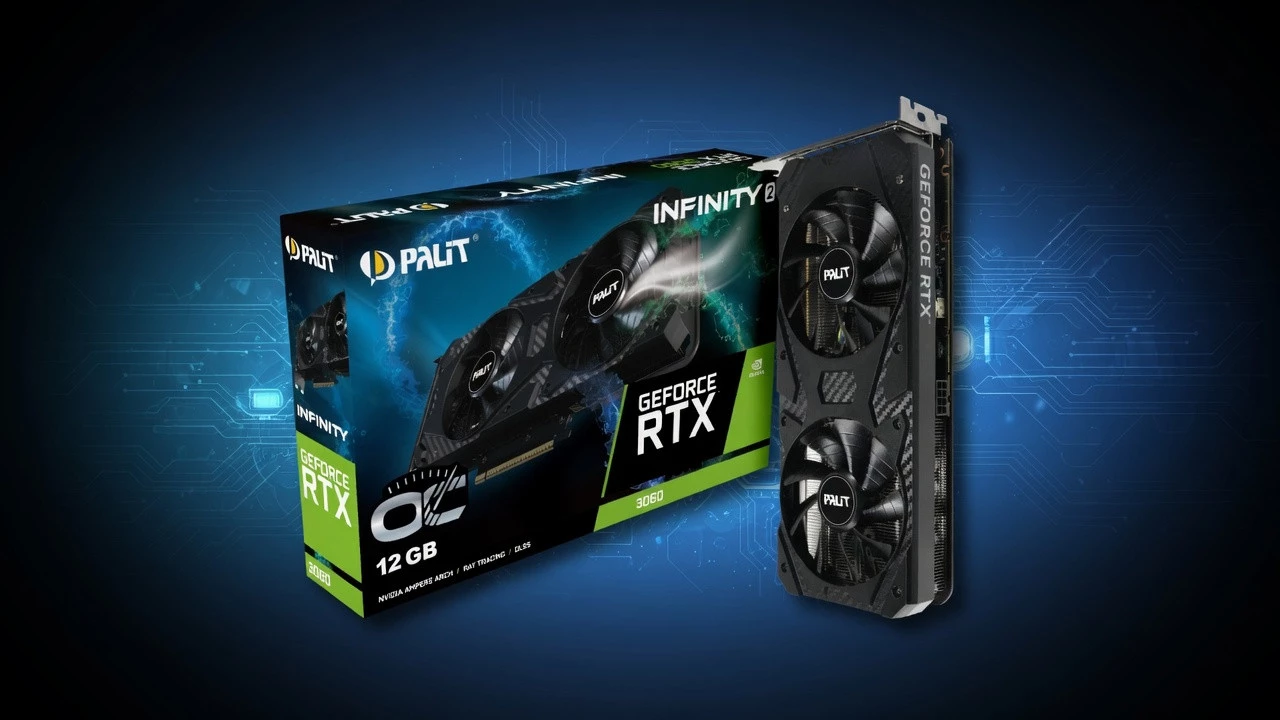
In a move that has caught the tech community off guard, Palit has officially announced the GeForce RTX 3060 Infinity 2 OC graphics card, marking the first concrete confirmation that GPU manufacturers are actively participating in the revival of the RTX 3060 production line. This unexpected announcement essentially turns back the clock to 2021, when the RTX 3060 first made its debut during one of the most turbulent periods in graphics card history. The decision to resurrect a four-year-old GPU architecture raises important questions about the current state of the graphics card market and NVIDIA’s strategy for addressing the budget segment.
The Original RTX 3060: A Look Back at Its Legacy
The GeForce RTX 3060 originally launched in February 2021, entering a market plagued by severe shortages driven by cryptocurrency mining demands and global supply chain disruptions caused by the COVID-19 pandemic. Based on NVIDIA’s Ampere architecture and manufactured on Samsung’s 8nm process, the RTX 3060 was designed as an entry point into ray tracing and DLSS technology for mainstream gamers. The card featured 12GB of GDDR6 memory—ironically more than its higher-tier sibling, the RTX 3060 Ti, which came with only 8GB. This generous memory allocation has proven to be one of the card’s most enduring strengths, as modern games increasingly demand more VRAM for high-resolution textures and assets.
During its initial release, the RTX 3060 carried a suggested retail price of $329, though actual street prices often exceeded $500 or even $700 due to extreme demand. The card was particularly targeted by cryptocurrency miners despite NVIDIA’s attempts to implement hash rate limiters. Over time, as the crypto market cooled and supply chains normalized, the RTX 3060 became widely available and settled into its intended role as a capable 1080p gaming solution with respectable 1440p performance in less demanding titles.
Why Revive an Aging GPU Architecture?
The decision to relaunch the RTX 3060 appears to be driven by several market factors. NVIDIA’s current budget offerings in the RTX 40 series have faced criticism for pricing that many consumers consider too high for entry-level products. The RTX 4060, while more power-efficient and featuring improved ray tracing capabilities, launched at $299 but offers only 8GB of VRAM—a specification that has drawn significant criticism from gamers concerned about future-proofing their purchases. By bringing back the RTX 3060 with its 12GB frame buffer, NVIDIA and its partners can offer an alternative that addresses these memory concerns at potentially lower price points.
Industry analysts suggest this move also helps NVIDIA maintain market share against AMD’s competitive Radeon RX 7000 series offerings in the budget segment. The Palit Infinity 2 OC variant specifically indicates that this isn’t merely a clearance of old inventory but rather a fresh production run with updated cooling solutions and factory overclocks designed to maximize the aging architecture’s potential. The “Infinity 2” designation suggests Palit’s second-generation cooling system, which typically features dual-fan designs optimized for noise reduction and thermal efficiency.
Market Implications and Consumer Considerations
For consumers, the return of the RTX 3060 presents both opportunities and considerations. On one hand, a well-priced RTX 3060 with 12GB of VRAM remains a compelling option for 1080p gaming and can handle many modern titles at medium to high settings. The card also supports NVIDIA’s software ecosystem, including DLSS 2.0 and ray tracing capabilities, albeit with performance limitations compared to newer architectures. On the other hand, potential buyers should weigh factors such as power efficiency, driver support longevity, and the availability of newer alternatives before making a purchase decision.
The relaunch also signals that NVIDIA may be acknowledging a gap in its current product lineup. With the RTX 50 series expected to launch in the coming months, the company appears to be using refreshed RTX 30 series products to maintain presence in price segments where it currently lacks competitive options. This strategy mirrors past industry practices, where older GPU generations continued production alongside newer ones to serve different market tiers. As more manufacturers follow Palit’s lead, consumers can expect increased competition and potentially more attractive pricing in the budget graphics card segment throughout the remainder of 2025.
Expert Opinion: The revival of the RTX 3060 represents NVIDIA’s tactical acknowledgment that its current-generation budget offerings have left a significant market gap. While this provides immediate relief for budget-conscious gamers seeking adequate VRAM capacity, it also suggests that NVIDIA’s RTX 50 series entry-level cards may not arrive until late 2025 or early 2026. Consumers should expect pricing around $200-250 for these refreshed units, making them competitive alternatives to AMD’s RX 7600 series.