
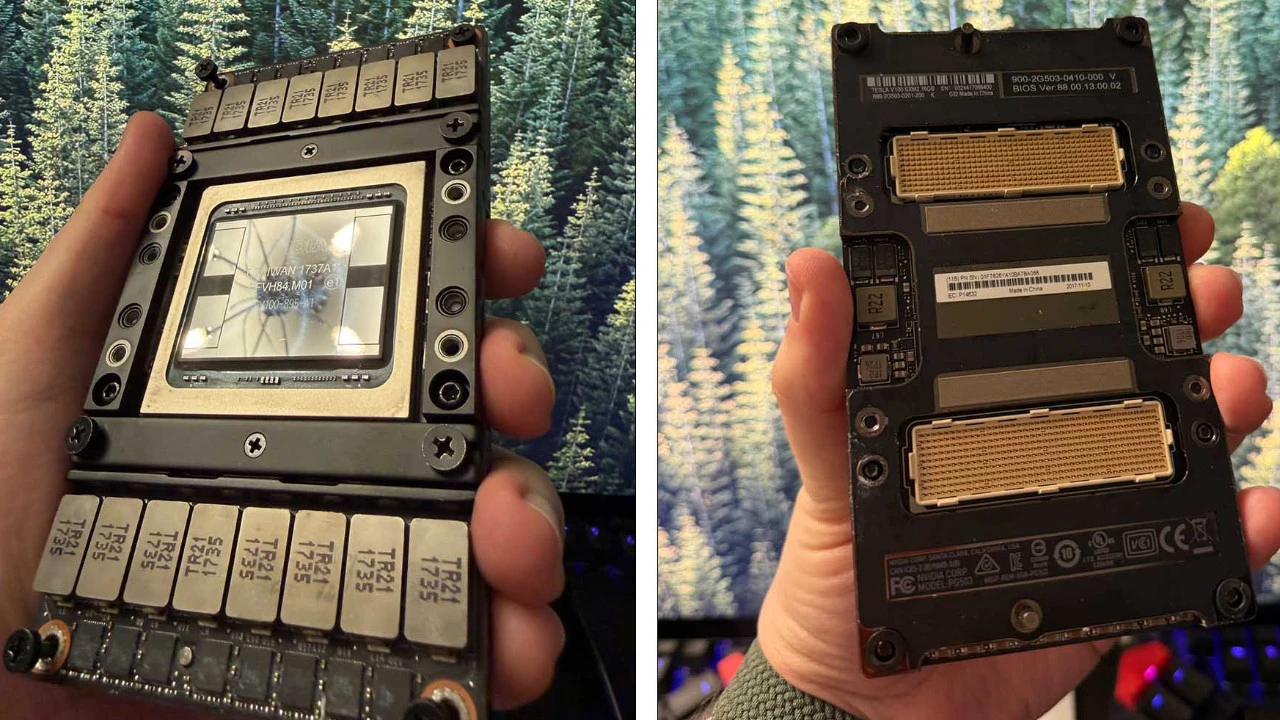
In an era where artificial intelligence demands ever-increasing computational resources, PC enthusiasts are finding creative solutions to run powerful AI models locally. A modder known as Tymscar has taken an unconventional approach to solving the chronic video memory shortage that plagues those attempting to run heavy AI models on consumer hardware. His solution? Installing a server-grade NVIDIA Tesla V100 accelerator directly into a gaming PC that already houses an RTX 4080 graphics card, creating a hybrid system that bridges the gap between consumer gaming and enterprise-level AI computing.
The project highlights a growing trend among AI enthusiasts and developers who are unwilling to rely solely on cloud-based solutions for their machine learning experiments. Running large language models, image generators, and other AI applications locally offers significant advantages in terms of privacy, latency, and long-term cost savings. However, the memory requirements of modern AI models have far outpaced what typical consumer graphics cards can provide, pushing creative minds like Tymscar to explore unconventional hardware combinations.
The VRAM Problem in Modern AI Computing
The fundamental challenge facing AI enthusiasts running models locally is video memory, or VRAM. Modern large language models and image generation systems require substantial amounts of high-bandwidth memory to load their parameters and perform inference. While NVIDIA’s consumer RTX 4080 offers impressive gaming performance with 16GB of GDDR6X memory, this amount proves insufficient for many cutting-edge AI models. Models like Llama 2 70B, for instance, require upwards of 35GB of VRAM to run efficiently, making them impossible to load on standard gaming hardware without significant compromises.
The Tesla V100, originally released in 2017 as part of NVIDIA’s Volta architecture, was designed specifically for data center and high-performance computing applications. Despite its age, the V100 remains relevant in AI circles due to its availability in configurations with up to 32GB of HBM2 memory. This high-bandwidth memory architecture, while older than modern GDDR6X, provides the capacity needed to load larger AI models. The cards have become increasingly available on secondary markets as data centers upgrade to newer hardware, making them attractive options for budget-conscious AI researchers.
Technical Challenges and Implementation
Installing a server-grade GPU in a consumer PC presents numerous technical hurdles that Tymscar had to overcome. The Tesla V100 was never designed for desktop use – it lacks display outputs, requires specialized cooling solutions, and expects the controlled environment of a server chassis. The card’s passive cooling design, intended to work with server airflow systems, necessitated custom modifications to prevent thermal throttling in a desktop environment. Additionally, power delivery considerations came into play, as the V100’s power requirements differ significantly from consumer cards.
The dual-GPU configuration also required careful software configuration. NVIDIA’s drivers treat gaming GPUs and compute accelerators differently, and getting both cards to coexist harmoniously in the same system demanded specific driver versions and system settings. The RTX 4080 handles display output and gaming tasks, while the Tesla V100 serves as a dedicated AI compute accelerator. This separation of duties allows Tymscar to run AI workloads without impacting his ability to use the system for other purposes.
A Growing Trend Among AI Enthusiasts
Tymscar’s project represents a broader movement within the AI community toward local, self-hosted AI solutions. As cloud computing costs continue to rise and privacy concerns mount, more developers and researchers are investing in home AI infrastructure. The market for used enterprise GPUs has expanded significantly, with cards like the Tesla V100, P100, and even older K80 units finding new life in hobbyist builds. This trend has created an ecosystem of guides, forums, and communities dedicated to repurposing enterprise hardware for personal AI projects.
The implications of this trend extend beyond individual hobbyists. As more people gain access to capable AI hardware, the democratization of artificial intelligence accelerates. Researchers in developing countries, independent developers, and privacy-conscious users all benefit from the ability to run sophisticated models without relying on corporate cloud infrastructure. While the technical barriers remain significant, projects like Tymscar’s demonstrate that with sufficient determination and creativity, enterprise-grade AI computing is achievable on a personal scale.
Expert Opinion: This hybrid approach to AI computing represents an important transitional phase in hardware accessibility. As consumer GPUs gradually increase their VRAM capacities and AI models become more efficient through quantization and optimization techniques, we may see these makeshift solutions become less necessary. However, for the next two to three years, expect the secondary market for enterprise GPUs to remain strong as AI enthusiasts continue seeking affordable paths to running the latest models locally.